
TAX FREEDOM DAY 2026
Britain to have the latest Tax Freedom Day ever this year
Tax Freedom Day falls on the 6th June;
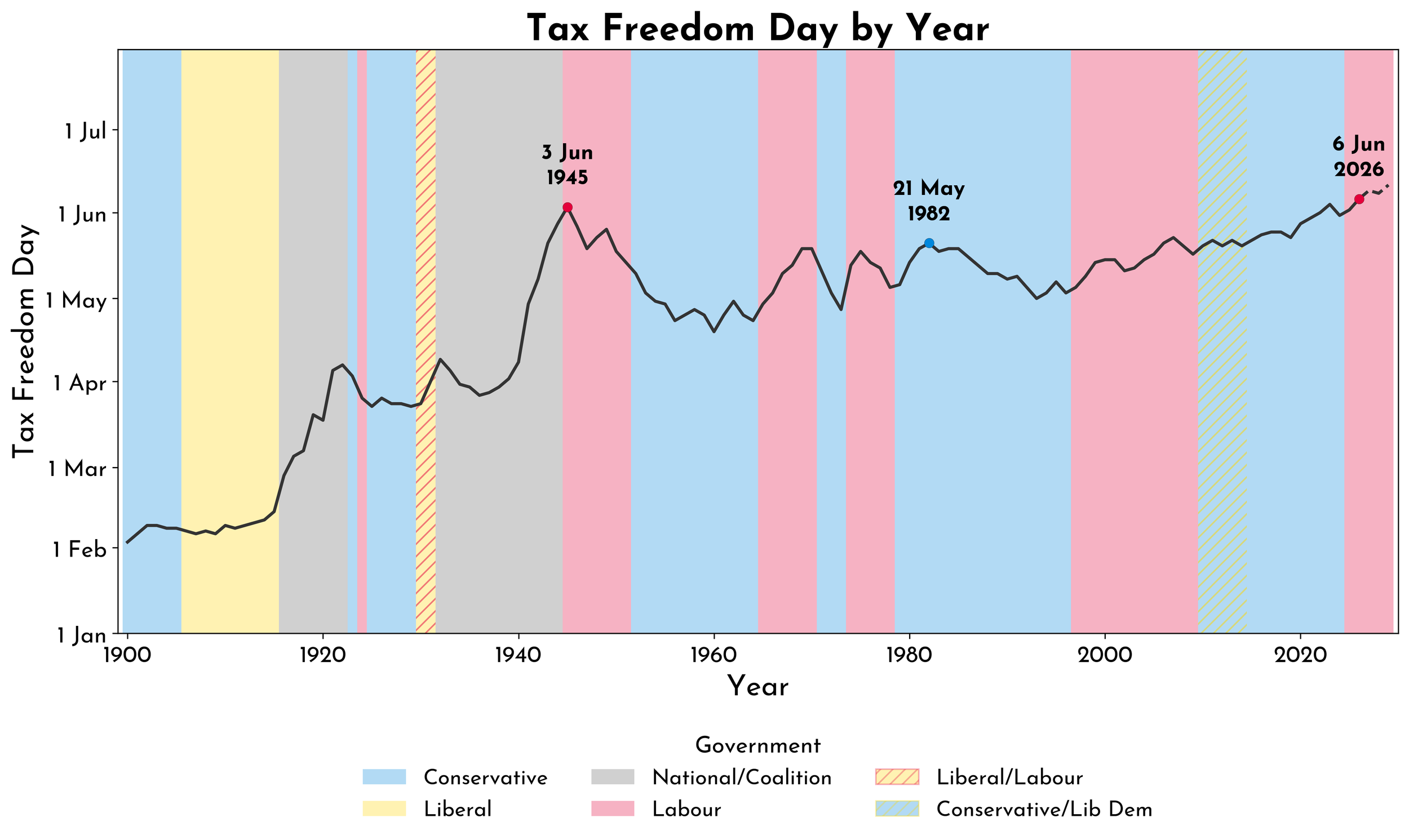
This year, Brits are working 156 days solely to pay taxes, 4 days longer than last year and higher than any year on record;
This is based on current Government taxation and spending plans, and OBR projections;
Cost of Government Day, which factors in borrowing as well as taxes, is July 22nd—the latest since the pandemic.
What is Tax Freedom Day?
Tax Freedom Day is the day when Britons stop paying tax and start putting their earnings into their own pocket. In 2026, the Adam Smith Institute (ASI) estimated that every penny the average person earned up to and including June 5th went to the taxman - from June 6th onwards they are finally earning for themselves.
British taxpayers have worked a gruelling 156 days for the taxman before they can start earning for themselves.
Brits’ tax burden is moving in the wrong direction. In the midst of a cost of living crisis and despite stagnant growth, taxpayers are being burdened with even more obligations to HMRC. With current trends, we can expect Tax Freedom Day to continue to fall later in the year. Using OBR growth and tax revenue projections from March 2026, Tax Freedom Day is projected to hit June 12th in 2030.
Notes on Tax Freedom Day and methodology:
Complications
Tax Freedom Day (and its sister, Cost of Government day, which measures total spending over national income) is not meant as anything but an illustration—an indication of the size of the state. As the complexities detailed below suggest, it does not correspond exactly to any individual’s experience. And yet many people do find it shocking to see how large the state really is, expressed in an intuitive way.
While Tax Freedom Day is a simple idea in principle, in reality it’s a little bit more complicated. First, there’s no average person. Because we don’t have a proportional tax system, every individual will have a different tax freedom day. In theory, Tax Freedom Day will come later for high-earners and earlier for low-earners and the unemployed. In practice, this isn’t necessarily true because HMRC does not simply tax income, but also taxes consumption, investment and ‘sin’ activities at different rates.
Second, we measure the total tax take. This includes indirect taxes (such as VAT and Corporation Tax) as well as direct taxes (Income Tax and National Insurance). Economists distinguish between legal and economic incidences (a fancy economist word for ‘burden.’) The legal incidence of Corporation Tax may fall on individual firms, but corporations are just legal constructs. In reality, Corporation Tax is paid by people, the debate between economists is to what extent it falls between consumers, shareholders and workers. (Our paper Corporation Tax: Who Pays had a crack at the answer.)
Thirdly, we take into account depreciation and foreign investment earnings, as is standard around the world, measuring total taxes over net national income, not gross domestic product, so as to more closely approximate net wealth creation rather than economic activity.
Fourth, tax receipts and net national income statistics are regularly revised by the Office of National Statistics and we revise past Tax Freedom Days along with them. The latest version of Tax Freedom Day is the most accurate, as we annually revise statistics.
Data Sources
Based on data availability, this year the ONS's NSRX was used for Net National Income and AHHY was used for Total Tax Take. This enables a TFD comparison going back until 1998, with a single consistent data source and methodology.
Historic reporting of Tax Freedom Days may have been based on different data sources, or prior to ONS data revisions, so can appear earlier or later than in ASI's latest analysis. The Tax Freedom Day for a given year in the past therefore may well have changed - typically the changes are very small, and the overall picture tends to be robust to these alterations.. For the purposes of monitoring the trend of Tax Freedom Day and making inter-year comparisons, our latest analysis is most appropriate.
Also, Net National Income and Total Tax Take figures are not available up-to-date for the latest or future calendar years so they are proxied from government and OBR forecasts and financial year numbers. They are then revised when exact numbers become available in subsequent years.
Writing in support of Tax Freedom Day…
James Lawson, Chairman of the Adam Smith Institute, said:
“High taxes don’t just eat into our pay packets, they hinder the UK’s economic prospects as a whole. They make starting or investing in a business more risky, and contribute to our stagnant wages, low productivity, and sluggish growth.
As the General Election approaches, politicians must be honest with voters about the size and nature of the tax burden. This includes frozen tax thresholds, which is dragging workers into paying high rates of tax, and increased taxes on businesses, the costs of which are often passed onto consumers and employees.
Whoever wins on July 4th, they will need to grapple with the fact that Tax Freedom Day is getting later and later. But a government which finds ways to let people keep more of their own hard-earned money will be rewarded by the electorate.”
Andrew Griffith MP, Shadow Secretary of State for Business and Trade, said:
“Britain is now spending 162 days a year slaving away for this high spending socialist government – far too long. It’s no wonder a generation of top talent are fleeing.
Tax ‘Freedom Day’ comes later every year because for too long politicians have not been honest about living within our means. We need to cut spending to give Britain room to grow.”
Saqib Bhatti MP, Shadow Minister for Culture, Media & Sport, said:
“I am a Conservative because I believe that people know how to spend their money better than the Government.
Keeping taxes down helps drive economic growth, supports dynamic businesses and raises living standards for all.
On Tax Freedom Day, I am calling on the Government to lower taxes to incentivise investment and turn our economy around. Give people their freedom.”
John O’Connell, Chief Executive of the TaxPayers Alliance, said:
“It’s staggering that hard-working Brits have to slog through nearly half the year before they’re earning for themselves, not the taxman.
Tax Freedom Day keeps drifting later, a damning sign of out-of-control public spending.
Ministers can’t keep burying their heads in the sand. It’s time for serious reform to slash waste and deliver better value for taxpayers.”