Just a thought about M. Piketty’s plan for this century
Just one of those little thoughts that pops up:
The Global Justice Report is the first attempt to propose a fully quantified plan for this transition. It combines four dimensions that today’s debates often treat separately: redistribution at the world scale; a deep reform of the international financial and economic order; a radical transformation of energy systems; and substantial shifts in consumption patterns. Compared with most climate scenarios (including those of the Intergovernmental Panel on Climate Change), the main novelty is that we model all four dimensions together – and place inequality and sufficiency at the centre of the analysis.
What would this transition deliver? At its heart is convergence between countries. Average per capita national income, today separated by a 16-fold gap between the poorest (€290 a month in sub-Saharan Africa) and richest (€4,590 in North America/Oceania) regions of the world, would rise towards a common level of about €5,000 a month in all countries by 2100.
This is all to be achieved by much planning and Frenchness. Well, it’s a plan.
The thing that gets us. Confuses even. The base idea here is that we in the already rich countries stand still for a century. Global growth is concentrated upon the currently have nots so that they become have equallys. Not an entirely immoral idea, obviously. Might not work - planning and Frenchness - but as a base idea, well.
Except the complaint is about the past 50 years of globalisation. All of this whatever it was, Washington Consensus, or neoliberalism, or globalisation, or for the truly demented, late stage capitalism. Which had, as from Branko Milanovic, the following effect:
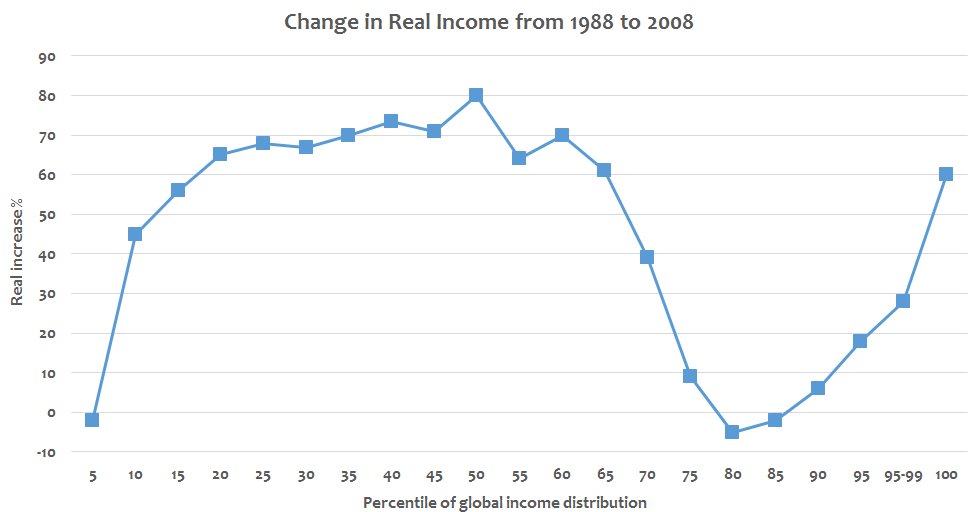
The gains of economic growth went to the have nots, globally, with the less than median in the rich world generally standing still. We created, through this Washington Consensus, or neoliberalism, or globalisation, or late stage capitalism, pretty much the outcome that the new bureaucratic and French plan has for the future. But the justification for the new plan is that the outcome of the old plan was terrible.
Which is what confuses. If this is what we want, catch up growth, then the old plan is working, has worked and presumably will work. Yet this outcome is used as the justification for a new plan, a totally different plan, which aims at gaining the same outcome. You can see the potential for confusion here, no?
We’ve been achieving the very goal M. Piketty claims to desire and this is why we must change everything?
Bit of a headscratcher, that.
Tim Worstall