
A useful reason for not believing The Guardian on matters economic is that they seem not to grasp much of matters economic. Here’s today’s example:
As the radical economists Fred Magdoff and John Bellamy Foster show in their new book, Grand Theft Capital: What Workers Should Know About the Affordability Crisis, the share of national income going to ordinary workers has slumped from 30% in the 1960s to 20% today.
And, well, no. If we actually have a look at their claim we find this very fun little point:
Indeed, from the 1960s to 2020, the wages of production and nonsuper-visory workers in private employment declined from about 30 percent to around 20 percent of GDP (Chart 2). A smaller share of income or value added in the economy was therefore going to wages, especially for those at the lower end of incomes. The inverse of this is that a larger share of value added was being appropriated by capital, resulting in enormous capital surpluses amassed at the top of the economy. In August 2022, corporations were sitting on $5.9 trillion in cash that was not being invested (much of it stashed abroad to avoid taxes), a phenomenon characteristic of monopoly-finance capital, where the economy is geared more to amassing financial assets and hoarding cash for that purpose than to productive investment.
Stashing money abroad only works to avoid taxes if the money was earned abroad. Profits of American corporations earned outside the US are not part of US GDP. The D there means domestic and as profits earned abroad are not domestic then they’re not part of GDP. They are part of GNP - what accrues to US persons and organisations - but not GDP. So we’re inclined not to believe. But more:
Fred Magdoff is professor emeritus of plant and soil science at the University of Vermont. John Bellamy Foster is editor of Monthly Review and professor emeritus of sociology at the University of Oregon.
We might be a little wary of detailed economic points from such sources. You know, maybe? We’d probably be right too, for this is central to their argument:
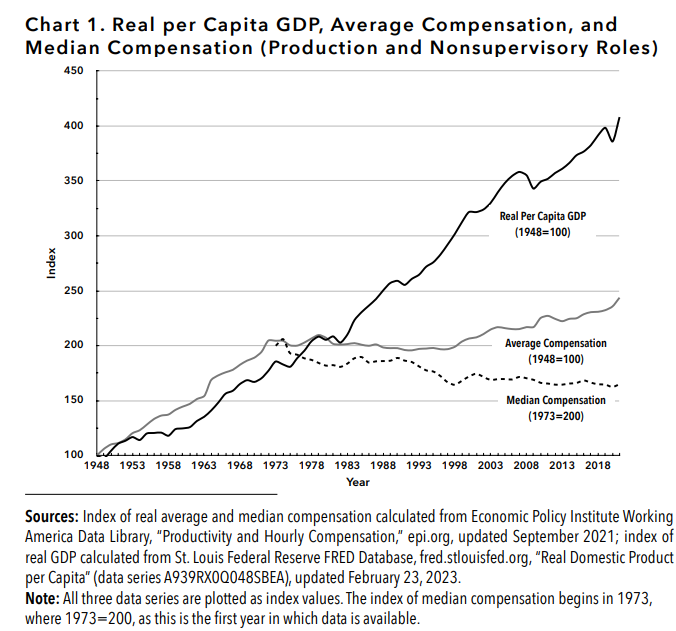
This is the calculation Paul Krugman was describing here:
One of America's new intellectual stars is a young writer named Michael Lind, whose contrarian essays on politics have given him a reputation as a brilliant enfant terrible. In 1994 Lind published an article in Harper's about international trade, which contained the following remarkable passage:
"Many advocates of free trade claim that higher productivity growth in the United States will offset pressure on wages caused by the global sweatshop economy, but the appealing theory falls victim to an unpleasant fact. Productivity has been going up, without resulting wage gains for American workers. Between 1977 and 1992, the average productivity of American workers increased by more than 30 percent, while the average real wage fell by 13 percent. The logic is inescapable. No matter how much productivity increases, wages will fall if there is an abundance of workers competing for a scarcity of jobs -- an abundance of the sort created by the globalization of the labor pool for US-based corporations." (Lind 1994: )
What is so remarkable about this passage? It is certainly a very abrupt, confident rejection of the case for free trade; it is also noticeable that the passage could almost have come out of a campaign speech by Patrick Buchanan. But the really striking thing, if you are an economist with any familiarity with this area, is that when Lind writes about how the beautiful theory of free trade is refuted by an unpleasant fact, the fact he cites is completely untrue.
More specifically: the 30 percent productivity increase he cites was achieved only in the manufacturing sector; in the business sector as a whole the increase was only 13 percent. The 13 percent decline in real wages was true only for production workers, and ignores the increase in their benefits: total compensation of the average worker actually rose 2 percent. And even that remaining gap turns out to be a statistical quirk: it is entirely due to a difference in the price indexes used to deflate business output and consumption (probably reflecting overstatement of both productivity growth and consumer price inflation). When the same price index is used, the increases in productivity and compensation have been almost exactly equal. But then how could it be otherwise? Any difference in the rates of growth of productivity and compensation would necessarily show up as a fall in labor's share of national income -- and as everyone who is even slightly familiar with the numbers knows, the share of compensation in U.S. national income has been quite stable in recent decades, and actually rose slightly over the period Lind describes.
Do note that the labor share has fallen more recently but this calculation is still wrong for it claims those wages falling behind productivity even when the labor share was not falling. Hasn’t stopped the EPI of course but those interested in accuracy might want to avoid using those numbers.
So, you know, no. Perhaps not with that idea of believing The Guardian on matters economic, eh?
Tim Worstall