

Millionaire Tracker
UK has fewest millionaires since 2008
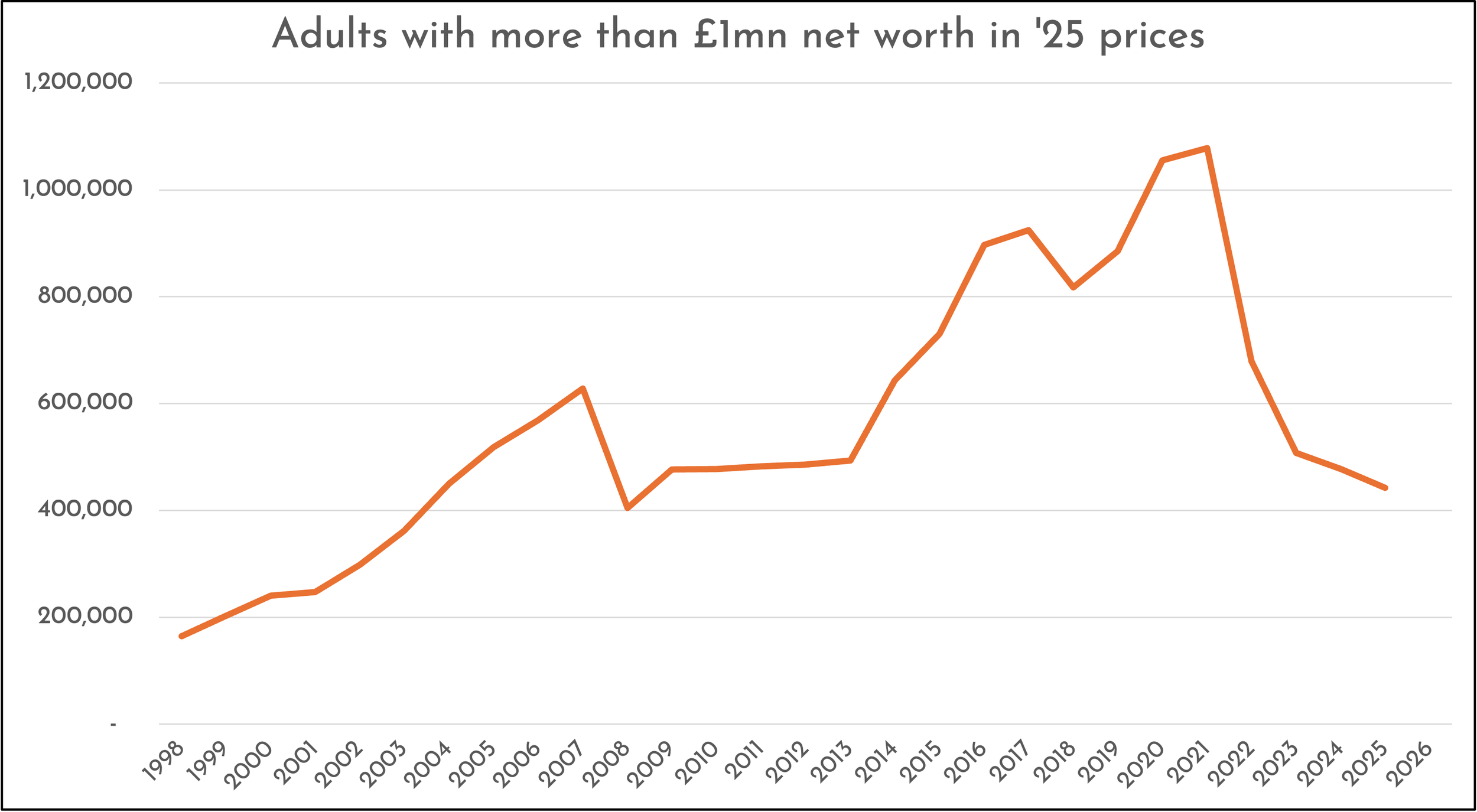
There are fewer millionaires in Britain than at any time since the Global Financial Crisis, according to new inflation-adjusted estimates from the Adam Smith Institute.
The latest records on our Millionaire Tracker show that there were 442,000 sterling millionaires in Britain, down by 7% since 2024.
This is driven by falling real asset prices, a low household savings rate and the emigration of high net-worth individuals.
Millionaires are leaving the UK for a number of reasons, including a lack of confidence in the British business environment, high levels of current taxation, threats of further increases (including a wealth tax), the abolition of the non-dom regime, and a culture which is hostile to wealth-creators.
Many millionaires are wealth creators who set up businesses, employ people and fund Britain’s public services.
Andrew Griffith MP, Shadow Business Secretary, said: “Whatever their personal finances, everyone should care about Britain having fewer millionaires to contribute to the tax pot and creating jobs and businesses here. It's a competitive world and when young and ambitious people are voting with their feet and leaving your country that's a shameful sign.”
Robert Jenrick MP, ReformUK’s Shadow Chancellor, said: “Labour’s policies are driving successful people away from Britain, as this latest report from the ASI shows. Each millionaire that leaves means less money for the NHS or defence, higher taxes for working people, and fewer good jobs. We can’t build an economy on envy. Reform will unashamedly attract successful people back to Britain.”
Based on new data from the Office of National Statistics, The Adam Smith Institute, a leading economics think tank, has updated its Millionaire Tracker - an estimate for the number of millionaires in Britain.
The number of constant-price sterling millionaires is just 442,000. This is the lowest level since the 2008 Global Financial Crisis decimated asset values and is 7% lower than 2024. The definition of a constant-price sterling millionaire is an adult British resident who has at least £1 million in individual net worth, across all real and financial asset classes, including pensions and property, measured in constant 2025 prices.
The long-term fall in the number of sterling millionaires is driven by a number of factors. Higher interest rates, as well as a lack of confidence in the British economy, have mechanically reduced the inflation-adjusted values of pension pots and high-end London property. Moreover, Britain’s low savings rate has reduced the pace at which households make themselves millionaires. Finally, and perhaps most concerningly, there has been a well-documented trend of high net-worth individuals either leaving Britain or no longer choosing to move here.
Millionaires are leaving the country for a number of reasons, including the abolition of non-dom tax status, high levels of general taxation, and a hostile culture for wealth creators.
As the leading think tank highlights, this could be seriously damaging to the UK economy. Both foreign- and British-origin millionaires bring jobs, capital, connections, and ideas to this country, which can create substantial wealth for other Brits. Moreover, they pay a disproportionate share of tax. This is especially true of income tax, which is the Exchequer’s largest source of tax revenue and where the top 1% of earners pay 29.1% of income tax.
To reverse this trend, the Adam Smith Institute calls on the Government to make the tax environment more welcoming to wealth creators. In particular, it suggests the abolition of inheritance tax, cuts to Capital Gains Tax and an international competitiveness assessment on the UK’s tax and regulatory treatment of non-doms and High Net Worth Individuals (HNWIs).
Why?
The UK has the fifth highest inheritance rate in the OECD. The US has a similarly high rate, however, the thresholds for impact are higher by a factor of ten. Capital Gains Tax also provides a problem for HNWIs and millionaires (both total and liquid), as it increases the costs of investing. Liquid millionaires often live on the capital gains on their investments - and there are long-running concerns about the current Government’s intentions to raise capital gains taxes to be in line with income, there is little surprise that there is likely to be an uptick in the exodus of the wealthy.
Changes to the non-doms status has also encouraged a flight of non-domiciled, but resident, HNWIs. The proposed changes to the non-dom regime means global income and gains will be included in tax, which differs significantly from the current foreign income and gains benefits applicable today. For these individuals, there are rumours that new reforms will tax global income and assets (non-remitted income) and abolish the time limit on the tax holiday. Although there are no up to date numbers on the number of non-doms who are considering leaving, rather than becoming domiciled, there is private wealth lawyers, realtors, and family offices have raised significant concerns. Should the government seek to expand the inheritance tax threshold to include global remittances, it is likely that there would be a larger outflow than forecast previously, as non-doms seek to avoid global taxation on their non-UK assets.
The culture towards the rich has also changed. As Rainer Zitelmann highlights in ‘The Rich in Public Opinion’, the public (and therefore the socio-political culture) has shifted heavily against millionaires and HNWIs since 2008. Higher, frozen tax rates, increases in corporation tax, pressure over private school fees, and a general seachange in rhetoric has made many millionaires and HNWIs wonder whether they feel welcome in Britain anymore.
It is not just for the millionaire’s benefit that a change in culture would be beneficial - a country which embraces and strives for entrepreneurialism, wealth creation, and a ‘go-get-it’ attitude would do much to engender a wealthier society. To forego a change in culture is to ignore the benefits of societal prosperity.
Since the 2016 Brexit vote, there has been marked volatility in the number of liquid millionaires in the UK. In 2015, the UK was home to 609,900 liquid millionaires, yet by 2022 there were 612,300. Now, there are 8% fewer than in 2007. Brexit has provided challenges to the certainty of the UK’s investment and immigration policies, however there has been a general settling point of around 600,000 since 2015 for the number of liquid millionaires. We can conclude from this that Brexit has not had a significant impact on the presence of liquid millionaires in the UK.
What to do next?
There are a number of things the government can do to reverse this change:
Reduce capital gains tax (without integrating it into income tax) (link);
Replace corporation tax with a cash flow tax (link);
Abolish Inheritance Tax (link);
Undertake an international competitiveness assessment on the UK’s tax and regulatory treatment of non-doms and other high net worth individuals.
Methodology
The ASI Millionaire Tracker counts the number of UK millionaires each year from 1998 to the present. Because the UK has no up-to-date register of personal wealth — the ONS Wealth and Assets Survey runs only every two years, and the tax system records income rather than assets — the figure has to be estimated. The tracker starts from total UK household net worth in the ONS National Accounts (everything households own, from housing to pensions to shares, minus what they owe), which stood at about £10.75 trillion in 2024. It then applies a Pareto distribution — a standard model for the top tail of wealth — to estimate how many people sit above the £1 million threshold. The single Pareto parameter (α ≈ 2.919) is fitted across all nine waves of the Wealth and Assets Survey at once, chosen to minimise the gap between the millionaire-household counts the model predicts and those the survey actually recorded. Fitted wave by wave, the parameter ranges from about 2.6 to 3.2, so the constant value is an approximation of a distribution that shifts somewhat over time.
The tracker produces two headline figures. The nominal USD measure counts people worth more than $1 million, matching the definition UBS uses in its Global Wealth Report and allowing a direct cross-check; because it relies on the Bank of England's USD/GBP rate, a stronger pound lifts the count. The second is a more conservative real-terms sterling measure, counting millionaires in constant 2015 prices to strip out inflation and currency swings. The method tracks year-to-year changes in the millionaire count more reliably than the absolute level, which remains uncertain — partly because the Pareto parameter is calibrated on Wealth and Assets Survey data but applied to National Accounts wealth figures, which are higher-frequency but defined differently.