
Adam Smith on the huge efficiency from specialisation
To mark the 250th anniversary of Adam Smith’s The Wealth of Nations, I have turned it into graphic novel. Believe me, it’s shorter, easier to understand and a lot funnier than the original.
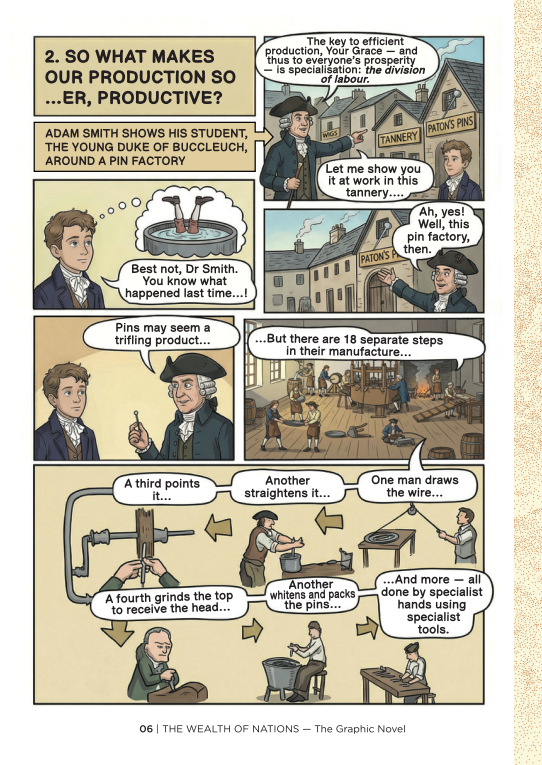
In this excerpt, Adam Smith takes his student, the young Duke of Buccleuch, to a pin factory to show how specialisation dramatically boosts productivity.
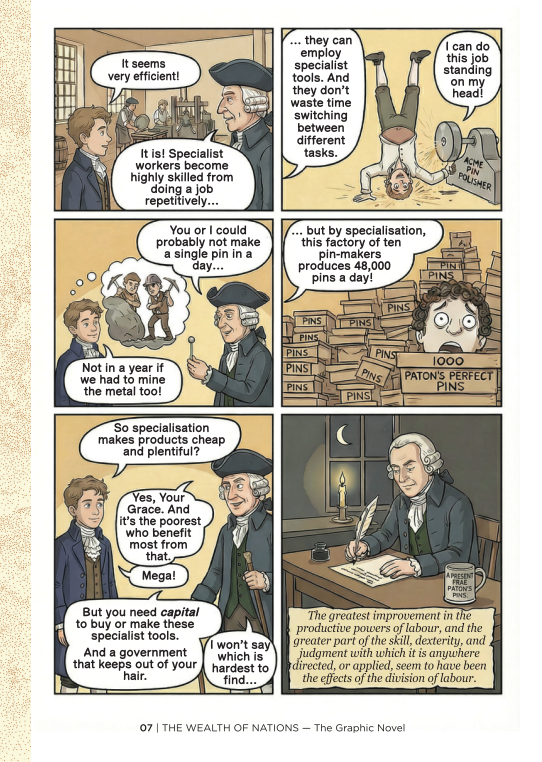
A single worker making pins from scratch might produce only a handful per day. But in the factory, the process breaks down into about 18 distinct and specialist operations. By focusing on one particular task, each worker becomes highly skilled, wastes no time switching tools or roles, and can use specialist tools. The results are astonishing. Smith reckons that ten specialised workers can produce an incredible 48,000 pins in a day — OK, his numbers might be out, but you get the idea. However many it is, that team is thousands of time more productive than any one of them trying to do all the operations themself.
This benefits everyone by making goods cheap and abundant, and turning former luxuries into commonplace necessities. Specialisation brings the “greatest improvement in the productive powers of labour” says Smith, especially to the poor, bringing “opulence” to “the lowest ranks of the people” as he says in his charming 18th Century prose.
Specialisation still underpins production today, from global assembly lines to global supply chains. But it relies on free exchange between producers and customers to deliver its benefits. Stifle markets endless value is created and shared. So why do that?
Eamonn Butler