
But of course manufacturing falls as a percentage of the economy
Larry Elliott is climbing aboard that bandwagon that, tsk, we must have more manufacturing:
Services now account for about 80% of the British economy, 10 times the size of manufacturing. Yet it is much harder to improve the efficiency of a labour-intensive service-sector job than it is a job in a factory. Britain’s weak productivity performance since the financial crisis of 2008 should not really come as that much of a surprise.
That’s Baumol’s Cost Disease right there. Because it’s more difficult to increase services productivity, and also because wages across the economy are determined by average productivity across the economy, then and therefore services become more expensive relative to manufactures over time. This is just true.
This then means - obviously - that manufactures become cheaper relative to services. Now add in that we measure the economy by value. So, any given level of manufacturing, over time, will become a smaller portion of the economy. Clearly and obviously manufacturing employment will fall - increasing productivity is the same thing as requiring fewer people to do the work after all. But, given that we measure output by value, so will manufacturing output as percentage of all output. This is just built into our observation about productivity.
Then there’s this:
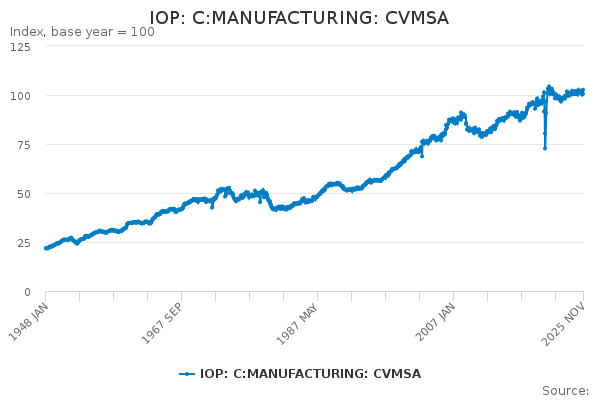
Index of manufacturing
It’s an index, so of course it is already adjusted for inflation. It’s of the value of manufacturing output in the UK. As we can see it’s at all time highs (well, close enough). We haven’t had a collapse in manufacturing output at all.
Manufacturing employment is down because we’ve increased productivity in manufacturing. Manufacturing as a percentage of the economy is down because we’ve increased productivity in manufacturing. Even a Marxist should be able to get this - if things are worth the labour that goes into their creation then using less labour means their value, per unit, goes down, right?
We can test this - the easier to increase productivity thing is even more true in agriculture than it is in manufacturing. Which is why we’ve gone from 80% of the economy, and 80% of the workforce, doing ag to only 2% of each in only a couple of centuries. All while we’re producing more food of course. Oh, and everyone’s vastly richer because everyone now spends well under 10% of the household budget on food not the 50% for a worse diet of yore.
The falling manufacturing portion of the economy is because we’re getting richer. It’s even possible to stretch that into if manufacturing isn’t falling as a percentage, while still growing in output terms, then we’re not getting richer.
Which is where the contention that we must have more manufacturing becomes so strange. People are complaining about the very evidence that we’re getting richer. No one at all is stupid enough to think that having more in the fields would make us richer. So why do they, misusing the same evidence, think that more in factories will?
Tim Worstall