
Gary Stevenson’s absolutely right, we have done this before
Gazza’s got a documentary coming out in which he will, undoubtedly, repeat his insistence that we’ve just got to tax wealth, noworrimean?
There is one true part of his claim. We have indeed killed off vast portions of British wealth before. In doing so we’ve reduced wealth inequality substantially. But it’s not, in fact, the example that Gary speaks of, it’s rather earlier. The method was also not taxation, it was free trade.
From Piketty and Zucman:
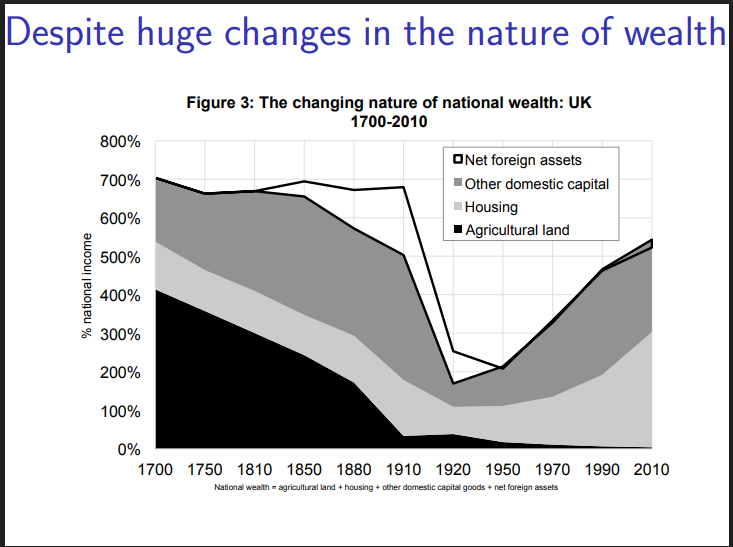
As we can see there at Jane Austen time - so beloved as an example by Thomas Piketty - agricultural land was the wealth thing. Wealth was pretty much defined by it in fact - a few thousand acres of waving wheat and you were rich, generationally rich. A century later and you weren’t.
No, it wasn’t taxation, even as such did exist. For it’s the value of the land itself that disappeared, not who held that value.
Yes, yes, obviously, it would be nice to own a few thousand acres of waving wheat these days but such a holding wouldn’t - observably, doesn’t - even maintain one of those country houses let alone build one. The wealth was killed off, not redistributed.
We did it by free trade. We abolished the Corn Laws and thereby invented - as far as Britain was concerned - millions upon millions of acres of new land covered in waving wheat. This dropped the price so substantially that the capital value of such domestic land pretty much, as a portion of the national accounts at least, disappeared. We can actually see, in those land values, when the oceangoing steamship made the prairies part of England’s food chain, then again as the railways made the steppes such.
Free trade kills off the protected fortunes of the domestic capitalists and rentiers. So, to kill off the fortunes of the domestic capitalists and rentiers we should have free trade then. No, it doesn’t matter what other people do in response, unilateral free trade achieves this goal.
We can make much the same point with a current example. There are 50% tariffs on steel of certain types and volumes. So, who does this benefit? The domestic capitalists who own the local steel companies, obviously. They make more money from the higher price achievable domestically - or, OK, this is steel, they lose less perhaps. Tariffs, restrictions upon trade, benefit the domestic capitalists and rentiers. That’s the whole point of them, their function.
We wish to reduce the wealth piles of the domestic capitalists and rentiers? So, declare unilateral free trade and thereby do exactly that thing. Gazza’s right, we have done this before. Let’s do it again, eh?
Hmm? Oh, you just want to be able to tax the rich, is it? Not actually solve the problem itself? Well, isn’t that a surprise with political propaganda then.
Tim Worstall