
If only journalists could grasp the basics
John Harris in The Guardian:
Back then, even if it was the defining condition of whole swathes of the country, no one in a position of power really talked about deindustrialisation. Margaret Thatcher’s governments had already blitzed the relevant parts of the UK economy; as Labour politicians must, some of them paid lip service to an industrial revival, but the Blair-Brown era presented a decidedly mixed picture: in the absence of any meaningful industrial policy, between 1997 and 2005 more than one million jobs in British manufacturing were lost.
Jobs going, yes, but not a blitz of manufacturing.
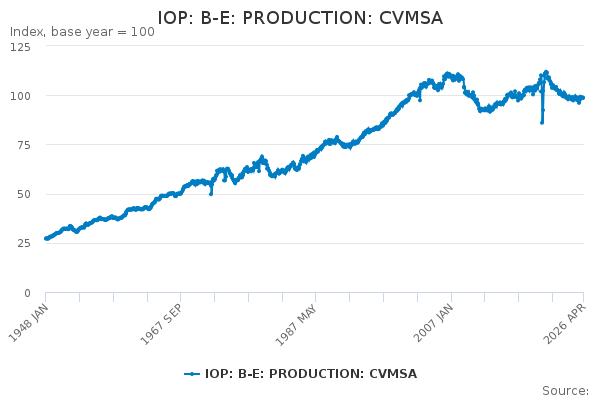
Index of manufacturing output by value. Yes, inflation adjusted
As we can see, manufacturing output increased during that Thatcher “blitz”. Output also increased during that ‘97 to ‘05 period being whined about. By 23 or 24% in fact.
Wholly true that manufacturing employment fell at the same time. Which is a good thing - this is also known as increasing labour productivity. As the average wage in the country is determined - no, determined - by the average productivity in it therefore increases in productivity mean higher wages. Good, eh?
Losing jobs in manufacturing* while increasing manufacturing output is, as the Sellars and Yeatman version of economics would have it, “A Good Thing”. It’s also not something we need to have a policy about in order to reverse the process.
Falling manufacturing output could be - could be - a symptom of something wrong with an economy. Manufacturing falling as a percentage of the economy is more likely to be the result of services growing faster than manufacturing. But manufacturing output going up while manufacturing employment goes down is, indeed, A Good Thing.
And, well, you know, if those who wrote about our economy knew these things then wouldn’t we all be better off? Richer, even?
Tim Worstall
*We are prepared to wonder about this. Have you checked behind the sofa?