
Restoring masculine self-worth
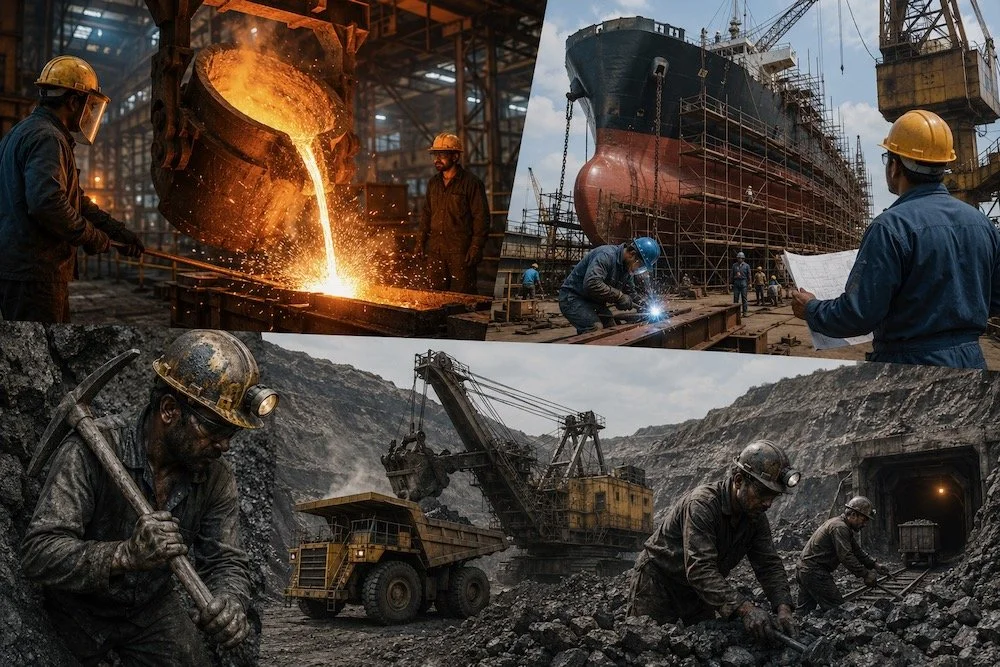
Commentators (notably Owen Jones) have identified a lack of self-respect among Northern men in Britain. The decline of heavy industry and tough, demanding jobs has taken away the feeling of masculine self-pride that is absent from the jobs that replaced them
Deindustrialisation is a fundamental reason why what it means to be a man is in a state of flux in Britain, but the industries themselves are not what men mourned. They mourned the visibility of their contribution: everyone knew what a miner did, what it cost him, and what it was worth. The service economy is largely invisible in this way because a warehouse logistics coordinator or a care worker doesn't carry a story others can read at a glance. That is essentially what the pit, the steelworks, and the shipyard did socially.
By ‘Northern masculine self-respect’ I refer to the status, identity, and social esteem that many men in northern industrial communities once derived from mining, shipbuilding, steelmaking, engineering, and similar work. Heavy industry provided several things at once. It gave a clear route to adult status and a visible contribution to the community. It encouraged male friendship and solidarity, economic independence, and a sense that effort was respected.
The challenge is that most modern jobs provide only some of those things.
If there is an idea worth exploring, it is not bringing back the factories but creating something new that confers status through service, competence, and responsibility. We need something that involves tangible achievement, discipline, teamwork, and public recognition.
A man earning a reasonable wage can still feel socially unnecessary. The old industrial jobs did more than pay; they told workers who they were. A useful question is therefore not, ‘What jobs can replace coal mines?’ but, ‘What modern activities can give ordinary men the feeling that they are needed?’ Heavy industry used to provide that framework almost automatically. The modern world has to create it deliberately.
Dr Johnson famously observed that “There are few ways in which a man can be more innocently employed than in getting money.” It should also be noted that this process is often accompanied by self-respect and the respect of others. The bosses of the crafts and industries of the Industrial Revolution enriched their Northern towns with civic works, and took pride in doing so. Places such as Manchester, Birmingham and Sheffield were adorned with public buildings and spaces as they prospered.
The obvious question to ask is, “Could it be done again?” And the answer is that it probably could, given the political will. The North could indeed become a powerhouse if, instead of pushing meagre funds in its direction, we reconstructed it to pull in wealth, mostly from overseas, to build up a self-sustaining and expanding economy.
To know how this might be done, we need only look at pre-mainland Hong Kong and Singapore. They were given an edge by light regulation and historically low taxation. That made them attractive places for industry to locate and expand. They were not concerned with levelling up, egalitarianism or diversity, but in making money and earning the respect that an expanding economy conveys.
The inhabitants of an increasingly prosperous North would feel a pride in what they were doing. There would be well-paid and high-status jobs, and the buzz of being in a place that knew where it was going.
Alas, even though we know what would work, there is not currently the political will to do anything about it. Could there be in the future? Perhaps.