
The Rwanda Britain Ignored
The Rwanda Britain Ignored
——Jiayi Li | 2026.6.12 | lijiayi2007815@163.com
Rwanda spent a decade quietly becoming one of Africa's most investable economies. Britain spent three years asking the wrong question about it.
“Commerce and manufactures can seldom flourish long in any state which does not enjoy a regular administration of justice, in which the people do not feel themselves secure in the possession of their property, in which the faith of contracts is not supported by law.”
Adam Smith (1776), An Inquiry into the Nature and Causes of the Wealth of Nations, Book V, Chapter III, p. 910
The Wrong Question
On the evening of 14 June 2022, a Boeing 767 sat empty on a runway at MoD Boscombe Down in Wiltshire. Liz Truss, then Foreign Secretary, had told reporters that morning the flight would go ahead "no matter how many people are on it." The European Court of Human Rights intervened just after 19:30. By 22:15 the plane had been emptied and returned to Spain. Labour cancelled the scheme in July 2024; the Home Secretary told Parliament that £700 million had been spent on a policy that sent four volunteers to Rwanda.
Rwanda's economy grew at an annual average above seven per cent across the same three years, faster than almost anywhere else on the continent. The country ranked first in sub-Saharan Africa for business readiness on the World Bank's 2024 metrics, and third globally for operational efficiency, ahead of most OECD members. A new company could be registered in six hours. Registered investment commitments reached $3.2 billion in 2024, up 32 per cent on the prior year, with Volkswagen, BioNTech, and Zipline operating manufacturing or logistics facilities in Kigali. The figures were public. None appeared in three years of parliamentary debate.
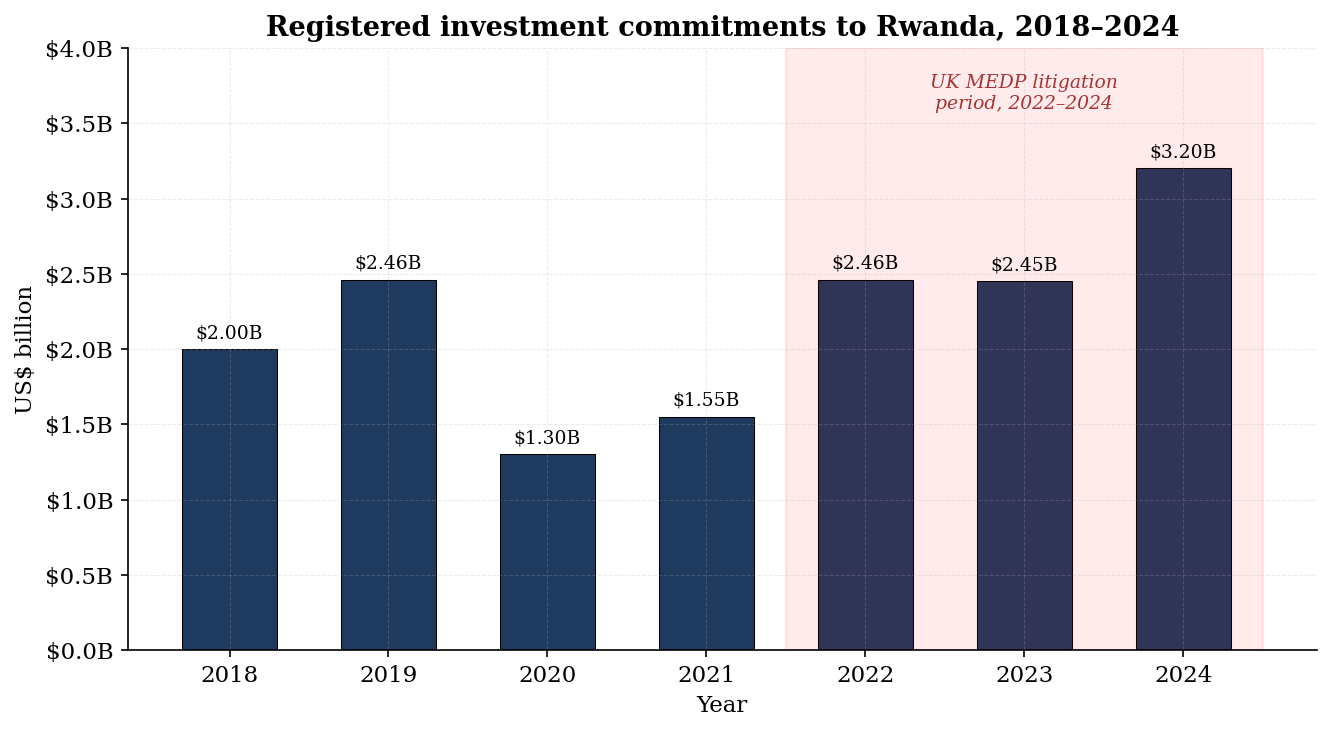
Figure 1: Registered investment commitments to Rwanda, 2018–2024 (US$ billion). Source: Rwanda Development Board annual reports.
By the time Boris Johnson announced the Migration and Economic Development Partnership in Kent on 14 April 2022, the terms of the debate had hardened around a single question: whether Rwanda was sufficiently safe to receive individuals Britain wished to remove from its territory. The political right answered yes, citing stability and a functioning asylum infrastructure. The political left dissented, with church leaders calling the scheme inhumane and the UN refugee agency condemning it as a violation of international law. Two years of litigation followed, culminating in the Supreme Court's unanimous November 2023 ruling that Rwanda did not qualify as a safe third country. Rishi Sunak responded with the Safety of Rwanda Act 2024, declaring Rwanda safe by statutory fiat.
The legal question was defensible. Its operative definition of safety was humanitarian, concerning individuals transferred against their will. Investors ask a separate set of questions: whether property rights are secure, whether contracts are enforceable, whether the regulatory environment is consistent across administrations. Private capital was answering that question with real money throughout the same three years. The two questions share no common subject. One concerns what might happen to a person transferred under compulsion. The other concerns capital committed voluntarily by actors who can withdraw at any time. A country can satisfy one framework and fail the other at once, and Rwanda did.
Close examination reveals three layers in Rwanda. The deepest is a normative substrate, reshaped by the genocide and by the policy choices the Rwandan Patriotic Front made in its aftermath, structuring informal trust, ethnic categorisation, and public authority in the post-1994 society. Above the substrate sits an institutional interface: a registered title deed at $6, a six-hour business registration, commercial courts staffed by specialised judges, IFRS-aligned listed accounts, sovereign debt rated by Fitch. The interface makes the economy legible to outside capital in the form Smith specified two and a half centuries ago. The third layer is a political engine: the Rwandan Patriotic Front’s commercial complex, its security apparatus, its statistical machinery, its cross-border revenue position. The substrate sets the conditions under which the interface could be built. The interface translates a domestic political settlement into the language of contract and disclosure that capital can act on. The engine maintains the settlement against the centrifugal forces that have, in comparable post-conflict states, repeatedly dispersed it. Conflating the three layers has been the methodological error producing two decades of unstable readings of Rwanda in the international policy literature.
The data was available to anyone who looked. In the World Bank's Doing Business 2020 report, Rwanda ranked 38th globally, the highest among continental sub-Saharan African economies, ahead of Kenya, South Africa, and Botswana. The B-READY 2024 successor framework placed Rwanda in the top quartile worldwide on operational efficiency. Fitch and Standard & Poor's rate Rwanda at B+ with stable outlook, tighter than the median for sub-Saharan African sovereigns of comparable credit quality. The Westminster question was answerable from a single afternoon's reading.
The Mechanism: Property Rights and Their Enforcement
Before 2004, around 90 per cent of Rwanda's land was governed by customary tenure arrangements, without written titles or registered boundaries. For a smallholder who had cultivated the same plot for twenty years, the consequences were severe. He held no documentary evidence of ownership. A neighbour could dispute his claim. A bank would turn him away. He would avoid any improvement requiring time to generate a return, because planning for the long term is rational only for those whose claims to the future are legally legible. Smith's observation that commerce depends on the security of property described, with precision, the constraint facing the roughly six to seven million Rwandans whose livelihoods turned on cultivation of unregistered land in the late 1990s.
The political commitment that preceded the legal commitment was formal and dated. The Vision 2020 programme, published in July 2000 under President Kagame and drawing on policy work initiated during President Bizimungu’s administration, identified secure land tenure, contract enforcement, and reduced barriers to business entry as the conditions for sustained growth. The document specified targets, deadlines, and the institutional reforms required to meet them, four to eight years before the implementing legislation reached the statute book. Vision 2020 functioned as a public political pre-commitment to a particular reform sequence, with the political authority of the cabinet behind it. The reforms that followed implemented the document with unusual fidelity.
The 2004 National Land Policy and 2005 Organic Land Law established the statutory framework for systematic registration. The pilot phase covered four cells in 2007. The national rollout, conducted between 2009 and 2013, surveyed more than ten million parcels and issued approximately seven million title deeds at an average cost of around six dollars each. The administrative architecture was deliberately minimal. Local committees verified claims in public meetings; disputed parcels were referred to mediation before adjudication; the resulting certificate was registered in a centralised database that became, by 2017, fully digital. The cost-per-deed of six dollars compares with figures in the hundreds of dollars for comparable schemes elsewhere on the continent. The Rwandan version worked as a registration exercise where others have failed because the political authority sustaining it accepted that the institutional commitment had to be priced low enough for the median farmer to take it up.
Independent evaluation documented the behavioural response. Ali et al. (2014) found that farmers receiving certified title undertook significantly greater long-cycle investments in soil conservation, including terracing, than comparable farmers without registration, with the effect particularly pronounced for female-headed households, and that land-market activity declined rather than producing the distress sales critics had predicted. Earlier policy work by Daley et al. (2010) had documented the legal framework protecting women's joint marital land rights and improved inheritance recording. The agricultural response operated through a change in what it was rational to do with the land, the mechanism Smith specified.
The same logic applied to commercial activity produced the reform package that followed. The Rwanda Development Board was established in 2008, absorbing seven previously separate agencies including the Investment and Export Promotion Agency, the Information Technology Authority, and the Privatisation Secretariat. Company registration time fell from nine days in 2007 to six hours by 2010, and to under three hours by 2018. A network of commercial courts established the same year, staffed by specialised judges and operating expedited procedures, brought the median resolution time for commercial disputes well below the sub-Saharan African average. The Integrated Electronic Case Management System, introduced in 2016, links courts, prosecutors, prisons, and police. Each reform was justified to international observers as an efficiency measure, and each produced the efficiency gains its design predicted.
Urban land and construction followed the same logic. Goodfellow’s research on Kigali (Goodfellow and Smith, 2013; Goodfellow, 2014) documents a planning regime that combined high-modernist master planning with effective property registration in the urban core, producing both speed of construction permit issuance and the displacement controversies that accompanied the city's redevelopment. The combination is characteristic of the Rwandan approach: administrative legibility for the actors the state wishes to enable, delivered through procedures that operate quickly and predictably for those actors, with the political costs concentrated elsewhere.
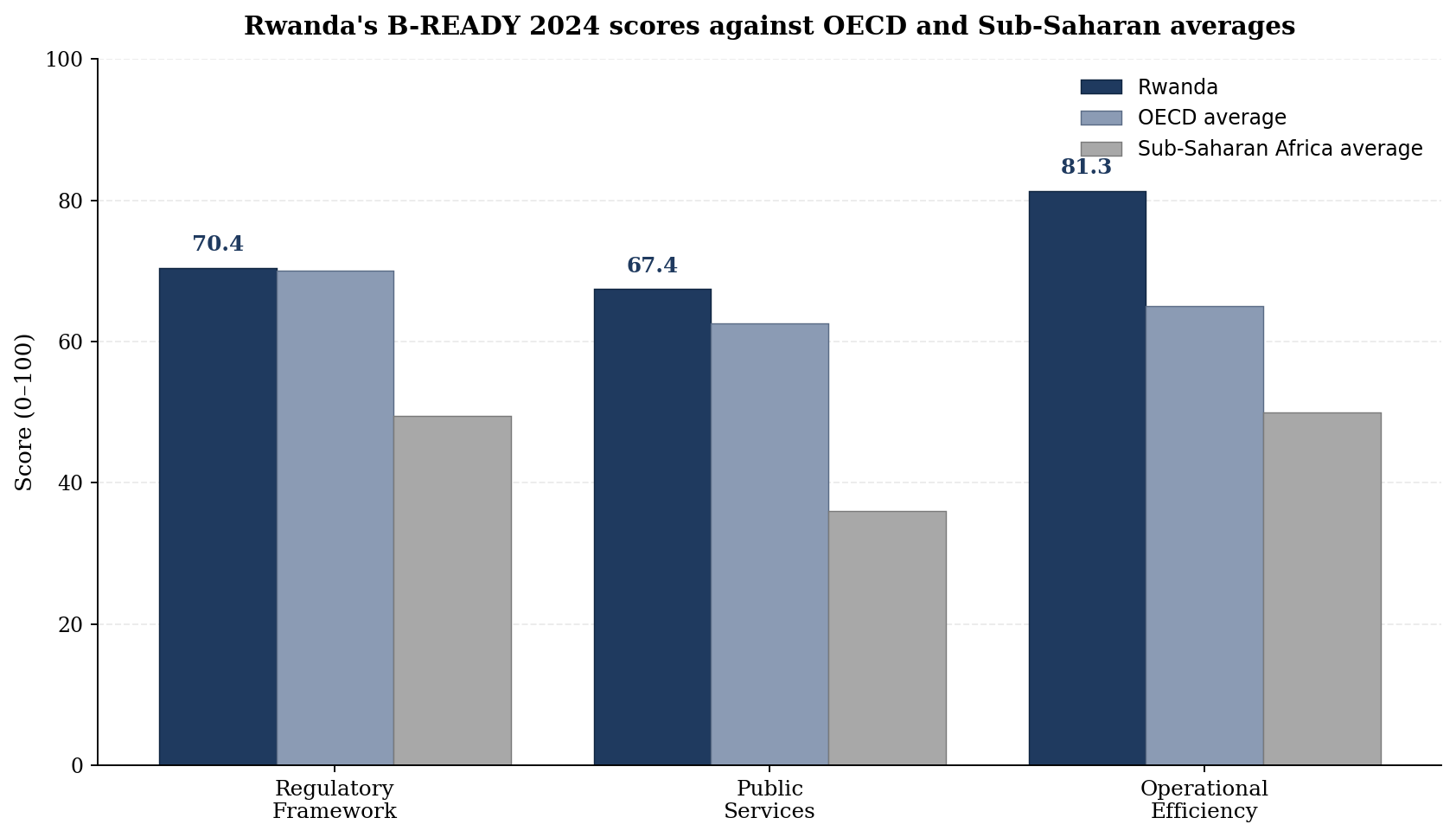
Figure 2: Rwanda's Business Ready 2024 scores against OECD and Sub-Saharan African averages. Source: World Bank Business Ready 2024.
The financial infrastructure layered above this base extended the mechanism to international capital. The Capital Markets Authority was established in 2011 with technical assistance from the IFC and the UK's Crown Agents. Accounting standards were progressively aligned with IFRS, with full mandatory adoption for listed companies from 2014. The Rwanda Stock Exchange, also established in 2011, remains small but functional, with eight equity listings and several corporate bonds by 2024. The architecture proved sufficient for the November 2018 cross-listing of Bank of Kigali on the Nairobi Securities Exchange, the first Rwandan company to do so, following a rights issue that raised approximately $70 million. The pace was unusual. The political authority sustaining the reforms committed to them publicly, in Vision 2020, and honoured them through cycles when honouring them was politically inconvenient.
The effect is visible in the sequence of foreign investments that entered Rwanda after 2008. MTN's 1998 entry into the telecommunications market operated through bilateral negotiation between South African executives and the Office of the President, since institutional infrastructure of the kind described above did not yet exist. By 2018, Volkswagen had opened a Kigali assembly facility with a $20 million initial investment, with customs treatment for imported components negotiated through a dedicated RDB account manager. Zipline, the medical drone delivery firm, began commercial operations in October 2016 under a partnership with the Ministry of Health that required the Rwanda Civil Aviation Authority to issue the first permit for autonomous commercial flight at that scale anywhere in the world. Long-term offtake agreements with the public health system guaranteed Zipline's revenue. The arrangement has since been replicated in Ghana, Nigeria, and Côte d'Ivoire, at slower pace and on weaker offtake terms. Rwanda's first Eurobond, a $400 million ten-year issuance in April 2013, was priced at 6.625 per cent with orders reaching $3.5 billion, nearly nine times the bond's issue size.
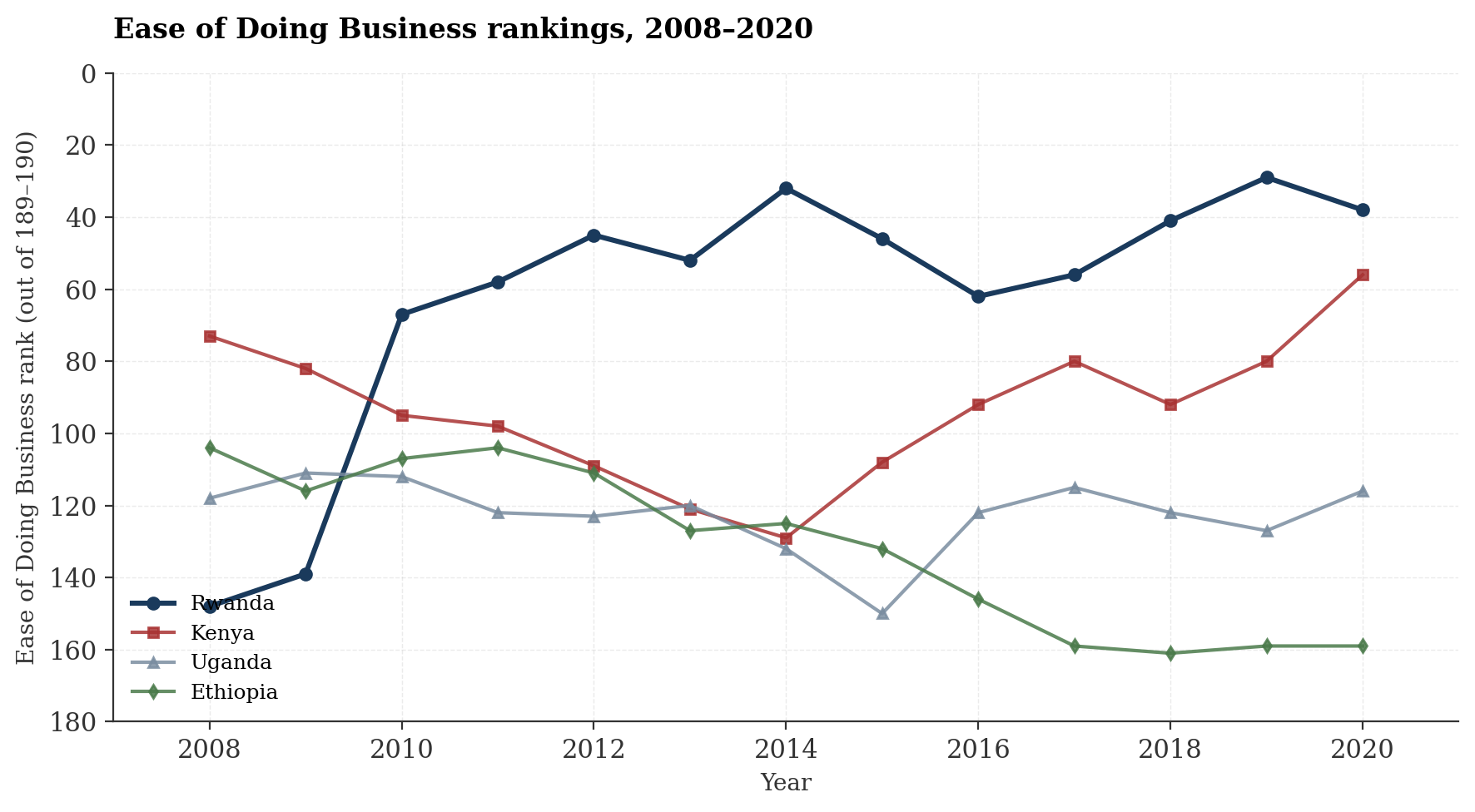
Figure 3: Ease of Doing Business rankings, Rwanda and East African comparators, 2008–2020. Source: World Bank Doing Business archive.
Between 2004 and 2018, the Rwandan state extended institutional legibility from the village to the international bond market, using essentially the same instrument at every scale: a credible state commitment, recorded in a public register, enforceable through a specialised judiciary, and priced low enough to be used. The instrument is recognisably Smithian. The political authority sustaining it is something else.
Crystal Ventures and Its Limits
The Rwandan Patriotic Front controls a commercial holding company, originally established as Tri-Star Investments in 1995 and rebranded Crystal Ventures in 2009, with operations spanning construction, furniture manufacturing, agro-processing, private security, telecommunications, and increasingly mining. A party-owned conglomerate with preferential access to state procurement is, by conventional metrics, a corruption indicator. The Africa Report's 2023 investigation placed its asset base above $500 million, with employee counts variously estimated between twelve and twenty-five thousand. Subsidiaries include Inyange Industries, which dominates the domestic dairy, bottled water, and packaged juice market through its own branded products; ISCO, the only private security firm in Rwanda licensed to carry firearms; Real Contractors, a major recipient of government construction tenders including the expansion of Kigali International Airport; and Bourbon Coffee, the largest specialty coffee chain in East Africa. The company does not publish consolidated accounts. Its ownership structure, beyond the formal RPF holding of shares on behalf of party members collectively, remains undisclosed.
A defence of the arrangement worth taking seriously sits behind the conventional reading. In 1995, after the genocide against the Tutsi, Rwanda possessed effectively no private sector. The international business community had concluded that the political risk was uninvestable. Domestic capital had either fled or been destroyed during the preceding civil war. The party-state stepped into the resulting vacuum, using funds collected during the 1990 to 1994 military campaign and contributions from the Tutsi diaspora in Uganda, Belgium, the United States, and Canada, and built the productive base that conventional private actors could not. The early Crystal Ventures investments (the 1998 partnership with MTN, Inyange Industries, road and housing construction in the early 2000s) were acts of post-conflict reconstruction in conditions where no alternative existed. The MTN case illustrates the logic. Private foreign capital was unwilling to enter a post-genocide economy whose risk premium it could not reliably price. Tri-Star took a 65 per cent stake in the venture, absorbing political risk that purely commercial investors could not underwrite. A decade later it exited at a substantial multiple of its initial outlay, the transaction demonstrating that the rules held.
The mechanism Crystal Ventures embodied in that period operated on a different logic from classical corruption. Pre-existing rent extraction in Rwanda took a discretionary and unpredictable form, with individual officials extracting payments from foreign investors on time horizons that extended only to their own tenure. An RPF that derives its legitimacy and survival from sustained economic performance has a different relationship to investor confidence. The party’s time horizon is coextensive with its own political survival, and that survival is contingent on the performance of an economy in which investors believe that commitments will be honoured. Officials diverting rents from foreign deals would have degraded the conditions on which the party’s continuation in power depended. The arrangement constructed after 1995 replaced a short-horizon predatory equilibrium with a longer-horizon coordinated one. Booth and Golooba-Mutebi (2012) characterise this configuration as “developmental patrimonialism” within the broader Africa Power and Politics Programme research, which Kelsall (2013) extended to comparative analysis of Ethiopia under Meles Zenawi.
The developmental patrimonialism framing captures a real mechanism, with the weight wrongly distributed. Booth and Golooba-Mutebi (2012) treat the commitment-device function as the founding logic and the entrenchment of party-state economic centrality as its downstream consequence. The temporal ordering and the political problem set the RPF faced in 1995 suggest the causal ordering ran the other way; without access to internal RPF decision records this remains analytical reconstruction, but the inference is sustained by what the configuration was structurally positioned to do. Tri-Star Investments was established in 1995, three years before the MTN partnership that the literature treats as the founding commitment-device demonstration; the institutional apparatus of party-state commercial centrality was in place before any specific foreign-investment opportunity required risk-absorption from a party vehicle. The Rwandan Patriotic Front in 1995 confronted three political problems that required immediate resolution: to occupy the commanding heights of an economy whose pre-genocide commercial elite had been killed, exiled, or implicated in the genocide; to displace the Habyarimana patronage networks before they could reconstitute themselves; and to secure revenue streams that did not depend on donor moods. Crystal Ventures was the instrument that solved all three problems at once. Absorbing political risk that purely private capital could not underwrite was a useful by-product of an instrument whose primary function was political reconstitution. The standard developmental-state assessment treats the resulting commitments as “good decision-making” against a benchmark independent of the decision-maker. The benchmark is growth, and the political vehicle whose decisions are being evaluated is one whose own continuation depends on growth. The two categories the assessment attempts to separate, institutionally productive action and self-entrenchment by political incumbents, collapse into a single category when the success metric and the agent’s survival condition coincide. The Rwandan post-1994 record is what that collapse looks like sustained across three decades. The implication for evaluation is structural. A regime configuration in which growth performance and political survival are mutually defined cannot be assessed against a benchmark that treats them as separable. Treating Crystal Ventures’ commercial productivity as evidence of good governance, or its capture of regional rents as evidence of bad governance, applies a benchmark the system itself has disabled by construction. The honest assessment runs one level deeper: what the configuration produces, the conditions under which it produces it, and the conditions under which it will produce something different. The classical-liberal critique of Rwanda needs to operate at that level to engage what is actually happening.
The alignment of the two functions held for fifteen years because of the particular form the RPF’s power centralisation took. The Rwandan Patriotic Army’s command hierarchy carried over directly into Crystal Ventures after 1995, with senior officers placed in commercial positions and operating under the chain-of-command discipline that had governed the campaign; advancement within the commercial network correlated with the same indicators of operational reliability and political loyalty the army used. The 1990 to 1994 diaspora financing channel left a residue of expectation: contributors from Kampala, Brussels, Toronto, and US-based networks had committed capital to a political project on the implicit understanding of long-term returns, and early Crystal Ventures performance was visible to a constituency the RPF could not unilaterally silence. The ethnic-minority returnee status of the leadership cohort meant the absence of inherited rent-extraction networks at the local level; the Habyarimana akazu had operated through preferential access embedded in regional and prefectural patronage chains, and the post-1994 leadership had no equivalent local infrastructure through which to extract rents discreetly. Internal rent extraction would therefore have degraded assets the cohort itself held while requiring the construction of new extraction channels the leadership configuration was poorly placed to build. The alignment persisted as long as the configuration that produced it did.
The form of power centralisation therefore shapes the kind of commercial institutions a post-conflict state can build. The principal African post-conflict cases of the same period bear out the counterfactual. Mozambique’s FRELIMO continued as incumbent ruling party after the 1992 negotiated settlement of a sixteen-year civil war, with leadership monitoring sufficient for political control but unable to forestall the senior-level rent extraction that culminated in the 2016 hidden-debt scandal. Sierra Leone’s post-2002 coalition was locally recruited and structured by negotiated power-sharing under international supervision, producing a recovery dependent on mineral booms and reconstruction-driven public investment without a party-state commercial vehicle to coordinate it. Liberia after 2003 followed a similar pattern. None of the three produced a Crystal Ventures equivalent because none had a leadership configuration in which the entrenchment motive and a long-horizon commitment-device function would have run together. Crystal Ventures was effective in the conditions of its founding because those conditions selected for that specific alignment; the subsequent expansion is what the entrenchment motive looks like in isolation, once the founding conditions have dissolved and the commitment-device function has been absorbed by the institutional interface.
The observed response runs the other way. The Crystal Ventures subsidiary network has expanded. Its Macefield Ventures vehicle now operates in the Central African Republic, the Democratic Republic of the Congo, Congo-Brazzaville, Zimbabwe, and Zambia, typically in countries where Rwandan military or diplomatic engagement has created a window for commercial entry. Scholarly work by Behuria (2015, 2018) documents that, in sectors such as pyrethrum, mining, and other strategic sectors, Crystal Ventures-linked entities have benefited from preferential procurement, tariff protection, and access to credit on terms unavailable to non-party-linked competitors. Subsequent observations in the scholarly literature (Reyntjens, 2013) have noted that anti-corruption enforcement in Rwanda, while genuine, tends to target mid-level civil servants and officials who have lost political backing more frequently than entities operating in proximity to the inner circle. The 2020 prosecution of former prime minister Pierre-Damien Habumuremyi for bounced cheques connected to his private university illustrates the pattern. Crystal Ventures and its principal subsidiaries have not been the subject of a comparable investigation in thirty years of operation.
A second strand of scholarship sharpens the analytical distinction. Clark (2010), whose fieldwork on the gacaca courts extends over a decade, documents the process through which the post-genocide state constructed a community-based justice architecture to address mass atrocity. Chakravarty (2015) extends the analysis, demonstrating that the same architecture of justice, including the gacaca community courts, the Genocide Ideology Law of 2008, and the broader judicial system, was simultaneously employed to enforce political conformity. The same institutional apparatus that constructed credible commercial commitments has been employed against political opposition with comparable effectiveness. Reyntjens's (2013) analysis of post-genocide Rwandan governance distinguishes rule by law from rule of law. The former describes a regime in which law is an instrument of political authority and is enforced predictably for the purposes that authority approves. The latter describes a regime in which the law constrains the authority itself. Rwanda has built the former on a scale and to a standard rare in the region. It has not built the latter. The commercial courts that enforce contractual claims between private parties operate independently in that domain. The constitutional and electoral courts that would otherwise constrain executive action against political opponents do not. This is the difference between the institutional interface, which extends Smithian legibility to outside capital, and the political engine, which retains discretionary authority for the regime that built the interface.
The classical liberal reading of this evidence is narrow and exact. Crystal Ventures' commitment-device function was indispensable in 1995, when no alternative coordinating commercial actor existed and the political risk premium was prohibitive for purely private capital. That function has been gradually displaced, over twenty-five years, by the institutional interface the same regime built. The expected institutional response would have been to allow the party-state commercial footprint to recede as the interface absorbed its function. Sustained expansion, both at home and across the region, indicates that the arrangement has acquired purposes beyond commitment provision. Smith's discussion in Book V of how public institutions become captured by the constituencies that depend on them describes the mechanism directly: an institutional vehicle established for one purpose accumulates beneficiaries whose interests bind it to a different purpose, its own continuation. The party-state arrangement has produced its own political support network, independent of whether the founding Smithian justification still applies.
The Precondition Nobody Measured
The Marshall Plan worked, and its success exercised an outsized influence on the development economics that followed. Capital arrived in Western Europe after 1948, and reconstruction followed. Subsequent analysis rarely interrogated the enabling precondition. Western Europe in 1948 already possessed functioning legal systems, enforceable contracts, and established property rights. Capital performed as expected because the institutional conditions for productive investment already existed. The aid supplied inputs to a productive apparatus whose institutional architecture remained intact even where physical capital had been destroyed.
An entire architecture of international aid was subsequently built on the implicit assumption that capital produces growth directly, without specifying what must be in place before capital can perform any productive function. Rwanda's trajectory before 1994 constitutes the empirical test of that assumption. The country was one of the highest per-capita aid recipients on the continent through the late 1980s and early 1990s, with net official development assistance reaching 22 per cent of gross national income in 1991. Belgium, France, Germany, Switzerland, the European Community, and the World Bank were the principal donors. Uvin’s (1998) study Aiding Violence: The Development Enterprise in Rwanda documented the validation language the donor community used during that period. The Habyarimana government was praised for budget discipline, primary school enrolment, road construction, agricultural extension, and macroeconomic stability. The World Bank's 1988 and 1991 country strategies referred to "remarkable progress" and "the most efficient public sector in the region."
In November 1990, with the civil war already underway and Tutsi households being subjected to organised harassment under official patronage, the Bank's preparatory documents for the Structural Adjustment Credit described political stability as "broadly satisfactory." The credit was approved in June 1991. It required a 40 per cent devaluation of the Rwandan franc, wage controls, and increased user fees for health and education services. The theoretical premise was that price correction would generate growth. The intervention generated inflation, a collapse in rural incomes, and a population more economically precarious than before. Three years later the genocide against the Tutsi killed an estimated 800,000 to 1,000,000 people in approximately a hundred days. The aid had funded nothing that mattered when it mattered most, because it had never engaged the institutional conditions that determine whether a society retains the capacity for political order.
The validation infrastructure that read Habyarimana's Rwanda as an institutional success is the same infrastructure now reading Kagame's Rwanda as an institutional success. The personnel rotate; the methodology persists. Country strategy documents are produced on three-to-five year cycles. The indicators they rest on are the same ones the 1988 and 1991 documents used. The validation has been more accurate this time because the underlying record is different, but the accuracy is incidental. The institutional memory of the validating apparatus is shorter than the history of the country it is validating, and the failure mode demonstrated in 1991 was demonstrated again in Mozambique in 2016.
After 1994, the same country received comparable volumes of aid under a fundamentally different institutional environment. By 2024, GDP per capita had tripled in real terms. The developmental trajectory was entirely different, and the difference had nothing to do with the donors.
The post-1994 Rwandan starting condition has been treated as institutionally empty, and the subsequent trajectory as construction from zero. The record requires more discrimination, because what was inherited shaped what could be built next. Six inheritances did decisive work. The Belgian colonial administrative architecture, more granular than that of any other state in the region with its four-tier division into cellules, secteurs, communes, and préfectures, gave the post-1994 state a pre-existing channel through which centrally-issued administrative instructions could reach the household; the 2009 to 2013 land registration ran on this substrate, and could not have been priced at six dollars without it. Kinyarwanda as a single nationwide language meant that the formalisation of any registry incurred no internal translation cost, a friction that registry exercises in linguistically fragmented African states have repeatedly encountered, and a constraint that explains why otherwise comparable post-conflict reformers have failed at this specific step. The combination of small territory (26,338 square kilometres) and one of the highest population densities in Africa meant that the marginal cost of monitoring local compliance was lower than in any neighbouring state, which is what made centrally-directed cadre supervision feasible at all. Geographically stable customary land tenure, with most parcels under continuous family cultivation for generations, gave the 2005 Organic Land Law something to formalise; the legal exercise was the registration of existing claims, and this distinction explains why the behavioural response (long-cycle investment in tree crops and terracing) followed within years rather than decades. The pre-colonial gacaca tradition of community-level dispute resolution, dormant under colonial and Habyarimana rule, was revived after 2002 to process the genocide caseload at scale, demonstrating that the selective reuse of indigenous institutional forms was available where the substrate retained them. The Belgian-era fiscal architecture, continued under Habyarimana, provided the administrative skeleton on which the Rwanda Revenue Authority was built in 1997; revenue collection capacity that was nominal under the prior regime became operational under the RPF because the underlying structure was already there to be activated. The inheritances were predominantly administrative-structural; the normative-political components were reconstructed afresh. This asymmetry is the precondition the replicability question turns on.
The post-1994 government removed specific items with comparable deliberateness, and each removal had a determinable institutional consequence. Ethnicity was eliminated as a category on official identity documents in 1996, withdrawing from the public record the principal axis along which the genocide had been organised and along which pre-genocide commercial networks had run; the legal effect was to make cross-ethnic commercial cooperation the default condition of registered economic activity, which is the condition under which a Smithian impersonal-rule-based economy can operate at all. The pre-genocide commercial elite, whose firms had operated through Habyarimana-era patronage from the akazu and whose principal figures had been killed, exiled, or indicted by the International Criminal Tribunal for Rwanda by 1997, was replaced by RPF-linked actors operating on different network structures and longer time horizons; the displacement was architectural as well as personal, removing a pre-existing rent-extraction network that, if intact, would have channelled foreign capital through informal payments and bypassed the registered routes the institutional interface was being built to create. The transition from French to English as the language of government, prepared through the 2000s and completed between 2008 and 2009, opened a different set of commercial counterparties—the East African Community, the Commonwealth, the City of London, the New York legal market—and shifted the legal-conceptual register of Rwandan commercial law toward common-law jurisdictions with which global capital markets are more familiar; this was a deliberate market-positioning choice expressed through linguistic policy. The Mouvement Révolutionnaire National pour le Développement (renamed Mouvement Républicain National pour la Démocratie et le Développement in 1991), the ruling party between 1975 and 1994, was dissolved; its provincial administrative reach, through which local officials had operated as both political and economic gatekeepers, was reorganised under a centralised cadre system answerable to the RPF, eliminating the local discretion that had produced the pre-1994 pattern of unpredictable rent extraction from foreign investors. The Genocide Ideology Law of 2008 criminalised both explicit denial and the public reactivation of ethnic categories as instruments of political mobilisation, formalising the settlement that the 1996 documentary change had signalled and placing the cost of network reconstitution along ethnic lines higher than any individual actor could plausibly bear. The institutional interface became the only available coordination mechanism in domains where ethnicity, patronage, and traditional authority had previously operated. The removals enumerated above were what made that singularity possible.
The asymmetry between administrative-structural inheritance and normative-political reconstruction is the binding constraint on the Rwandan model’s replicability. Most post-conflict African states inherited weaker administrative-structural foundations: linguistically fragmented populations requiring registry exercises to operate across multiple languages, lower population densities raising the marginal cost of central-to-local communication, customary tenure systems disrupted by displacement that cannot be formalised through the mapping of continuity because continuity does not exist to be mapped. The RPF’s political choices operated on a substrate that included the inheritances enumerated above. Replication that imports the political choices without the substrate produces a different result. The Mozambican, Sierra Leonean, and Liberian cases discussed earlier are examples; each had functional but thinner administrative-structural inheritance, and none produced the rapid registration-to-investment cascade that the Rwandan title-deed scheme produced. The transferable element of the Rwandan model is methodological: how to select political decisions for a given substrate. The substrate is what most replicators do not have.
The normative consequences of the genocide cut against the institutional record. The conventional theory of social capital, developed from the work of Putnam et al. (1993) and extended to general economic outcomes by Knack and Keefer (1997), predicts that the destruction of generalised interpersonal trust degrades the conditions on which commerce depends; post-conflict field studies in Burundi by Voors et al. (2012) and in Sierra Leone by Bauer et al. (2014) have documented patterns consistent with the Putnam framework on some dimensions while complicating it on others: violence exposure correlates with elevated discount rates (constraining long-horizon investment behaviour) alongside heightened in-group parochial altruism that does not extend to generalised social trust. The Rwandan genocide met the conditions for the interpersonal mechanism more completely than most cases in the comparison set: neighbour killed neighbour, killing was organised through ordinary administrative and community channels, and 1.96 million cases against close to one million accused passed through the gacaca community courts between 2002 and 2012. The damage extended beyond the interpersonal level. Generalised institutional trust collapsed across the channels normally responsible for substituting for it: the Catholic Church was deeply implicated, with prosecutions of clergy continuing for years after the events; traditional authority structures had been mobilised for the organisation of the killing; and the formal judiciary had been emptied of personnel and credibility. The standard substitution path, in which institutional trust compensates for damaged interpersonal trust, was unavailable. The destruction of human capital compounded both levels of damage, with teachers, doctors, agronomists, and traders among the categories specifically marked for killing. On the Putnam mechanism extended to include institutional substitution, the post-1994 trajectory should have been an extended period of low investment, network thinning, and contractual reluctance.
The observed trajectory ran the other way at the margins where formal institutions intervened, and ran in the predicted direction where they did not. The behavioural response to land registration described earlier and the foreign investor response after 2008 show that formal commitments substituted for the trust the genocide had destroyed, where the formal commitments were credible enough to substitute. The reversal applied only in domains where formal institutions intervened. In inter-household borrowing outside the banking system, in the informal labour market, and in the marriage market, the trust deficit Voors et al. (2012) and Bauer et al. (2014) documented in comparable settings persisted. Sommers’ (2012) fieldwork on post-genocide Rwandan youth records the household-level pattern: severe constraints on marriage and family formation, with social dislocation and trust deficits limiting the cooperative arrangements through which rural households normally pool risk. Ingelaere’s (2010, 2014, 2016) peasant-perspective ethnography documents continued reticence about cooperative agricultural arrangements outside state-coordinated channels through the 2010s, twenty years after the events. Ansoms’ fieldwork on the crop intensification programme (Cioffo et al., 2016; Ansoms, 2009) records the same pattern from the policy side: farmer compliance runs on contractual logic with the state in place of cooperative norms with neighbours.
The reversal at the institutional margins required political action that most post-conflict cases do not produce. The standard outcome is the Putnam result: normative collapse persists because no political actor with the time horizon, the coordinating capacity, and the access to founding capital steps into the position the collapse opens up. The RPF’s actions made the Rwandan reversal possible through four deliberate choices. The state was positioned as the only legitimate adjudicator after the traditional authorities had compromised themselves. The formal substitutes for collapsed informal arrangements were priced low enough to displace the failing alternatives: a six-dollar title deed, a six-hour business registration. The public recognition of ethnicity was made legally inadmissible, closing off the network architecture that would otherwise have re-formed on familiar lines. Horizontal civic integration was actively constructed in parallel. Monthly umuganda community labour requirements, structured as Saturday morning sessions in which roads close and households assemble for cleanup, drainage, and infrastructure work alongside neighbours regardless of pre-genocide identity, produced cross-household cooperative tasks at the village level. Ingando residential reorientation camps and itorero leadership programmes built cross-ethnic civic experience for cadres and youth. Localised reconciliation procedures ran parallel to the gacaca trials. Thomson’s (2013) ethnography reads these programmes as instruments of state penetration that participants experience as coerced rather than as horizontal integration. The analytical point made here holds on either reading, since the programmes produced cross-ethnic contact at scale whether the participants experienced that contact as cooperative or as imposed. The normative substrate created by the genocide held both outcomes open. The institutional interface was the response to a question the substrate had opened, and its specific shape (formal, state-mediated, low-priced, ethnically neutral) reflects the specific question the substrate posed. The political engine, with its capacity for sustained enforcement of the response, was the instrument that made the response durable across more than one electoral cycle. The three layers operate as a causal chain, with the layer below setting the conditions to which the layer above is the answer.
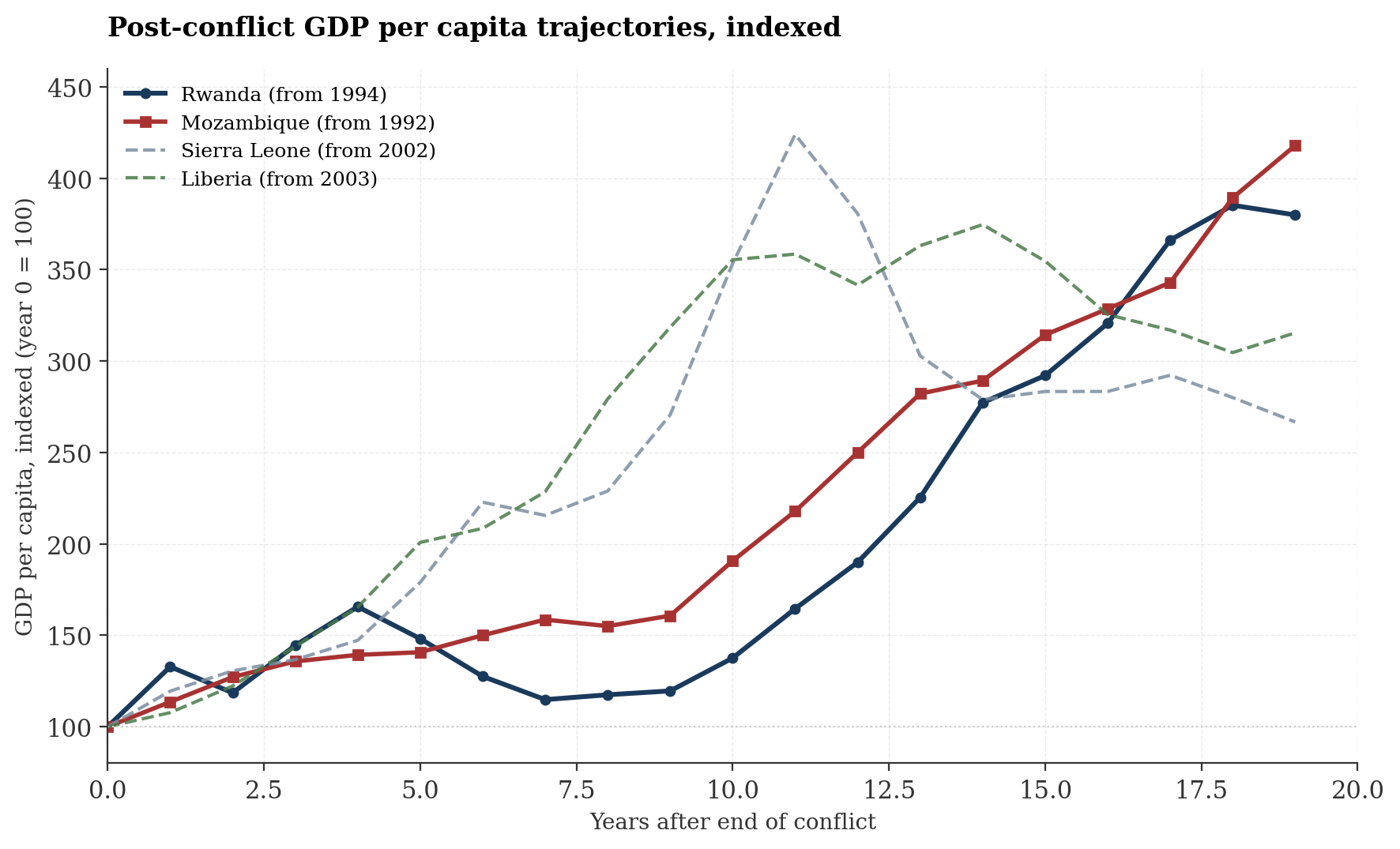
Figure 4: Post-conflict GDP per capita trajectories, indexed to year of conflict end = 100. Source: World Bank World Development Indicators.
The comparison that tests this proposition most rigorously holds the post-conflict starting condition constant and varies the institutional response. Four countries meet the relevant criteria. Mozambique signed the Rome General Peace Accords in October 1992, ending a sixteen-year civil war that had displaced approximately a third of its population. Sierra Leone's civil war ended in January 2002 after the disarmament of the Revolutionary United Front. Liberia's second civil war ended in August 2003 with the resignation of Charles Taylor. Each country emerged into a single dominant political faction capable of basic administrative continuity, each received substantial donor support, and each began with a destroyed civil service and an empty treasury. Rwanda's first decade of recovery, indexed to the conflict-end year, was the slowest of the four. Mozambique's GDP per capita reached approximately 60 per cent above its 1992 baseline by year ten; Rwanda reached the same threshold only at year twelve. Sierra Leone and Liberia recovered faster in absolute terms on the back of mineral booms and reconstruction-driven public investment, though their trajectories have been more volatile.
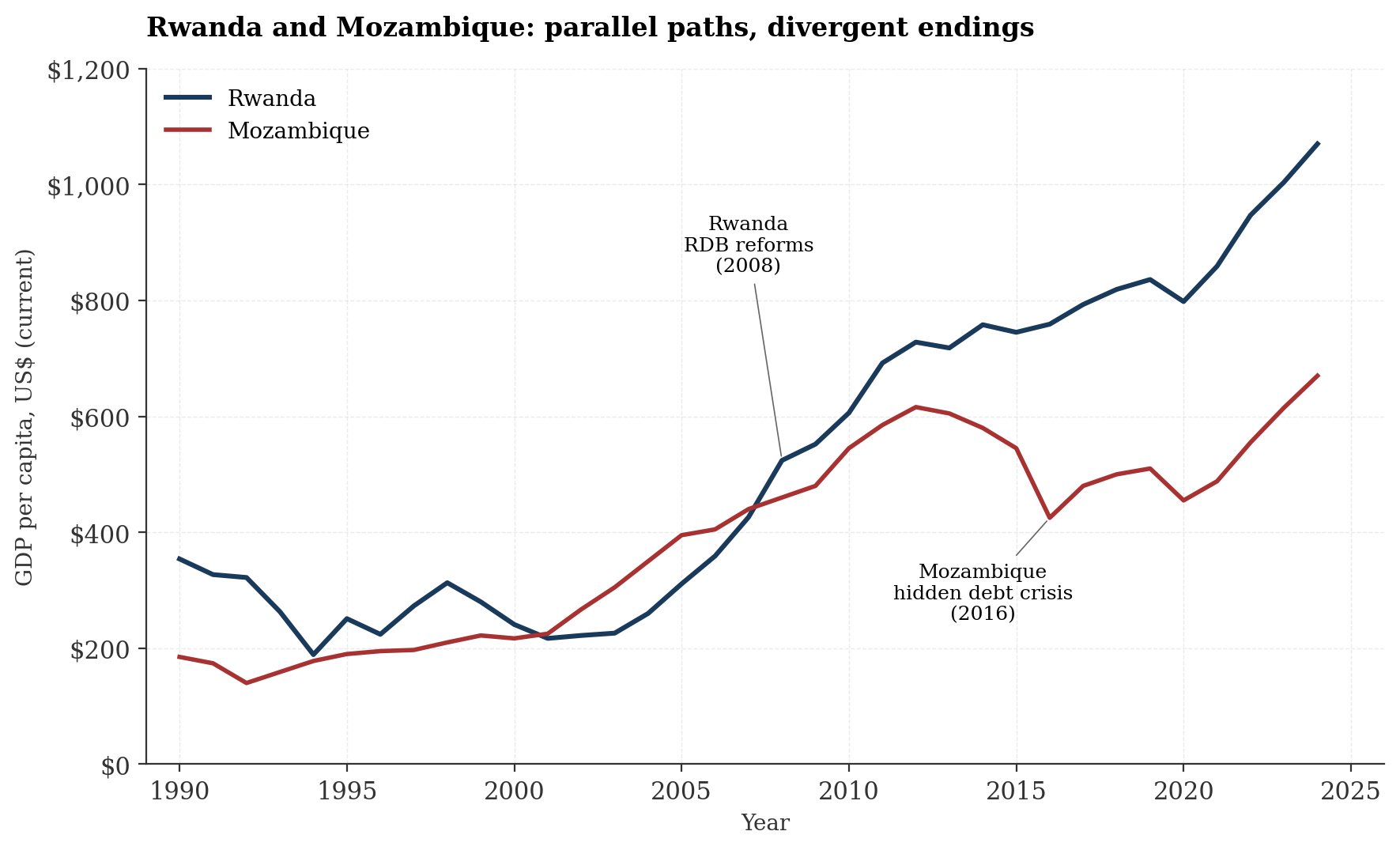
Figure 5: Rwanda and Mozambique GDP per capita, 1990–2024 (current US$). Source: World Bank.
Mozambique's structural endowment was, in several respects, superior to Rwanda's. The Port of Maputo and the Port of Beira provide deep-water access to global trade. Rwanda is landlocked and routes its exports through Mombasa or Dar es Salaam at significant cost. Mozambique has substantial natural gas reserves in the Rovuma Basin, agricultural land at several times the per capita figure for Rwanda, and a population three times larger. From 1993 to 2013, the Bretton Woods institutions described Mozambique in the same language later applied to Rwanda: a "donor darling", a model of post-conflict reconstruction, of structural adjustment done correctly. GDP grew at close to eight per cent annually for two decades, faster than Rwanda's first decade. The Independent Evaluation Group's retrospective assessment used the phrase "rising star" without irony. The 2016 revelation that the Mozambican government had taken on roughly $2 billion in sovereign-guaranteed debt outside official channels, undisclosed to parliament, the IMF, or existing creditors, broke the validation. The hidden borrowing was channelled through three state-linked companies (ProIndicus, EMATUM, and MAM), ostensibly established to finance maritime security and fishing operations. Investigations subsequently established that approximately $200 million had been paid in kickbacks to officials and to bankers at the arranging institutions. Credit Suisse pleaded guilty in 2021 and agreed to a $547 million coordinated global resolution. The former finance minister, Manuel Chang, was convicted in August 2024 and sentenced to 102 months’ imprisonment in January 2025. Mozambique defaulted on its sovereign bond in January 2017, the metical lost roughly 40 per cent of its value against the dollar within a year, and the country has not recovered the growth trajectory it had before the revelation. The institutional architecture that distinguished Rwanda from Mozambique after 2008 was invisible in the headline indicators that the validating institutions had been citing for either country.
The same pattern runs in reverse where the underlying mechanism operates against productive activity. Zimbabwe in 2000 was a functioning economy by African standards, with courts, a literate population, basic infrastructure, and an agricultural sector that had made the country the breadbasket of the region. The fast-track land reform programme initiated that year began with seizures of white-owned commercial farms, conducted through a process declared lawful by a judiciary operating under significant political pressure. Property rights, in any meaningful sense, ceased to exist. Private actor response was immediate and rational. Farmers stopped planting for harvests they might not collect. Foreign investment fled. GDP fell by more than 40 per cent over the following eight years. An economy that had fed its neighbours was importing food within a decade. By 2009, the country had abandoned its own currency. The mechanism is identical in both cases. The variable that changes is the enforceability of a claim.
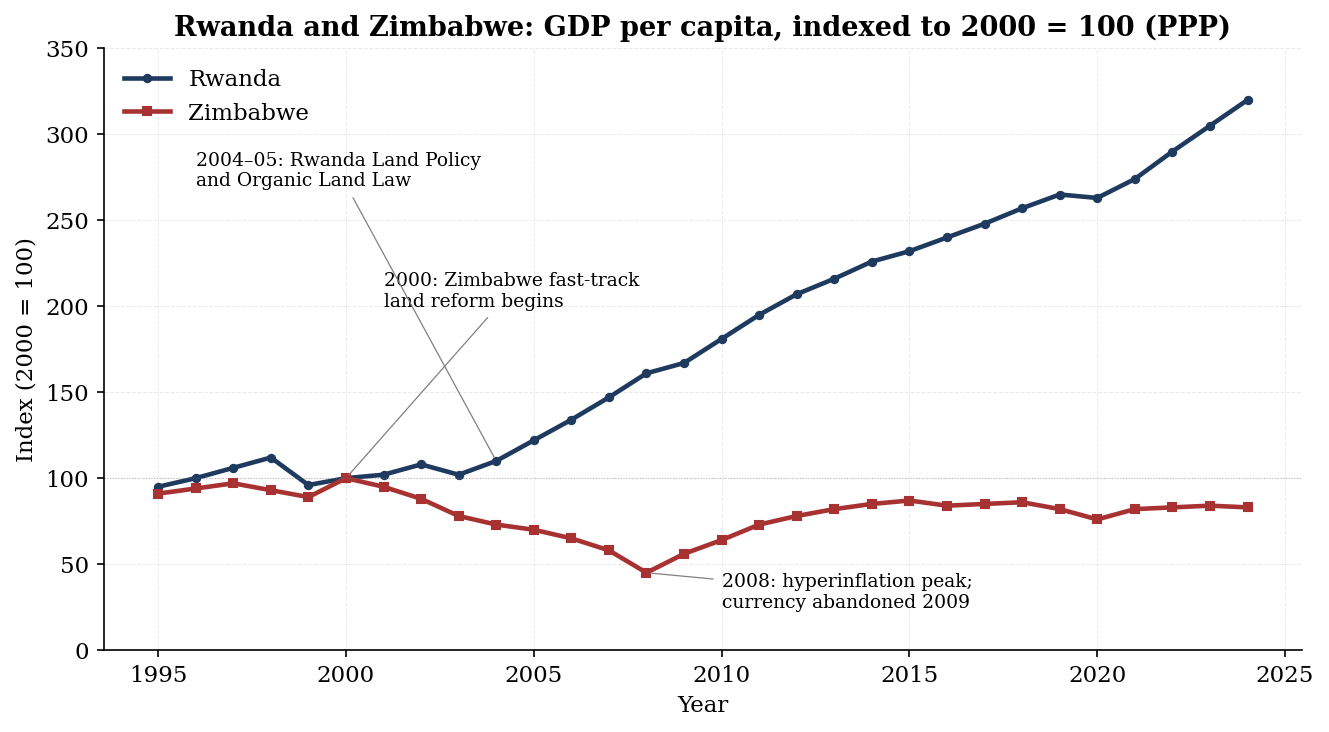
Figure 6: Rwanda and Zimbabwe, GDP per capita indexed to 2000 = 100 (PPP). Source: World Bank World Development Indicators.
The aid system has never seriously engaged with this comparison. Easterly (2001, 2006) spent years tracking where development assistance went; institutions appeared only at the margin of the policy conversation. Donors disburse because disbursement is how they justify their existence to their own governments. Institution-building is slow, invisible, and produces nothing that fits into an annual report. Aid flows toward what can be measured: schools built, clinics opened, roads paved. These things have value. They do nothing for the farmer who lacks legal title to his land, or for the foreign investor assessing whether regulatory commitments will hold. The variable that determines whether an economy grows is one that aid was not designed to supply.
Between Miracle and Mirage
A standard narrative about Rwanda has accumulated over the past two decades. The country was destroyed by the genocide against the Tutsi and rebuilt itself in a generation. Growth has averaged above seven per cent for most of the period. Corruption has fallen to levels comparable to Portugal and Italy on Transparency International's Corruption Perceptions Index. Maternal mortality and under-five mortality have fallen sharply. The IMF projects growth at 7.1 per cent in 2025 and 7.5 per cent in 2026. Bill Clinton, presenting the 2009 Clinton Global Citizen Award, called Paul Kagame "one of the greatest leaders of our time." Tony Blair has described Rwanda as "an inspiration." The figures are accurate.
The figures cover only part of the record. Himbara (2016), a former RPF official turned academic, characterises the miracle as an "economic mirage," with growth concentrated in an elite-connected sector that does not reach the rural majority. Freedom House rates Rwanda 21 out of 100 on its Freedom in the World index. The Wilson Center has questioned whether the developmental model can survive Kagame's departure. The New Lines Institute issued a 2024 assessment of stability and investment risks. The industrial base remains shallow. Most employment remains in low-productivity agriculture. The agricultural crop intensification programme studied by Ansoms and colleagues at the Université Catholique de Louvain (Cioffo et al., 2016) has documented displacement of smallholder food crops in favour of state-mandated cash crops, with welfare consequences for the rural poor that are invisible in aggregate growth statistics. Political repression suppresses the kind of open contestation that would air these critiques fully.
The pro-government counter-position has its own analytical content. Rugira (various), writing in The New Times and other Rwandan outlets, has argued that the international critique conflates the absence of European-style multi-party competition with the absence of governance, and that the genocide's institutional inheritance, a state that had organised mass killing through ordinary administrative channels, necessitated rebuilding the relationship between citizen and state from the ground up, with different sequencing than Western critics expect. The Institute of Policy Analysis and Research-Rwanda (IPAR), the principal domestic research body, has produced empirical work on land titling, agricultural productivity, and local government performance that supports the official record on land registration impact while raising independent concerns about the rural costs of the crop intensification programme. The pro-government scholarship is partial in the literal sense: it cannot, within Rwanda, openly contest the regime's political record. On the questions it does engage, its analytical content holds independently of that constraint.
The headline figures themselves have been disputed in scholarly literature on grounds an honest assessment must acknowledge. Reyntjens (2015), the Antwerp-based Rwanda specialist, conducted a reanalysis of the 2010–11 and 2013–14 Household Living Conditions Surveys (EICV3 and EICV4) and concluded that the official figure of a six percentage point fall in the poverty rate over that period was the result of methodological changes that, applied consistently, would have produced a six-point rise. Subsequent work by Desiere et al. (2016), and the broader scholarly debate involving Fatima and Yoshida (2018), has raised related questions about the inflation series and the agricultural production figures that drive the rural component of GDP. The statistical agencies producing those numbers, principally the National Institute of Statistics of Rwanda, remain organisationally part of the political apparatus whose record they are measuring. The basic finding that Rwanda's economy has grown substantially since 1995 stands. The magnitude is contested, and international validation has not engaged with the contestation.
A second qualification concerns external revenue. The UN Group of Experts on the Democratic Republic of the Congo, established under Security Council Resolution 1533, has produced annual reports since 2004 documenting cross-border flows of conflict minerals; the relevant reports include S/2022/479, S/2023/990, and S/2024/432. According to the UN Comtrade database, Rwanda in 2023 officially produced approximately 350 tonnes of tantalum but exported an estimated 715 tonnes, more than twice as much. The Group of Experts has concluded that the discrepancy corresponds to minerals extracted in eastern DRC and exported through Rwandan channels, with the M23 rebel group operating in North Kivu identified as the principal extraction-side actor. The ITSCI mineral tracing scheme, intended to certify conflict-free origins, has been repeatedly flagged as insufficient by independent monitors. Mineral exports account for roughly 32 per cent of Rwanda's goods exports, and the implied external mineral contribution to recorded GDP runs from three to six per cent depending on the year. The figure is material though it does not redraft the growth story. A portion of recorded earnings, and therefore of the GDP figures international observers have cited, originates in cross-border trade with the DRC, and this revenue stream operates independently of the success of domestic productivity reforms. The mechanism producing this outflow depends on an asymmetric military and logistical position that Rwanda holds relative to its neighbour, a position no other African state holds relative to any of its own neighbours; this component of the model is therefore unavailable for emulation whatever its other characteristics.
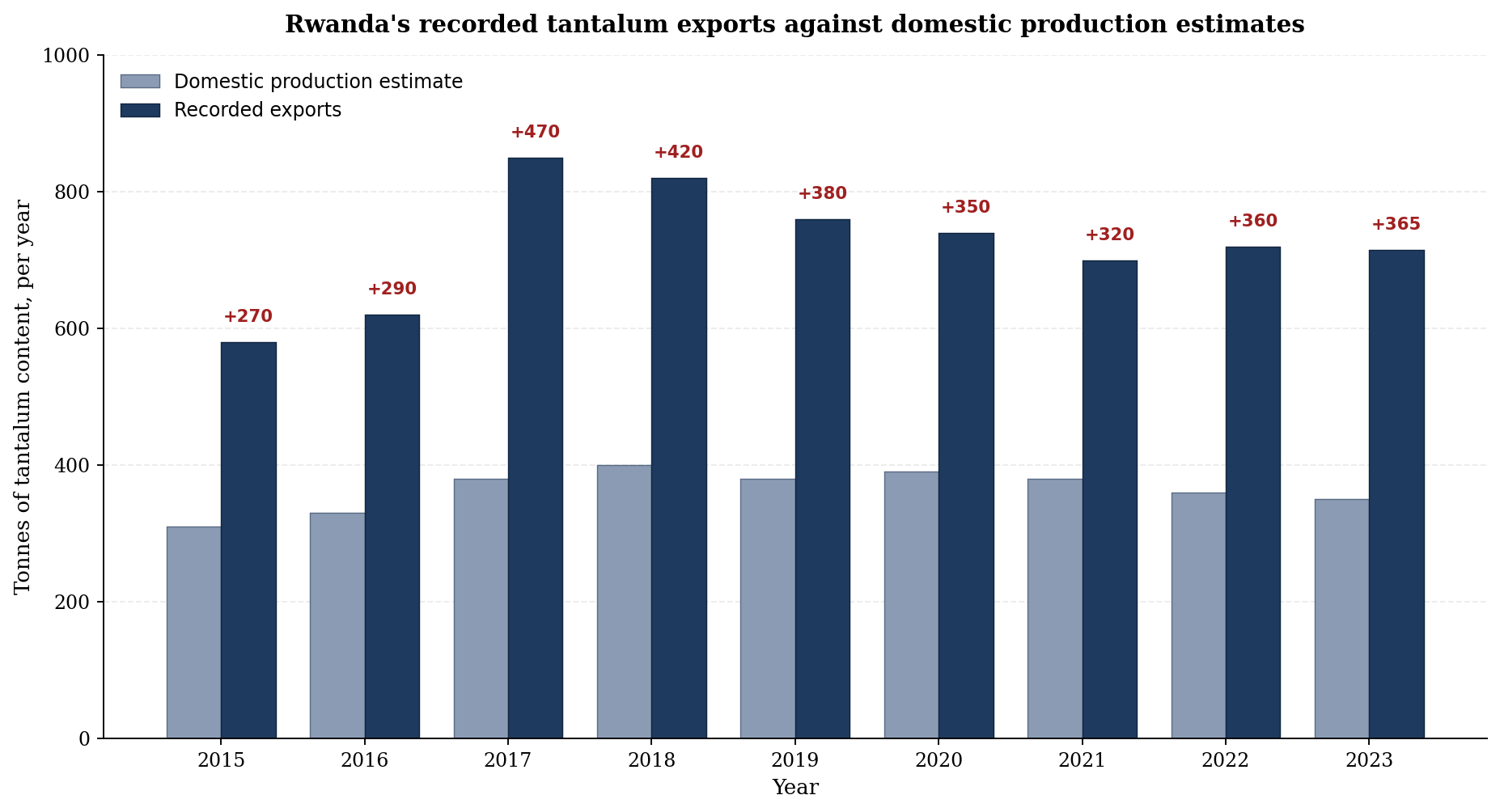
Figure 7: Rwanda's recorded tantalum exports against domestic production estimates, 2015–2023. Source: UN Comtrade database and Rwanda Mines, Petroleum and Gas Board.
The miracle and mirage readings share a common error. Each treats the Rwandan record as a single object on which to render a single judgement. The record runs through the three-layer structure introduced earlier, and the upper two layers do different work the readings conflate. The institutional interface has done genuine work, visible in the behavioural responses of farmers, lenders, and foreign investors. The political engine does different work, with different implications, and is partly insulated from the productivity of the reform agenda. The Mozambican experience indicates one form the cost of conflating interface and engine can take. The methodological mistake the validation infrastructure has been making, on Rwanda and elsewhere, is to read the interface and infer about the engine. The engine sustains the interface's political viability, and the interface produces the revenue and legitimacy the engine uses. They remain analytically separable, and the separation matters for every prediction the validation literature has been making.
The Comparison Rwanda's Critics Avoid
Critics of the Rwandan model are correct that political repression has accompanied the economic reforms. They tend to draw a stronger conclusion than that observation supports: that the reforms could not have been delivered without the repression, and therefore that any country without a comparable political configuration is unable to reproduce the institutional record. The argument is intuitive and testable, by examining cases in which the institutional capacity Rwanda has built was achieved under different political arrangements.
Three comparators occupy distinct positions in the relevant analytical space. The first is institutional capacity reached through sustained democratic competition. The second is comparable capacity reached and maintained under a durable single-party regime. The third is comparable capacity built under a single-party regime and then unwound when the political configuration shifted. The cases are Botswana, Vietnam, and Ethiopia.
Botswana has held continuous multi-party elections since independence in 1966. The Botswana Democratic Party governed for fifty-eight consecutive years before losing the October 2024 general election to the Umbrella for Democratic Change, led by Duma Boko, and conceding power peacefully, the first national-level democratic transition of its kind in Botswana's history. President Mokgweetsi Masisi delivered the concession speech within twenty-four hours of the result becoming clear. The judiciary is operationally independent. The press operates under legal protections that Freedom House classifies as broadly free. On the dimensions of state capacity Rwanda is praised for, Botswana ranks comparably: top quartile in the Worldwide Governance Indicators for government effectiveness, a Pula Fund sovereign wealth vehicle holding roughly $5 billion in counter-cyclical reserves, and a Debswana joint venture with De Beers structured on stable 50-50 ownership since 1969, with the 2023 sales agreement granting Botswana a larger share of direct diamond marketing. The Chandler Good Government Index score sits close to Rwanda's, achieved without the suppression of political contestation that Rwanda's record requires.
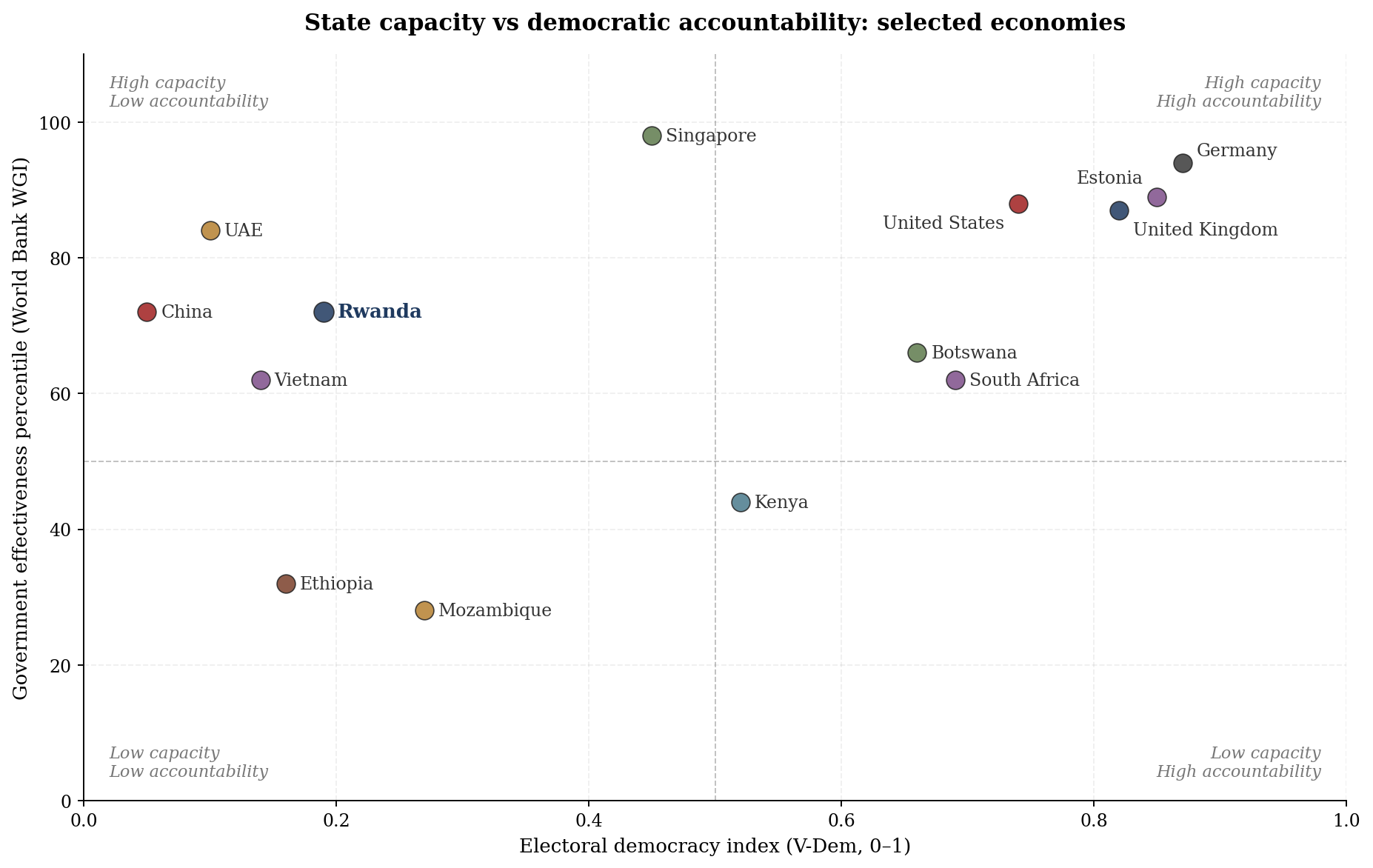
Figure 8: State capacity versus democratic accountability across selected developing economies. Source: V-Dem Institute and World Bank Worldwide Governance Indicators.
Vietnam occupies the second position. The Communist Party of Vietnam has maintained the developmental patrimonialist arrangement for nearly four decades since the Doi Moi reforms of 1986, with state-owned enterprises and party-linked commercial vehicles playing a role functionally similar to Crystal Ventures' role in Rwanda. Growth has averaged above six per cent since the late 1990s. The institutional interface is recognisably Smithian in many of its components. Vietnam has been admitted to the World Trade Organization, has been a signatory to the Trans-Pacific Partnership in its successor form, and has attracted high-quality manufacturing FDI from Samsung, Intel, and Apple's principal suppliers. The political engine remains, like Rwanda's, single-party, opaque, and sustained by a constituency that benefits from the arrangement's continuation. The Vietnamese case indicates that at intermediate scale the configuration is durable where the Communist Party of Vietnam maintains internal discipline, and on the available evidence more durable than the Ethiopian configuration was because that discipline has held. The conditionality matters and the later section returns to it: at the intermediate scale where neither the small-state coordination buffer nor the large-state inter-regional competition buffer is fully available, outcomes are contingent on coalition coherence in a way that does not apply at the scale extremes.
Ethiopia occupies the third position. The post-1991 EPRDF government, drawing on Meles Zenawi's developmental-state theorising, built an arrangement structurally similar to Rwanda's, with the Metals and Engineering Corporation (METEC), a military-owned conglomerate established in 2010 with more than ninety subsidiaries, playing a role roughly analogous to Crystal Ventures. The Ethiopian institutional interface progressed substantially through the 2000s. The political engine maintained itself for nearly three decades. In 2018, the post-Meles reform government opened a corruption investigation that indicted more than sixty senior officers and managers, with subsequent prosecutions and asset seizures continuing through 2020. Ethiopia defaulted on its sovereign debt in December 2023. The political configuration that had sustained the developmental-state arrangement could not survive the leadership succession from Meles to Hailemariam Desalegn to Abiy Ahmed. The arrangement did not.
The three comparators together generate a structured prediction. Botswana indicates that comparable institutional outcomes can be reached without the political costs Rwanda has accepted; Rwanda’s repression is therefore not the load-bearing variable in its institutional success. Vietnam indicates that the configuration can be medium-term durable where the party is sufficiently entrenched; Rwanda’s arrangement need not unwind on Kagame’s departure, provided the supporting coalition holds. Ethiopia indicates the failure mode: where the political coalition fractures, the institutional interface erodes with it. Rwanda’s durability turns on whether the supporting coalition is more or less concentrated than Ethiopia’s was. The argument that “the rules are the engine and authoritarianism is the chassis”, typically advanced with reference to Park Chung-hee’s South Korea, holds more weight when made with these three cases. Park’s Korea had structural advantages (an external security guarantee, privileged capital market access through Japan, a particular Cold War geopolitical position) that confound the comparison. The three African and Asian comparators do not carry comparable confounds. Rwanda’s outcome depends on a specific set of conditions, none of which reduce to the presence or absence of multi-party democracy.
China occupies the same quadrant as Rwanda on the state-capacity versus democratic-accountability map, with comparable blank-slate-creating events in the Boxer Rebellion and the late Qing reforms it precipitated, the conclusion of the Chinese Civil War in 1949, and the Cultural Revolution. The structural parallels run deeper than the surface placement. Both states maintain a party-linked commercial conglomerate complex, Crystal Ventures and its subsidiaries on the Rwandan side and the central state-owned enterprises and regional princeling-linked vehicles on the Chinese side, whose preferential access to procurement and capital operates as a discreet substitute for the formal stake the party retains in the economy. Both ground their legitimacy in performance against developmental targets rather than in electoral accountability, with the party-state’s continuation contingent on growth at rates that pure private capital and unmanaged market processes would not reliably deliver. Both constructed their property-rights regimes rather than inheriting them through gradual customary evolution: China’s post-1978 reforms wrote new property law against a backdrop in which Maoist collectivisation had eliminated the prior regime, and Rwanda’s post-2004 land titling created a formal registry-based system where prior customary arrangements had operated without legal documentation. Both rely on an ethnic-political alignment that the scholarly literature has documented but the official discourse has reframed, though the magnitudes differ by an order of magnitude. Han are approximately 91 per cent of the Chinese population and approach 100 per cent of the Politburo Standing Committee, a disproportion in the upper Chinese party apparatus of single-digit percentage points. The returnee Tutsi subset is a small share of the Rwandan population and a majority of the senior political and military leadership, a disproportion in the RPF leadership cohort of roughly forty to fifty percentage points. Both alignments are publicly framed through universalist nationalism. The structural mechanism is the same; the intensity is not. The Rwandan case operates at the magnitude where ethnic-political coalition is the central organising feature of the regime; the Chinese case operates at the magnitude where it is one structural feature among several. The parallel holds at the level of mechanism and breaks at the level of weight, and serious comparison has to keep both facts in view. The abstract logic of developmental patrimonialism operates across the parallels.
The differences are larger than scale. China’s blank-slate events were programmes of political construction, deliberate attempts to remake the institutional order from above; Rwanda’s 1994 reconstruction operated under the constraint of preventing recurrence, which produces narrower but more defensible commitments. China inherited a two-thousand-year bureaucratic tradition and a sequence of administrative apparatuses (imperial, Republican, Communist) that Rwanda’s Belgian colonial inheritance does not approach. The Chinese developmental model relies on inter-regional institutional competition, with the Special Economic Zone framework from the 1980 Shenzhen designation onwards generating differentiated regulatory environments and provincial cadre promotion linked to growth performance; the scale that makes this possible is itself a productive instrument that small unitary states cannot reproduce. The 1978 reforms operated on a fully state-owned economy and proceeded through partial liberalisation, while the post-1994 Rwandan trajectory operated on an economy without a significant private sector and proceeded through construction of formal institutions where customary alternatives had collapsed. The starting topologies differ in kind, and the resulting institutional configurations differ in kind with them. A further confound operates at the external-geopolitical level. China’s post-1978 reform path was enabled by the US-China rapprochement of 1972 to 1979, which opened Western capital, technology, and product markets to Chinese exports at scale; the trajectory depended on a specific Cold War geopolitical configuration that no other developmental authoritarian state has been offered on the same terms. The same kind of structural confound that excluded South Korea from the earlier comparator set applies in modified form to China. Rwanda’s external position involves no comparable geopolitical advantage; its post-1994 access to Western capital came through development finance institutions and bond markets on standard terms available to any sovereign of comparable credit quality.
The Rwanda-China comparison points to a pattern the three-comparator analysis does not capture. Developmental patrimonialism operates through different supporting mechanisms at different scales. The small unitary state with high administrative density supports the model through direct coordination intensity: monitoring costs at the centre are low enough that the leadership can observe and intervene at the commercial-political interface without intermediating institutions. The very large state supports the model through inter-regional competition: differentiated subnational regulatory environments and performance-linked cadre promotion deliver discipline without direct central monitoring. The intermediate scale, exemplified by Vietnam, Ethiopia under the EPRDF, Mozambique under FRELIMO, and Indonesia under Suharto, operates with neither buffer fully available. Outcomes at this scale become contingent on continued political coherence to an extent that does not apply at the extremes. Vietnam has sustained the arrangement under the Communist Party of Vietnam’s continued discipline. Ethiopia’s METEC collapsed when the EPRDF coalition fractured after Meles Zenawi’s death. Mozambique’s FRELIMO produced the 2016 hidden-debt scandal during a period of internal factional instability. Indonesia’s Suharto-era arrangement unwound through the 1997-98 Asian financial crisis when the leadership’s capacity to maintain coherence was undermined by external shock. The intermediate range predicts variance in outcomes: success when coalition coherence holds, failure when it fractures. The structural buffers operating at the scale extremes are unavailable as compensation.
The abstract logic shared by both cases generates a further prediction. The commitment-device function of party-state commercial vehicles is time-bounded, diminishing as the institutional interface matures and absorbs the coordinating role originally performed by direct party-state ownership. Crystal Ventures’ commitment-device function has been displaced in Rwanda since roughly 2010, and the observed response has been continued expansion of its commercial footprint. The same logic applies in China. State-owned enterprises and party-linked vehicles were indispensable through the period in which the formal institutional interface (commercial courts, property law, foreign-investor protections) was being constructed. By the 2010s the interface had matured to the point where its absorption of the commitment-device function should have been visible. The observed response since 2012 has run in the same direction as Rwanda’s: SOEs have expanded relative to the private sector, Party committees have been re-embedded into private firms above a certain size, and the regulatory environment for foreign capital has tightened. The mechanism is the constituency Smith analyses in Book V. An institutional arrangement established for one purpose accumulates beneficiaries whose interests bind it to a different purpose, its own continuation, and the same dynamic operates whether the constituency is Crystal Ventures’ scale or the Chinese central SOE complex. The time-boundedness of the commitment-device function and the durability of the entrenchment that succeeds it appear at both scales.
The Load-Bearing Question
Paul Kagame won the 2024 presidential election with 99.18 per cent of the recorded vote. The figure requires no interpretive gloss. Opposition parties operate within boundaries set by the RPF, with the Democratic Green Party, the PS Imberakuri, and Diane Rwigara's blocked independent candidacy in 2017 the most visible cases of permitted-but-constrained opposition. Independent media occupies a space that is, for practical purposes, negligible. The statutory offence of generating "hostile international opinion" is regularly used against journalists and domestic critics. Human Rights Watch has documented a systematic campaign of surveillance, intimidation, and violence directed at Rwandan dissidents abroad, including killings and enforced disappearances. Patrick Karegeya, Rwanda's former intelligence chief and a vocal Kagame critic, was found strangled in a Johannesburg hotel room in January 2014. Kagame did not acknowledge state involvement, though he stated publicly that traitors receive what they deserve. The political costs are real, and a complete reading of the Rwandan record cannot evade them.
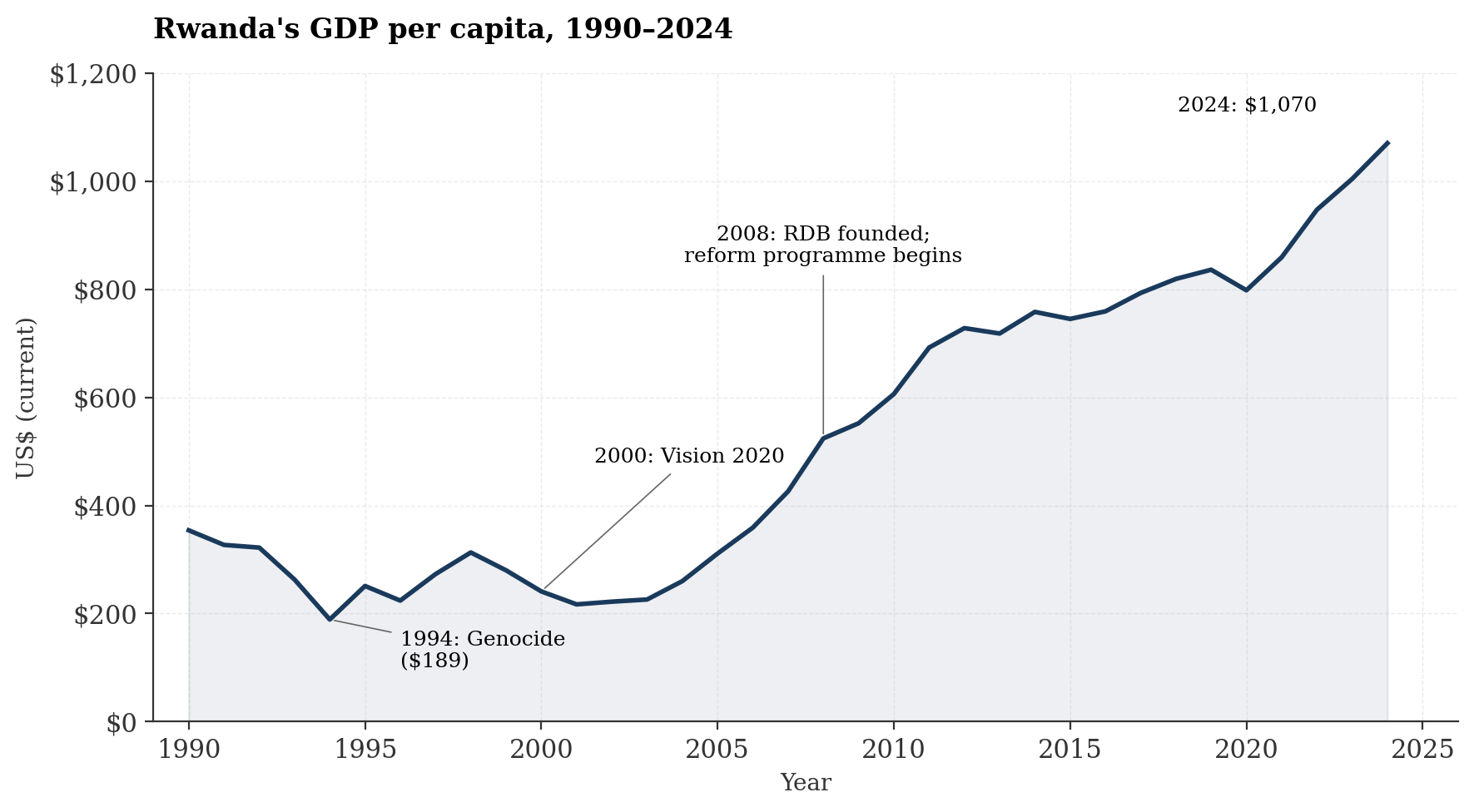
Figure 9: Rwanda's GDP per capita, 1990–2024 (current US$). Source: World Bank World Development Indicators.
The succession question is conventionally framed in personal terms. Kagame is 68. Rwanda has no established mechanism for the transfer of power outside the RPF. On the personalist reading, the architecture of state capacity is the current expression of one individual's political will, maintained because that individual wishes it to be maintained. If he goes and the rules hold, the model survives. If he goes and the rules collapse, the mirage critique looks prescient.
The structural reading produces a different prediction and a more accurate one. The arrangement has produced its own political constituency, and that constituency outlasts the personalities at the top. Four components together explain its durability.
The first is an aligned domestic constituency, broader and more deeply embedded than the conventional party-state account allows. Crystal Ventures' direct employees, in the tens of thousands, sit at the centre of a downstream contractor network of further tens of thousands whose livelihoods depend on the continuation of preferential procurement. The military-linked Horizon Group, which controls construction, logistics, and increasingly mining operations, and the Rwanda Investment Group, hold positions that entangle senior officers' pension entitlements with the same network. The Rwanda Social Security Board, consolidating earlier civil service and military pension funds, has become a frequent co-investor with Crystal Ventures in joint ventures in real estate, agro-processing, and infrastructure, blurring the formal distinction between state pension funds and party-linked capital. The constituency that would lose materially from any structural reform extends through the formal public sector, the formal pension system, the construction and security sectors, and the senior officer corps. The total cannot be precisely fixed; the order of magnitude runs to hundreds of thousands of working adults.
The second is external revenue insulated from the productivity of the reform agenda. The mineral export pattern documented earlier is the principal channel. The implied external mineral contribution of three to six per cent of GDP is, by itself, too small to change the country's trajectory. Its analytical significance lies elsewhere: it is a revenue stream available to the regime regardless of how the domestic reform agenda performs. In a counterfactual in which the agricultural and manufacturing reforms slowed or reversed, the cross-border mineral revenue would continue. That asymmetry breaks the standard discipline mechanism by which productivity disappointment feeds back into political pressure for further reform. The Ethiopian arrangement lacked a comparable insulating revenue stream, and the discipline mechanism therefore operated when the productivity returns disappointed.
The third is a statistical apparatus organisationally embedded in the political system. The disagreements identified by Reyntjens (2015), Desiere et al. (2016) and Fatima and Yoshida (2018) earlier reflect, on the available evidence, not fraud but an institutional configuration in which the agency producing the headline numbers, the National Institute of Statistics of Rwanda, sits within the political machinery whose record those numbers measure, with senior personnel appointed on the same political cycle as the cabinet. Independent research by IPAR on land titling and local government performance has supported the official record where the official record is internally verifiable through direct survey. The contested aggregates depend on methodological choices upstream of any survey: poverty rate, inflation, sectoral GDP. Each validation cycle that draws on the headline aggregates reinforces the institutional position of the agency producing them, and reduces the political space for independent reassessment. The arrangement self-strengthens with use.
The fourth is external financing through dispersed commercial channels. Net official development assistance, which approached the country's entire gross national income in 1994, has fallen to around ten per cent. The fall in aid dependence has been accompanied by a rise in commercial financing, including sovereign bond issuance, IMF programme borrowing, and concessional loans from the EXIM banks of Asian creditors. China Development Bank, the Export-Import Bank of China, and the Export-Import Bank of India together account for an increasing share of long-term external borrowing, with construction contracts often bundled with the financing. The 2021 Eurobond, a $620 million ten-year issuance, was priced at 5.5 per cent and oversubscribed by a factor of seven, with the order book dominated by European and US institutional investors. The new channels involve dispersed bondholders and Article IV review cycles in place of a small number of donor capitals making coordinated decisions; they are, on the available evidence, harder to interrupt than budget support was. The 2012 suspension of budget support by the United Kingdom, the Netherlands, and others, following the UN Group of Experts allegations about Rwandan support for M23, illustrates the point. The fiscal shock was real. The institutional architecture held. Rwanda's response was to accelerate domestic revenue collection, with no parallel attempt to negotiate for restoration of aid flows. The episode revealed what the aid relationship had previously obscured: Rwanda had been building a state that could function without aid, while using aid to grow faster.
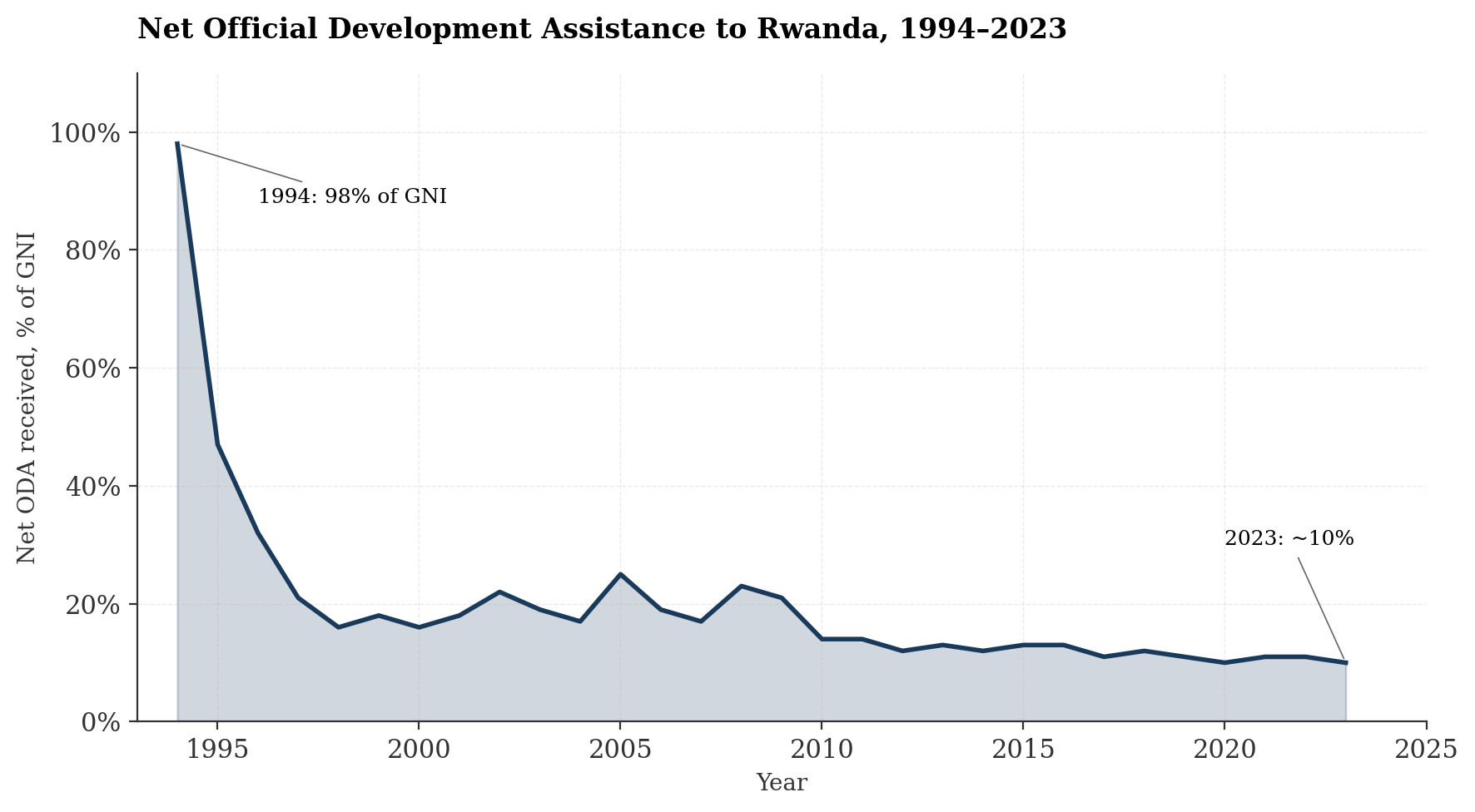
Figure 10: Net official development assistance to Rwanda as percentage of gross national income, 1994–2023. Source: World Bank World Development Indicators.
The four components are independent but not separable. Each, taken alone, would be insufficient to make the arrangement durable across a leadership transition. Each, taken in combination with the others, raises the political and economic cost of any reform attempt by a different group of senior actors. No single faction within the post-Kagame configuration has a clear interest in initiating reform. The Ethiopian METEC case is the cautionary comparison. A structurally similar arrangement did unwind when the political configuration shifted; the Ethiopian arrangement lacked the insulating revenue, the deep pension-fund integration, and the dispersed commercial financing structure that Rwanda has built. The Ethiopian transition was costly for the political leadership and the senior military officers immediately associated with METEC. The broader civil service and the pension entitlements of officers below the most senior ranks were not similarly exposed. The Rwandan arrangement has constructed costs at every level. The succession question, properly framed, is therefore whether the constituency the model has built will permit a successor to choose otherwise. The structural answer is that it will not. The institutions Rwanda has built will continue to serve the political settlement that built them, and will continue to do so after the personalities who built them have gone.
What Britain Cannot See in Itself
The three-layer analysis of Rwanda developed in the preceding sections yields different lessons for different audiences. For governments considering whether to underwrite Rwanda as an investment destination, the institutional fundamentals are real and the political risk is concentrated in the durability of a settlement that has already produced its own support coalition. For development institutions, the validation infrastructure has been wrong about Rwanda in both directions and has not built the analytical apparatus that would have allowed it to be right. For a British audience, the implications run in a different direction altogether, and they turn on a mechanism Smith identified in the same Book V passage that opens this essay.
Smith's analysis of public institutions in Book V argues that any state apparatus, once established, accumulates constituencies whose private interests bind it to its continuation. The argument is offered as a description, and Smith's principal examples concern the eighteenth-century military and ecclesiastical establishments. The mechanism is general. In Rwanda, the party-state commercial complex established in 1995 has accumulated a constituency that now makes it structurally durable, even where its founding rationale no longer applies. Crystal Ventures' employees, the pension funds entangled with party capital, the military officers with construction-sector retirement positions, the statistical apparatus reinforced by each validation cycle: these are constituencies, in Smith's specific sense, whose existence binds the arrangement to its continuation. The same mechanism, applied to a different political configuration, can run in the opposite direction. Where the constituencies organise politically around the short-term rewriting of rules, and where long-term enforcement has no comparable advocate, institutional erosion follows the same logic that produced the Rwandan durability. This is the British case.
Britain occupies the inverse position from Rwanda. The country enjoys political freedom in abundance, and is quietly eroding the economic kind. The mechanism Rwanda built across three decades is the mechanism Britain inherited across several centuries. Rwanda is preserving its institutional inheritance; Britain is consuming its own. The constituencies that depend on the continued integrity of the British inheritance are diffuse, unorganised, and politically silent. The constituencies that benefit from short-cycle rewriting are concentrated and politically active. Each electoral cycle in which the rules can be rewritten produces beneficiaries whose interests bind them to the rewriting; each rewriting reduces the political weight of the constituencies that depended on the rule. The mechanism is symmetrical with the Rwandan one. The vector runs the opposite way. The Rwandan coalition has an interest in preserving rules. The British coalition has an interest in rewriting them.
The inverse position runs through all three layers of the structure introduced at the outset, and each layer has eroded through specific traceable mechanisms rather than through general decline.
The British normative substrate, the public norm treating long-term commitments as binding on successor governments, has been eroded across decades through specific, traceable mechanisms. The convention that an incoming administration honours the commercial and regulatory commitments of its predecessor, once treated as constitutional infrastructure operating below political contestation, has been progressively reclassified as itself a matter of political preference. The 2017 Conservative manifesto’s social care provision was abandoned within weeks under political pressure. The commitment to maintain foreign aid at 0.7 per cent of gross national income, written into legislation in 2015 and repeated in the 2019 manifesto, was reversed in 2020. The 2024 Conservative manifesto’s National Insurance position was contradicted in the same election cycle by departmental planning, and the 2024 Labour manifesto’s pledge not to raise taxes on working people was reinterpreted in the October Budget through the employer National Insurance increase. Each reversal was individually defensible in its political context. Their cumulative effect on the norm has been to make commitment durability a contested rather than infrastructural feature of British government. The senior civil service, which historically supplied the institutional memory enforcing inter-administration continuity, has been progressively reshaped through the 1980s public-sector reforms and the post-2010 expansion of special-adviser networks; the locus of policy authority has shifted from departmental knowledge to ministerial discretion, with the consequence that the technical case for honouring prior commitments now has weaker institutional voice than the political case for revising them.
The British institutional interface—the architecture of contracts, planning regimes, fiscal commitments, and regulatory predictability through which long-term investment is operationally executed—has been progressively reshaped into a discretionary apparatus. The planning regime, structured by the Town and Country Planning Act 1947 around individual application determination, treats each consent as a discrete political decision rather than a rule-based entitlement; the absence of by-right development is the absence of a Smithian institutional interface for property-secured construction investment, and is the structural reason London planning permission times have moved from 167 days to 616 days within a single decade. The fiscal rules governing public investment have been redefined by every Chancellor since 2010, from Osborne’s fiscal mandate through Hammond’s adjustments, Sunak’s pandemic-era suspension, Hunt’s restoration, and Reeves’ 2024 redefinition, with the consequence that any commitment dependent on a specific fiscal framework is exposed to redrafting in each Parliament. The Retained EU Law (Revocation and Reform) Act 2023 introduced bulk legal uncertainty into thousands of regulations that had previously supplied the predictability backbone for cross-border commerce and infrastructure investment. The Energy Profits Levy’s five revisions in three years, the inheritance tax reliefs revised in 2024 after decades during which agricultural families had been advised by successive governments to rely on them, and the recurring business rates reforms whose frequency has itself become a source of planning uncertainty for retailers and small businesses, each illustrates the same pattern. The interface that exists is functional for short-cycle adjustment and dysfunctional for long-cycle commitment, and the functionality difference is the result of cumulative discretionary insertions into what were once rules-based regimes.
The British political engine, the constituency that would enforce rule continuity against short-cycle capture, has dispersed. The actors with the strongest material interest in stable rules (long-cycle private investors, pension savers planning over forty years, infrastructure operators committing capital across multiple parliaments, smaller landowners and businesses depending on the durability of property and contract) are structurally diffuse and politically silent at the aggregate level; their interest in rule continuity is too generalised to mobilise organisation. Pension fund beneficiaries respond to specific changes affecting their entitlements but do not organise around the meta-principle of inter-administration continuity. Property owners are organised locally against specific developments through the planning system but not at the level of general rule durability. Trade associations focus on the regulatory questions in their sector rather than the cross-sectoral question of whether rules outlast administrations. Each rewriting, by contrast, produces concentrated beneficiaries—the consultancies that prepare applications under the new regime, the tax advisers helping clients restructure around the new rules, the legal practices on each side of each change—whose interest in further rewriting is politically organised and continuously voiced. The asymmetry between dispersed defenders of rule continuity and concentrated beneficiaries of rule revision is structurally identical to the Rwandan one but vectored in the opposite direction. The Rwandan constituency that benefits materially from the institutional arrangement’s continuation has the political weight to defend it. The British constituency that benefits materially from rule continuity does not.
The three failures reinforce each other. The substrate’s erosion makes the rewriting publicly acceptable. The interface’s discretion makes the rewriting operationally feasible. The engine’s absence makes the rewriting politically unopposed. Rwanda’s record is what running the same three layers in the opposite direction looks like over thirty years.
The North Sea is the clearest illustration. Since May 2022, the Energy Profits Levy has been raised, extended, and restructured on five separate occasions under two successive governments. The effective rate now stands at 78 per cent. Shell announced a review of investment plans valued at £25 billion. Harbour Energy curtailed its UK operations and announced job reductions affecting approximately 350 staff. Nine out of ten North Sea operators in Offshore Energies UK's 2024 survey reported reducing capital expenditure plans. The substance lies less in the rate than in the signal that the rules governing long-term investment in Britain can be rewritten at any point, by any government, with no institutional accountability for the gap between what was promised and what was delivered. Each rate change builds its own beneficiary coalition whose continuation depends on further changes, while the operators whose investment horizons were premised on the original commitment have no comparable political channel.
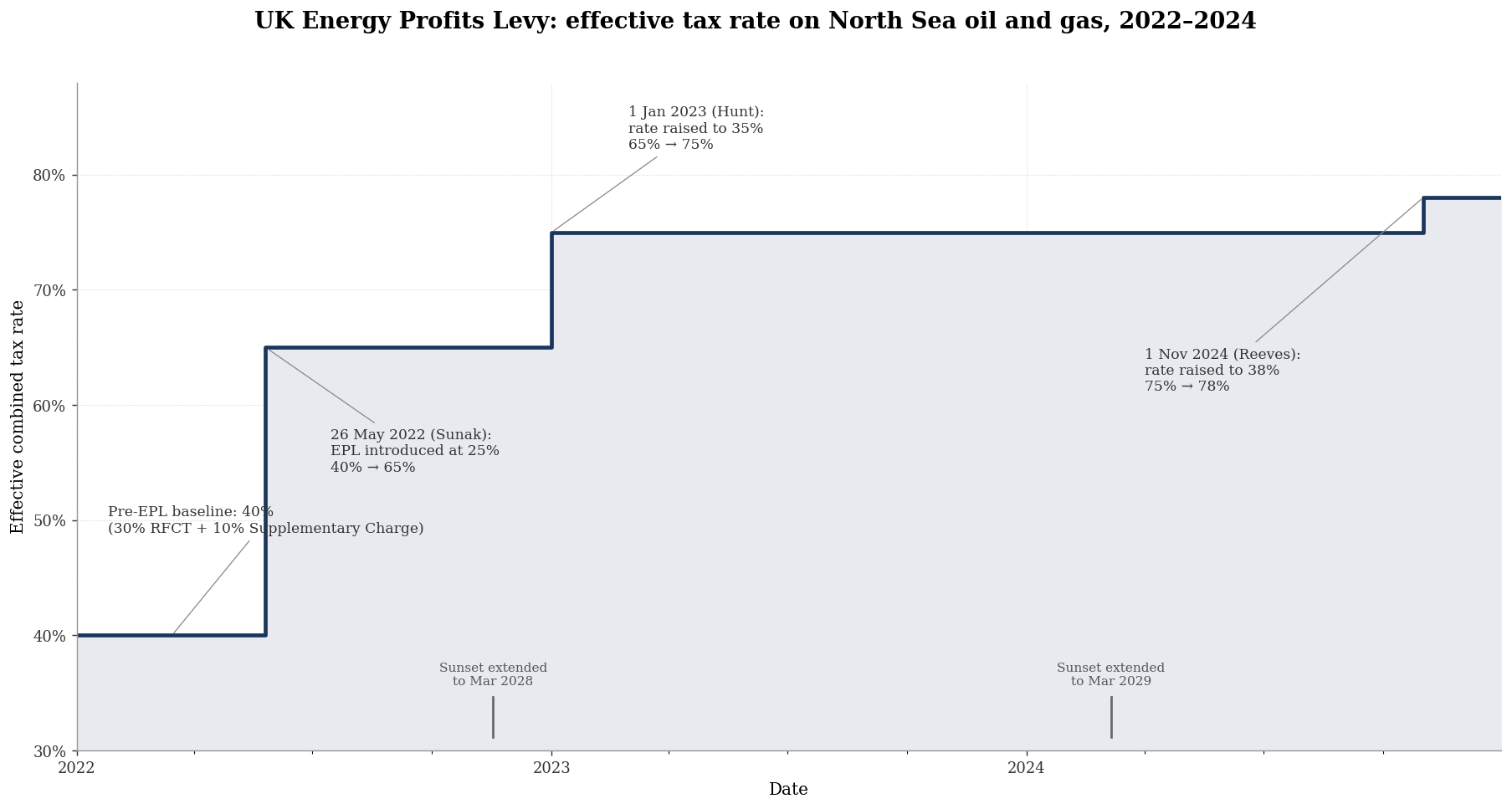
Figure 11: UK Energy Profits Levy effective tax rate on North Sea oil and gas production, 2022–2024. Three rate changes plus two sunset clause extensions across two successive governments. Sources: HM Treasury Cost of Living Support Statement May 2022, Autumn Statement November 2022, Spring Budget March 2024, Autumn Budget October 2024.
Housing makes the same point with less drama. The government's stated target is 370,000 new dwellings annually. In 2023 to 2024, approximately 200,000 were built. England's planning regime is discretionary: each application is determined on its individual merits, and owning land tells you nothing about what you are permitted to build on it. In London, the average time to receive planning permission reached 616 days in 2024, compared with 167 days in 2011. The title deed that transformed the incentive calculations of a Rwandan smallholder cost six dollars. Achieving equivalent certainty in Britain requires years of process and cannot be assured as an outcome. Major infrastructure projects fare worse: the Development Consent Order process under the Planning Act 2008 now averages approximately 1,500 days from application to decision, with the Sizewell C nuclear project taking over four years for a single consent stage. The constituency that benefits from each discretionary decision being made on its individual merits is concentrated in the planning authorities, the consultancies that prepare applications, and the political actors who can credibly intervene on either side of an individual case. The constituency that would benefit from a rules-based regime is the future occupants of homes that have not yet been built and cannot yet be politically organised.
The same pattern runs through pensions policy, infrastructure procurement, and business regulation. The pension triple lock has been protected, modified, suspended, and reinstated across three governments. HS2 illustrates the pattern at its most expensive: the eastern leg to Leeds was cancelled in November 2021, the Birmingham-to-Crewe northern phase was cancelled in October 2023, and the project's total cost rose from an initial estimate of £33 billion in 2010 to in excess of £100 billion at the point of partial cancellation. Business rates have been reformed so many times that the reform process itself has become a source of uncertainty for retailers and small businesses planning lease commitments. The 2024 Autumn Budget's adjustments to inheritance tax on agricultural property, capping full Agricultural Property Relief at £1 million, prompted organised protests in central London in November 2024, with the National Farmers' Union initially estimating that the changes would affect approximately 70,000 working farms; in December 2025 the same Labour government raised the threshold to £2.5 million following sustained pressure, reducing the projected number of affected estates by roughly half. The episode demonstrates the rule-rewriting pattern in compressed form: an established expectation on which farming families had been advised to rely for decades was revised in October 2024 and partially re-revised by the same administration fourteen months later. Each episode is individually explicable. Taken together they describe a system in which the rules that govern long-term investment are treated as instruments of short-term political management, and in which no actor is held accountable for the cumulative cost of that approach.
The lesson the Rwandan case offers a British audience is methodological. Classical liberal institutions are not self-maintaining. They survive where the political coalition with most to gain from their preservation is concentrated enough to defend them, and they erode where the coalition with most to gain from their rewriting is concentrated enough to capture them. Rwanda's record indicates that a regime under existential pressure can construct the institutional interface where one did not previously exist, when the political constituencies have not yet formed, and that the same regime can subsequently allow a political engine to accumulate beside the interface that may, in due course, capture it. Britain's record indicates that a regime in possession of a mature institutional inheritance can permit the accumulation of short-cycle constituencies that erode the inheritance, and that the erosion is consistent with each cycle's local rationality. Rwanda constructed its rules under conditions where institutional failure meant the end of everything. Britain is eroding its rules under conditions of margin sufficient to defer the consequences. The margin that accounts for Britain's wealth is the same margin that underwrites its complacency.
When Labour cancelled the Rwanda scheme in July 2024, the announcement took about four minutes in the Commons. The Home Secretary said it had cost £700 million and sent four volunteers. The right said the scheme had been a necessary deterrent undermined by the courts. The left said it had been a moral disgrace from the start. The legal question had been answered. Parliament had legislated. Three years of litigation had produced a conclusion: the scheme was over. Westminster never produced a different question. The other version of safe, the one investors had been answering with real money the entire time, was never put to Parliament. It was never litigated, and it was never reported in the parliamentary record.
On the evening of 14 June 2022, a Boeing 767 sat on a runway in Wiltshire while ministers and lawyers argued about what Rwanda was. Somewhere in Rwanda that same evening, a smallholder was looking at a piece of paper that told him, for the first time, that the land he had worked for twenty years was his. The plane never went anywhere. The paper changed something real for him. It changed nothing for the journalist trying to ask questions about its origin, or for the political organiser trying to register an opposing party in 2024. Both things happened. Both are visible in the same institutional record. Westminster's three years on Rwanda revealed little useful about Rwanda. They revealed that the country which once took its institutional inheritance most seriously has stopped being able to read it, even when the evidence sits on a runway in Wiltshire and on a hillside in Rwanda on the same evening of the same day. Smith offered the observation in the epigraph above in 1776, as a description of an institutional achievement Britain had only recently completed. Two and a half centuries later, the achievement is being consumed by a generation that has stopped recognising what it inherited. The first task, before any policy follows, is to remember.
Bibliography
Ali, D.A., Deininger, K. and Goldstein, M. (2014) ‘Environmental and gender impacts of land tenure regularization in Africa: Pilot evidence from Rwanda’, Journal of Development Economics, 110, pp. 262–275.
Ansoms, A. (2009) ‘Re-engineering rural society: The visions and ambitions of the Rwandan elite’, African Affairs, 108(431), pp. 289–309.
Bauer, M., Cassar, A., Chytilová, J. and Henrich, J. (2014) ‘War’s enduring effects on the development of egalitarian motivations and in-group biases’, Psychological Science, 25(1), pp. 47–57.
Behuria, P. (2015) ‘Between party capitalism and market reforms – Understanding sector differences in Rwanda’, Journal of Modern African Studies, 53(3), pp. 415–450.
Behuria, P. (2018) ‘Examining effectiveness and learning in Rwandan policymaking: The varied outcomes of learning from failure in productive sector policies’, Journal of International Development, 30(6), pp. 1023–1043.
Booth, D. and Golooba-Mutebi, F. (2012) ‘Developmental patrimonialism? The case of Rwanda’, African Affairs, 111(444), pp. 379–403.
Chakravarty, A. (2015) Investing in Authoritarian Rule: Punishment and Patronage in Rwanda’s Gacaca Courts for Genocide Crimes. Cambridge: Cambridge University Press.
Cioffo, G.D., Ansoms, A. and Murison, J. (2016) ‘Modernising agriculture through a "new" Green Revolution: The limits of the Crop Intensification Programme in Rwanda’, Review of African Political Economy, 43(148), pp. 277–293.
Clark, P. (2010) The Gacaca Courts, Post-Genocide Justice and Reconciliation in Rwanda: Justice without Lawyers. Cambridge: Cambridge University Press.
Daley, E., Dore-Weeks, R. and Umuhoza, C. (2010) ‘Ahead of the game: Land tenure reform in Rwanda and the process of securing women’s land rights’, Journal of Eastern African Studies, 4(1), pp. 131–152.
Desiere, S., Staelens, L. and D’Haese, M. (2016) ‘When the data source writes the conclusion: Evaluating agricultural policies’, Journal of Development Studies, 52(9), pp. 1372–1387.
Easterly, W. (2001) The Elusive Quest for Growth: Economists’ Adventures and Misadventures in the Tropics. Cambridge, MA: MIT Press.
Easterly, W. (2006) The White Man’s Burden: Why the West’s Efforts to Aid the Rest Have Done So Much Ill and So Little Good. New York: Penguin Press.
Fatima, F. and Yoshida, N. (2018) ‘Revisiting the poverty trend in Rwanda: 2010/11 to 2013/14’, World Bank Policy Research Working Paper No. 8585. Washington, DC: World Bank.
Goodfellow, T. (2014) ‘Rwanda’s political settlement and the urban transition: Expropriation, construction and taxation in Kigali’, Journal of Eastern African Studies, 8(2), pp. 311–329.
Goodfellow, T. and Smith, A. (2013) ‘From urban catastrophe to "model" city? Politics, security and development in post-conflict Kigali’, Urban Studies, 50(15), pp. 3185–3202.
Himbara, D. (2016) Kagame’s Economic Mirage. CreateSpace Independent Publishing Platform.
Ingelaere, B. (2010) ‘Peasants, power and ethnicity: A bottom-up perspective on Rwanda’s political transition’, African Affairs, 109(435), pp. 273–292.
Ingelaere, B. (2014) ‘What’s on a peasant’s mind? Experiencing RPF state reach and overreach in post-genocide Rwanda (1994–2014)’, Journal of Eastern African Studies, 8(2), pp. 214–230.
Ingelaere, B. (2016) Inside Rwanda’s Gacaca Courts: Seeking Justice After Genocide. Madison: University of Wisconsin Press.
Kelsall, T. (2013) Business, Politics, and the State in Africa: Challenging the Orthodoxies on Growth and Transformation. London: Zed Books.
Knack, S. and Keefer, P. (1997) ‘Does social capital have an economic payoff? A cross-country investigation’, Quarterly Journal of Economics, 112(4), pp. 1251–1288.
Putnam, R.D., Leonardi, R. and Nanetti, R.Y. (1993) Making Democracy Work: Civic Traditions in Modern Italy. Princeton, NJ: Princeton University Press.
Reyntjens, F. (2013) Political Governance in Post-Genocide Rwanda. Cambridge: Cambridge University Press.
Reyntjens, F. (2015) ‘Lies, damned lies and statistics: Poverty reduction Rwandan-style and how the aid community loves it’, African Arguments, 3 November.
Rugira, L. (various) Selected columns on Rwandan governance and political economy. The New Times, Kigali. Available at: https://www.newtimes.co.rw.
Smith, A. (1776 [1981]) An Inquiry into the Nature and Causes of the Wealth of Nations. Edited by R.H. Campbell and A.S. Skinner. Glasgow Edition of the Works and Correspondence of Adam Smith, Vol. II. Indianapolis: Liberty Fund.
Sommers, M. (2012) Stuck: Rwandan Youth and the Struggle for Adulthood. Athens, GA: University of Georgia Press.
The Africa Report (2023) ‘How Kagame does business in Africa’, The Africa Report, 16 May. Available at: https://www.theafricareport.com/in-depth/how-kagame-does-business-in-africa/.
Thomson, S. (2013) Whispering Truth to Power: Everyday Resistance to Reconciliation in Postgenocide Rwanda. Madison: University of Wisconsin Press.
Uvin, P. (1998) Aiding Violence: The Development Enterprise in Rwanda. West Hartford, CT: Kumarian Press.
Voors, M.J., Nillesen, E.E.M., Verwimp, P., Bulte, E.H., Lensink, R. and Van Soest, D.P. (2012) ‘Violent conflict and behavior: A field experiment in Burundi’, American Economic Review, 102(2), pp. 941–964.