
The Frontier Strategy
Antonios Marios Giannakopoulos - August 2026
“The Frontier Strategy”, breaking the European bottleneck:
How AI and market deregulation can reverse stagnation and shrink the Administrative State
Breaking the European AI bottleneck requires an aggressive rupture with the current regulatory consensus. The Frontier Strategy rejects the managed decline of the status quo, which remains trapped in a self-soothing delusion: the belief that writing rulebooks will allow us to dictate terms on the AI frontier. Managerial vanity has masked a catastrophic structural reality. While Europe convenes summits, issues thousands of pages of precautionary regulations, and pours subsidies into top-down planning and failed enterprising projects, it is actively ceding the technological century. The era of artificial intelligence is here, and it will not be decided in committee rooms, nor will it bend to the rules of a risk-averse administrative state. AI deployment demands integrated markets and commerce, cheap energy and grid expansions along with aggressive elimination of bureaucratic drag; we cannot regulate our way to prosperity.
The continent has not kept up with frontier innovation; however, it is clear it did not fall behind because it lacked physical or human capital, or an innovative spirit. It stalled because its political status quo chose risk-averse proceduralism over technological ambition and results.
Following the post-war period, the USA and Western Europe seemed to economically converge, however, the inability of the latter to create a robust tech sector in the 90’s and early 2000’s eventually created the ground for a future reversal of the trend. After the 2008 financial crisis, Europe has found itself in a structural low-growth environment: weak productivity growth, little innovation, overregulation, rising energy costs, and aging demographics coupled with increasing debt service costs. Over the past three decades, American output per hour has grown roughly 85 percent while Europe's has grown only 29 percent. This disconvergence is mostly driven by the growth in the US financial and tech sector. As Mario Draghi puts it in his famous report on European competition: “The EU has less activity in sectors in which much of the productivity growth has originated in recent years, notably the ICT sector and the exploitation of large-scale digital services. Due to slow technology diffusion within industries, the EU’s productivity growth gap compared to the US was particularly pronounced in these industries with very high productivity growth”.
Artificial intelligence offers Europe an opportunity to reverse economic stagnation. Europe has debated technological leadership for decades, but the past few years have proven that our current model is outdated. As we mentioned, AI offers a unique opportunity for the European industry to make rapid gains in economic productivity, growth, and efficiency. Great power competition also entails an increased risk of lost competitiveness and market relevance if we do not embed AI. The USA and China accounted for over 90% of all notable frontier models released over the past year; Europe, as of now, is deeply behind the curve.
Among other applications, AI is also one of the most potent tools to help European societies alleviate pressure from the demographic shift. Economic dependency is guaranteed to rise in the future; by definition, in order to sustain our standard of living, output per worker needs to dramatically rise to compensate. The EU dependency ratio is projected to surge from 37.6% to 54.5% by 2050, and that does not say anything about how certain countries, especially in the European south and eastern Europe, are in an even worse state.
A good strategy evaluates strengths against weaknesses. The United States and China dominate the artificial intelligence frontier because of their capital investments, abundant and cheap power, infrastructure, unified market structure, and agile regulatory environments, which Europe currently fails to do. Leverage in the emerging technological century will belong to those who command both the physical infrastructure and the institutional speed necessary to deploy artificial intelligence technologies.
We define strategy as the link between policy Ends and physical Means through actionable and institutional Ways; available means fundamentally shape strategic ends, and policy constraints dictate realities. Thus, the primary End for Europe is the reversal of stagnant productivity and economic growth, the uplift of future living standards amid severe demographic contraction, and the prevention of permanent dependency on foreign foundational models. Yet this objective by itself does not generate a functional strategy without identifying and mobilizing tangible capabilities, something which has been mostly ignored.
Europe’s fundamental Means should not lie in top-down bureaucratic planning, but in its world-class, high-end manufacturing base, robust startup/mid-technology sector, highly skilled human capital, and large single market. To transform these capabilities into competitive leverage, the Frontier Strategy establishes the tactical Ways: an aggressive supply-side reform that dismantles administrative and regulatory drag through single-market harmonization, cheaper, optimized energy with increased grid capacity, and artificial intelligence deployment to reduce the administrative touch while accelerating vertical AI integration across the economy.
On regulation: Instead of the EU being concentrated in driving market integration and lifting internal barriers, the Commission in recent times has been more active in stifling innovation and growth. While there is definitely a wide range of sectors where indeed market integration has taken place to a level comparable with the USA, in areas which are critical for productivity growth and international competition “Brussels” has had a much more detrimental effect. The regulation of every single aspect of life is not an achievement to boast about, especially when there are little to no material benefits to show for (quite the opposite in fact).
It is prudent for the Commission to return to its original role; that of harmonizing regulation and erasing national economic barriers to create a more integrated market. Overregulation must stop.
EU accumulated regulation is massive. Here is a list presented by the European think tank “Bruegel” that lists all of the new regulations in 2024 relating to the digital sector. In another insightful analysis by the ECIPE, a more comprehensive and staggering picture is given about the amount of excessive red tape: “In less than a decade, the EU rulebook added 562 new pages and 511 new articles on Data & Privacy; as well as 271 new pages and 247 new articles on E-commerce and Consumer Protection. The number of new restrictions reached nearly 2,500 for Data & Privacy and 1,200 for E-commerce and Consumer Protection.” It goes on further to say that “A study conducted by the Bank of Spain found that each additional regulatory provision was associated with a 0.7 percent decline in the employment rate of the affected sector.”
The first step is to increase integration and streamline tech regulations across Europe along with subsequent deregulations; the current status quo produces a set of contradictory and fragmented rules that by itself raises non-balance sheet costs in terms of compliance. The EU’s economic power is still relevant in terms of high-end manufacturing and indispensable in terms of the overall current AI ecosystem. Europe has managed to maintain a robust mid-technology sector; there has been notable success in terms of small to medium AI data enterprises as well as vibrant startups; the European data economy is indeed growing. However, these are not as strong of a driver in labour productivity growth as American big tech companies.
The following means the continent is incapable of setting global standards as done in the past in other sectors through the so-called “Brussels effect”; this does not mean a retreat from AI governance, rather it means allowing the market to create a coherent ecosystem which can then be reasonably regulated when needed through AI governance. The Denmark and Estonia examples are a good compass to follow when policymakers set up their governance framework; the Danish regulatory sandbox for AI states “This initiative aims to help organizations navigate complex legal requirements while developing or deploying AI solutions”.Estonia is an even better example of a sound pro-innovation policy towards AI deployment; this has been achieved through an AI digital assistant tool (Bürokratt)in public administration, while also implementing the use of AI in other public services such as job-seeker profiling, predictive traffic regulation, and automated parliamentary transcription,
The current regulatory stance has produced a series of negative ramifications. According to an empirical analysis found in a policy brief by the ECIPE, related tech regulations have negatively impacted European productivity gains and held back digital adoption. The problems of tech regulation in the EU are not only that of an overabundance of rules but also include a lack of harmonization and inherent contradictions. According to the European think tank EPICENTER, the EU has adopted close to 400 laws for the tech sector and digital networks combined. The EU should thus prioritise dissolving barriers that are limiting the innovatory capabilities of European companies in the AI competition.
The last few years have seen a massive expansion of European technological regulations. The quality and policy thinking behind those regulations is questionable; indeed, they can be summarized as contradictory, ambiguous, lacking legal clarity, and creating all sorts of difficult to quantify compliance costs. European firms have thus minimized or even entirely paused the introduction and the deployment of AI services in the EU. The model followed by the UK through the “Digital Markets, Competition and Consumers Act 2024” is an improvement; however, it does not come without its own problems.
As things stand, there is a set of regulatory rules which hinder AI development in Europe, specifically the Digital Markets Act (DMA) and Digital Services Act (DSA), along with the AI Act of 2024. Furthermore, the EU GDPR rules have also negatively impacted the development of European tech enterprises and are one of the main bottlenecks. The application of the EU GDPR, for example, is much wider than the latter three acts. The very nature of the GDPR restricts the use of data that AI foundational models are reliant on for their training. This policy treats data as a finite physical commodity that requires extensive regulation. The approach of the USA treats public data as an input for model training, restricting liability strictly to harm when it happen. However, the European Union exposes developers to statutory fines simply for ingesting the open internet. Online data is infinite; thus, it can be utilized simultaneously across multiple productive processes and enterprise agents without depletion. These types of restrictions cross-service data pipelines and vertical feedback loops that allow hardware and model developers to optimize and develop their systems, depriving European companies of much-needed inputs.
The most problematic articles within the GDPR can be considered the following: Article 5(1)(b), Article 5(1)(c), and Article 22. Article 5 restricts data variety, collection, and future usage of data and thus scalability. Article 22, on the other hand, will have negative long-term ramifications if the EU ever aspires to seriously engage with frontier models. Vertical integration AI will become impossible on a big scale, especially within state administrations where AI will reduce paperwork and automate tasks.
We then turn to the DMA, DSA and AI Act of 2024, which produce a hostile cocktail towards AI development through a set of legal obligations that are contradictory and cannot be practically satisfied without violating another related law. For example, Article 7 of the DMA cannot be followed without breaching the requirements of GDPR articles relating to data security. In 2024, the Draghi report also stated the consequences and severe bottlenecks that the AI Act creates in terms of compliance costs by expanding on some of the provisions of the DMA: specifically Article 7 and Article 6(2).
More importantly, the AI Act imposes a fixed threshold for general-purpose models through Article 51, which effectively determines when the AI model presents a systemic risk by crossing roughly 10²⁵ FLOPs, which does not mean demonstrated harm; in practice this is highly ambiguous since it is not clear for frontier developers whether a model crosses that threshold.
The EU took some positive steps in the AI race in 2019 through the Digital Single Market (DSM) directive; specifically, articles 3 and 4 were a positive, forward-thinking development. Article 3 created a set of exceptions related to scientific research: “reproductions and extractions made by research organisations and cultural heritage institutions to carry out, for scientific research, text and data mining of works or other subject matter to which they have lawful access.” Article 4, on its part, extended this exception to commercial AI and open-source projects.
The directive allowed European open-source developers and startups to train models without the threat of high legal costs while establishing a framework for intellectual property protections. One thing that Europe does not lack is startups; those startups, however, witness major difficulties in scaling due to a lack of capital, market integration, and general risk aversion. Big tech American companies have the necessary financial means to absorb potential legal transaction costs. A mandatory opt-in regime would eventually force small European startups to be dependent on foreign models.
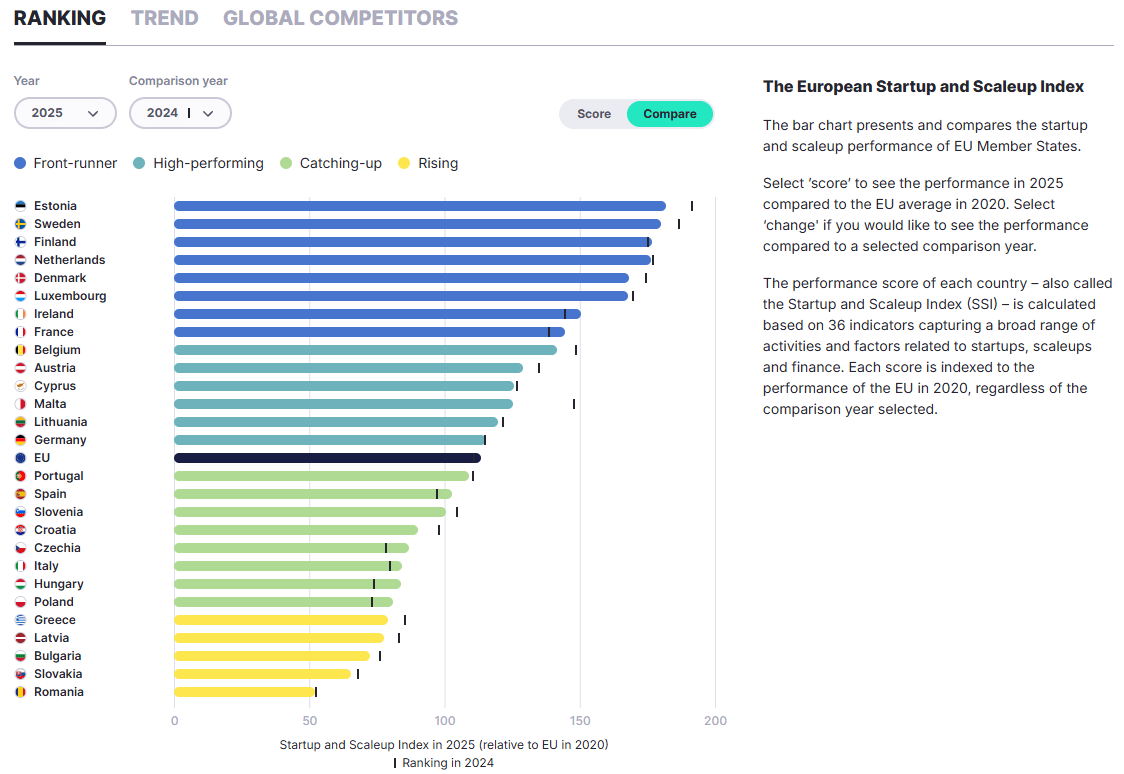
Currently, in order for a new European tech firm to operate, it must comply with a highly complex and fragmented set of both EU and national regulations, which hinders its ability to develop and innovate. Even if some firms face initial success, scalability becomes a major challenge. The relatively high transaction costs not only effectively diminish the ability of the firm to penetrate an EU-wide market, but also block the possibility of achieving that at a low marginal cost. Additionally, the AI ACT has imposed an even greater set of regulations when it comes to limits on computational on general purpose AI; some more advanced AI models have even been subjected to a higher threshold; additional limits are placed on data storage, which makes large data creation for AI training an impossibility. The 2024 Draghi report was already warning that all of the previous aforementioned developments have the capacity to become digital bottlenecks, which they indeed have become.
The EU AI Act of 2024 falls short of realizing the necessary changes that need to take place for Europe to get back into the AI race. Dreams of European AI sovereignty still capture the minds of Brussels policymakers while at the same time doing everything to undermine any progress.
Following the potential danger for the European AI project to be completely paralyzed, the Digital Omnibus on AI amended the EU AI Act and put the brakes on more aggressive regulations until 2027. The Omnibus package must, however, be followed by a reform of the regulatory regime; creating uncertainty is not a viable strategy. The first step to rethink the current policy approach is to re-embed the opt-out regime and reject proposals and national legislative initiatives that can undermine market harmonization and future market integration. Such as the April 2026 French Senate bill concerning AI..
In the short term, the EU should continue efforts to implement and finish the 28th regime, which will establish a set of uniform rules. However, this must be done as a means for further regulatory simplification of the 27 fragmented national sets of laws, more critically in terms of a single labour law framework. Based on figures provided by the International Monetary Fund (IMF) and the previously mentioned Draghi Report(2024), non-harmonized national rules and bureaucratic obstacles stemming from lack of market integration create internal trade barriers equivalent to an implicit 45% tariff on goods and a 110% tariff on services between EU Member States.
Deregulation coupled with simplification of rules and subsequent harmonization would eventually allow AI developers to test vertical applications in healthcare, autonomous transport, and energy without risk of unexpected national fines or further transaction costs; member states would meanwhile be incentivized to further liberalize their own laws following market pressure, this does not abolish national rules; it introduces an opt-in alternative in which companies can choose whether to adopt the domestic legal framework or the 28th Regime.
Under the 28th regime, the 48th hour window, which is a crucial component of the overall policy, would guarantee that companies across the European Union can incorporate fully online within 48 hours for a capped administrative fee. As previously mentioned, the 27 different sets of legal regimes create an internal tariff barrier across the single market; the 48-hour window and its subsequent low administrative fee seek to remedy the substantial initial friction faced by European enterprises. Anyone with experience from member state bureaucracies knows the great lengths required in terms of licences, appointments, verifications and paperwork required in each different country
This process can take three to eight weeks and costs thousands of euros in fees. The 48-hour window will be binding, with digital identity verification, while preventing excessive national administrative rents. Once the company registers, its corporate data is simultaneously shared with all relevant national administrations; This will provide for the immediate assumption of business operations. The 48-hour window will also have the ability to create competition by establishing a pan-European performance baseline which will act as a pressure mechanism; Companies will now have the ability to bypass their domestic bureaucratic registry to incorporate online in 48 hours with a capped €100 fee, and sluggish national corporate registries will face direct competitive pressure.
The momentum that this can create should be followed by more ambitious deregulation, specifically the creation of a binding “one in-two out” rule across the Commission's directives and regulations, meaning for every new digital rule, regulation, or compliance burden introduced, the Commission must identify and repeal at least two existing administrative rules of equivalent economic cost. The target should be not simply to slow down (and reverse) overall bureaucratic growth but to increase the use of AI and its adoption across the economy.
A further improvement would be to substitute EU directives with regulations, which will be more immediate and direct in terms of implementation; the use of directives has only exacerbated the problem of national market fragmentation regarding competition. In terms of EU law, directives allow more leeway for member states as to the method that will best achieve the result by the legislation, as one understands this is an inefficient process for a task such as rapid market integration and harmonization in terms of AI since this produces 27 different legal regimes to follow. An EU regulation, on the other hand, is binding but, most importantly, directly applicable across all Member States immediately, thus creating uniformity and minimizing national legal friction.
Furthermore, EU member-states have continuously missed the implementation deadlines, and EU regulation solves these problems and minimizes economic uncertainty. An EU regulation would prevent added national red tape and transaction costs; thus, European AI startups would not have to traverse 27 different legal environments. The following policy prescriptions would not only achieve a pro-innovation deregulatory environment from which European tech companies could benefit but would also move us to an integrated digital single market.
Following from that, efforts should then be concentrated on the vertical integration of AI; this can start by first of all increasing computational capacity. The first steps of single market integration and regulatory harmonization can now allow for some significant spillovers. The EU can promote and aid European tech companies by giving them a mandate for access to harmonized legislation, most urgently in labour and taxation law across the EU-27, the ultimate goal being granting them immediate access to all member states without further national legislation burdens.
We then finally arrive at the vertical integration goal, which also crucially hinges on allowing further data sharing capacities; a top-down commission plan for some industries may not be required if we allow the market to properly function and grant it the necessary level playing field. National AI sandboxes have increasingly delayed any effort towards harmonization despite the EU AI Act.
To achieve progress on that front, it is urgent to create some type of anti-regulatory bottleneck mechanism by first of all analyzing specific EU and member-state rules that unnecessarily obstruct commercialization and scalability of companies. Whenever there have been multiple instances of rules that are disproportionate or unfeasible, the Commission should undertake maximum efforts to simplify the regime. The industries where the vertical implementation of AI through market means is the most directly plausible are: automobiles, manufacturing, energy, telecoms, agriculture, environmental forecasting, pharma and healthcare; those specific sectors should be further promoted through EU-wide data sharing and protections from antitrust as the Draghi report recommends.
The White House recently published a policy paper called “America’s AI Action Plan”. There are certainly interesting policy formulations which can be emulated, with a lower baseline nevertheless. A good leading principle which the policy paper sets forth from the start is that “AI is far too important to smother in bureaucracy at this early stage”. One of the recommended policy actions which are easily transferable to the European context would be to similarly request an inquiry from the European tech startups and leading companies which are connected with the broad AI ecosystem to make a list about the current EU regulations that stifle AI innovation and adoption, and from that take action to alleviate current and future bottlenecks
Energy Policy: Cheap energy is an indispensable part of the creation of a robust AI ecosystem; energy costs are one of the biggest challenges that need to be tackled for Europe to be able to firmly place itself as an AI powerhouse. Without cheap and abundant energy, Europe cannot hope to see a big increase in terms of competitiveness and innovation, not only in the AI space but overall economic performance relative to China and the USA. Energy policy is highly complex and deserves a whole research project on its own; getting extremely specific and detailed goes beyond our current scope; nevertheless, there are some short-term second-best solutions to fix some issues.
European electricity demand up until the coming of AI and data centers was stable. That means that there is currently a mismatch between the grid and electricity production compared to the future energy demand required to power the AI industry; the IEA estimates an increase of 70% in demand for European data centers.
National electricity markets are still isolated; countries with data center concentrations will face additional price pressure. There is an ever-growing need for countries to start updating and expanding their power systems; data centers in the EU consume around 2% of electricity production, and this is expected to grow up to 5% by 2030. Another major challenge is that data centers take around 18-24 months to construct, while grid connection requires 4 to 5 years, and large-scale grid transmission projects at least seven to twelve years.
The current EU plan entails recognizing the need for a massive expansion of its data centers. However, the required infrastructure to achieve this goal is severely lacking; the new data centers have to compete with other infrastructure and electricity-related projects. Regulations related to permissions, demand for connection points, and the heavily constrained grip capacity are the biggest obstacles, not lack of capital or potential demand.
Solutions to the current conundrum need to recognize that the regulatory and bureaucratic review times must be adjusted and be connected to the investments and construction timelines rather than stalling projects past the point of financial viability.
We should be treating electricity as the foundation for our industrial base. China added 430 gigawatts in 2025 alone, deploying close to 5 times more renewable capacity in a single year than the entire European Union.
The "first-come, first-served" rules and the requirement for guaranteed firm grid capacity before any asset can connect cannot be sustained. Data center hub developers face connection delays of 5 to 10 years. Under revised EU rules, national regulatory authorities would be allowed and encouraged to approve "forward/anticipatory investments" allowing Transmission System Operators (TSOs) to build high-voltage capacity.This would allow and encourage TSOs to execute forward-looking anticipatory investments that align grid construction timelines with market demand signaled tech companies and compute developers. This allows network capacity to expand in step with market investment cycles, rather than relying on top down planning.
As mentioned previously, the main underlying issue is not a lack of capital nor a lack of potential demand, but regulatory review times that stall projects past the point of financial viability.
A complementary measure that takes into account the delays and increased hampering of the electricity market driven by prior government intervention should be an upfront investment by the European Investment Bank (EIB) since it is unlikely that, at the moment, private capital will undertake early-stage risk. Thus, the EIB will provide guarantee schemes and low-cost credit for grid infrastructure.
The White House’s recent policy paper, among others, is also concerned with the construction and expansion of the necessary infrastructure connected with AI. The agenda outlined by the paper is one amplifying permissions, an example which can be followed by the European Commission. European countries have a relative advantage versus the US in terms of having a more synchronized and well-interconnected grid; thus, we should aim to implement an ambitious agenda when it comes to grid expansion and thereafter market deregulation.
Permissions and regulations have placed obstacles in terms of renewable energy adoption and growth (even excluding nuclear power). Despite the large political backing and massive investments and support provided by the EU Green Deal, the regulatory barriers delay new projects and raise monetary and transactional costs. According to the Draghi report the extended bureaucratic delays lead to private capital exposure in terms of project investments through increasing borrowing and non-borrowing costs, while also mentioning that permitting procedures for renewables and cross-border transmission can take up to 9 years for complex installations, and 7 to 12 years for high-voltage interconnectors. This also means that the network operators will need to invest significantly in longer repair and emergency works rather than expanding existing capacity. The heavy increase in EU rules in terms of data privacy and consumer online protection have also been detrimental to the development of small to medium European tech companies; the heaviest of burdens is produced by the GDPR.
Not to mention the more recent risks that have arisen from the weaponization of critical minerals by China, which expose Europe’s renewable energy infrastructure to severe supply chain disruption.
Another major problem with European grids is that they are outdated. According to a report by the EU Commission, around 40% of Europe’s power distribution grids are more than 40 years old; modernizing them will require at least €584 billion in investments by 2030. A sensible course of action would recognize that immature phase-outs of nuclear energy power plants would need to stop; a development which, on the positive side, has now been embedded after the catastrophic policy taken by Germany (Atomausstieg); this development had its origins in the early 2010s, initially backed by the center-right CDU under Angela Merkel and then carried out to its extreme by the center-left SPD and the Greens; even if faced with an extreme energy crisis following the Russian invasion of Ukraine.
It is well established that nuclear energy is one of the main solutions to the current energy insecurity of Europe; the benefits and policies required to have also been well documented; it is also important for this effort to be part of a European coordinated effort, from the UK to Ukraine. Ukraine specifically has great expertise in this field from which Europe could greatly benefit; thus, further European countries would greatly benefit from a continental wide effort in terms of nuclear energy infrastructure cooperation.
AI and the Administrative State: It is safe to say that the biggest positive material spillover effects that AI can have at the moment is the direct application it can have at the level of the state bureaucracy. While most of the analysis on the effects that AI can have on that sector concentrates primarily on the increased efficiency (and while that is definitely true), we believe it is just as important to analyze the potential for AI to reduce the scope of government that hinders growth and innovation stemming from the giant increases that state bureaucracies have witnessed in the past few decades. AI must be seen as a tool that helps us achieve one of the biggest revolutions in the public sector by dismantling unnecessary regulatory drag and unleashing market power.
While there are exceptions to the rule, like the Estonia example, public administrations across Europe remain bogged down by paperwork and other manual tasks which create unnecessary bureaucratic frictions. Legislative accumulation has been so great that it has produced thousands of contradictory, redundant, and obsolete regulations which governments, even with the greatest of liberalizing intentions, cannot effectively untangle by themselves; this is where AI can step in to help. Excluding specific sector related regulations, the current administrative procedures of most European states as well as the EU create barriers to further AI adoption within government and the private sector. AI integration across the EU grew to 20.0% in 2025 from 11% when the Draghi report was written; however, if we zoom out, it very much remains dramatically short of the 75% “Digital Decade” 2030 target. The growth in AI adoption has also been driven by large multinationals(55%) rather than small-medium enterprises.
Aside from slowing down procedures, the following create a hidden tax on enterprises across major European economies, reducing national GDP by an average of 0.8%. For Germany, which has been notorious in terms of paperwork accumulation, the lost economic output amounts to €146 billion annually, with the private sector investing up to 7% of their working hours in administrative compliance.
A paper by the Tony Blair Institute (TBI) mentions that deploying AI in the public sector can automate approximately 20% of total civil service working hours, rising to 40% in tasks such as social welfare, pensions, tax collection, and planning. There are also great fiscal benefits if European states follow a prudent automation strategy. The TBI estimates that for example the UK can save up to up to £34 billion every year if it can go forth with integrating AI in automating manual bureaucratic tasks, while one might say this is too ambitious of a target it is nevertheless safe to say that in the long-term the fiscal space that AI can unlock, could alleviate some of the massive public finance pressure that European states are expected to face in the near future especially with deteriorating demographics coming into the picture. The state of European public finance is already bleak; the UK’s interest on debt has reached 5%, while France continues its big fiscal deficits, with the 10-year being close to 3%; borrowing costs should only be expected to rise if not for a wave of economic growth.
Backlogs and paperwork are a notorious and long-standing problem across most European countries. This is because of a combination of inefficient use of resources(human labor and capital) along with a failure of central planning to deal with the demand for basic public services, creating a severe bottleneck.
Despite the huge increases in public administration workforce, there has been a systematic failure within governments to be able to effectively provide some of the most necessary services to the public; this has completely undermined the faith that citizens have on the social contract.
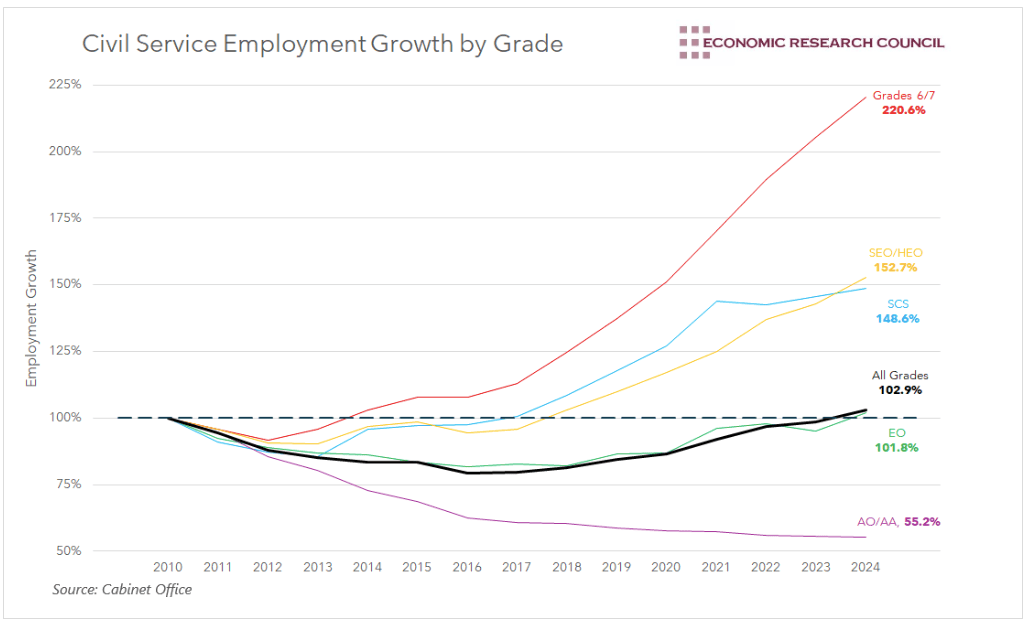
AI must be deployed to streamline, minimize labor costs, and modernize oversight and review. As mentioned previously, a “one in, two out” policy can reverse the trend of growth in regulations and incentivize state bureaucracies to conduct cost-benefit analysis in terms of existing and future regulatory legislation. Past examples of the previously mentioned policy show that while it has managed to reduce some of the growth in regulations, the “two out” part of the equation has been difficult to implement. A complementary measure to follow on that could be that government agencies should have to prove that any type of new regulation clearly provides higher economic and social benefits than costs. This would serve as a good compass for both the UK and European states to follow; keeping in mind the massive regulatory increases in recent times, this would surely amount to an improvement.
Another potential application for further deregulation would encourage the use of AI to assist in removing outdated and unnecessary regulations. AI language models can help in fast-tracking the process of recognizing those outdated and at times contradictory regulations. If modern AI excels at one thing, it’s analyzing texts; as a piece by the Cato Institute makes clear, “human analysts struggle to parse even a few pages of dense regulation, AI can plow through thousands-mapping connections, spotting redundancies, and flagging requirements for revision or removal”
Governments should encourage and incentivize their most inefficient departments and agencies to identify fields where AI can be used to streamline bureaucracy and reduce overall workforce numbers in positions which can be automated through the application of AI. AI models can thus help the public workforce to maximize its output in the most important places through a division of labour while removing repetitive and frustrating tasks for humans. In a report by McKinsey, it is estimated that government productivity can be improved up to 12 %, while another analysis by Accenture, found that there is a significant amount of opportunities for potential automation within the public sector.
Other meaningful proposals would include a strategic increase of professionals with relevant AI skills into agencies, departments and commissions in the EU. Following from that, a collaboration with private companies that have proven capable of integrating AI to increase efficiency and streamline procedures will also be a step in the right direction.
It should not be understated that the human component will remain critical; there should be a clear line of human accountability when it comes to decisions taken through the use of AI. The human element is not only necessary for direct accountability, but is crucial for recognizing gaps and shortcomings in AI analysis and decisions, while also ensuring a stable and trustworthy relationship with the citizens remains in place. The lack of accountability produced by the massive growth of the state apparatus in recent times has only been proven detrimental; thus, AI should be used as a tool to remedy this relationship, not to make it more detached from the public. Efforts should not be to create an “AI State-Leviathan”; instead, AI should help in the fight to shrink the size of government, allowing for more decisive action, which would be ultimately left to the human element.
Conclusion: The most commonly addressed critics of AI cite fears of unemployment, and the threat that AI can pose to the human element in interactions across the public and private sector. We believe that, at the current moment, stakeholders have done a poor job of communicating to the public the material benefits that the use of AI can have, while also promoting a faceless technocratic picture in terms of how AI governance will take place across governments. The most famous historical example we have of a period with great technological innovations which displaced but also, more importantly, created a series of jobs was the Industrial Revolution, which was responsible for the biggest increase in human welfare in history. Fears of massive unemployment lay mostly on a fallacy that the amount of labour to be done within the economy is fixed; what automation has historically done is remove repetitive, highly hazardous tasks. Empirical data also do not support the assumption that technological improvements increase unemployment.
Just as with our experience with any period of great technological change there is an amount uncertainty as to what sorts of innovation we will have in the future, no one at the time of the Industrial Revolution knew the spillovers and applications of the early innovations, discoveries; so we now do not know the complementary innovations that AI will bring along with it especially since AI is entirely dependent on its interactions with humans. AI development has been so great that already legislation such as the EU AI Act is now becoming even more outdated; policymakers should keep this in mind when creating proposals, a prudent approach that recognizes that what we do not know as of now would be a great improvement rather than creating legislation which seeks to find problems to legitimize further legislation to regulate AI.
Frederick Bastiat wrote extensively in the early 19th century about the “seen versus unseen” when he was talking about the economic effects of innovations, meaning the great changes that take place in a dynamic market economy typically go unnoticed until further in the future, while the crowding out of traditional jobs and sectors does not. In our age it is easier to see how AI will destroy rather than create jobs; for politicians, AI is also a good excuse to blame rather than accept their responsibility that the current labour market, especially for new entrants, is in a bad and inflexible state(in fact, that was the case well in Europe before the coming of AI).
AI will create new spaces, jobs, increase productivity and efficiency, and boost overall aggregate demand. It is just that we do not know with certainty how this will play out; and that is fine. What policymakers should do is approach this with a certain degree of humility and caution when they are willing to make new rules and regulations that can stifle innovation. Historically speaking, increases in unemployment have been driven by the economic cycle, not by technological changes; automation in the past was a positive development.
Political elites have not communicated clearly to the general public the costs and benefits of AI. A major part in that is the lack of trust that has been cultivated between the two in recent times, an important part to that problem is the failure to envision a long-term societal vision that goes beyond short-term election cycles; clearly there is no goal or objective to meet in the future for our countries, instead political debates at best circle around the best way to preserve social security to the financial detriment of young generations.
Polls are now increasingly finding growing public skepticism about the integration and deployment of AI, even if young people are increasingly using it in their education and work environments. A YouGov poll found that around 55-65% anticipate net negative outcomes and fewer than 20% positive from AI; more than 70% also expressed growing concerns that automation through generative AI will lead to losses of jobs and entry-level roles. Another survey conducted by KPMG Australia & University of Queensland found that UK citizens are also pessimistic about adequate AI governance frameworks. Across the channel, public sentiment is similarly negative; according to the Eurobarometer, over 79% believe that AI requires strict regulatory oversight. On an important note, it is also interesting that different regions within the EU have different feelings about this. Some small northern European and Scandinavian countries are more optimistic about the positive developments and results that AI can have on society. It is also interesting that, as of recently, those same countries have been at the forefront of European innovation and enterprise creation.
There is now more to say about the sort of environment that particularly young generations have grown up, indeed even the computing revolution in the late 90’s to early 2000’s does not come close to technological advancements previous generations witnessed; to put in historical context the west went in around a hundred years from early steam engine adoptions to mass commercial flights to nuclear power and flying to the moon. An individual born in 1900 entered a world where horses were the primary mode of transport and lived to watch live television broadcasts of astronauts walking on the moon.
AI will probably not even come close to that sort of technological revolution, but it represents a huge opportunity to pull ourselves out of current stagnation through the biggest increase in material welfare if we allow it to work. Productivity increases are one of the most reliable indicators for lower prices, wage and profit increases; the following will culminate in increased aggregate demand boosting economic activity. As economist Paul Krugman put it in the 90s,“Productivity isn’t everything, but in the long run, it is almost everything. A country’s ability to improve its standard of living over time depends almost entirely on its ability to raise its output per worker.”
It is the case that young people have not experienced any groundbreaking technological advancements within their lifetime; that is a testament to how little ambition or formulation of a positive societal vision our current political predicament has offered. The West and more specifically Europe has retreated from history; re-entering is paramount to our progress. In his 1962 address launching the Apollo mission, President John F. Kennedy captured the thinking that we most urgently need: "We choose to go to the moon. We choose to go to the moon in this decade and do the other things, not because they are easy, but because they are hard, because that goal will serve to organize and measure the best of our energies and skills, because that challenge is one that we are willing to accept, one we are unwilling to postpone, and one which we intend to win, and the others, too”.