What is the Free Speech Bill, and why do we need one?
Preston Byrne, ASI Legal Fellow and Managing Partner at Byrne & Storm LLP
Over the course of the last year, I have defended Americans from the UK’s Internet censorship agency, Ofcom – as well as parrying inbound censorship demands from Australia’s eSafety and several European regulators. Most of you reading this will have learned about this work, and these cases, because of an e-mail we sent to Ofcom in response to that agency’s failed attempt to fine my client 4chan.
That e-mail contained a cartoon hamster, and an X post about it went viral two weeks ago.
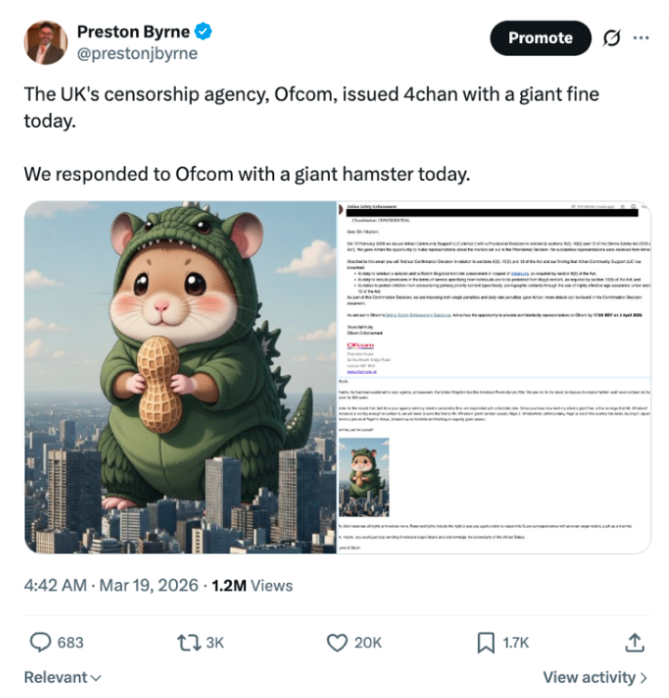
The hamster thing is a running private international law joke between 4chan’s legal team and Ofcom’s legal team – although I suspect, as between us, only 4chan’s legal team finds it funny – about service of process formalities. Specifically, it illustrates that Ofcom's e-mailed fines to my clients are not validly served in the United States.
Ofcom’s letters may, therefore, safely be shredded for my pet hamster’s enclosure without any enforceable legal repercussions. The joke even made it into court filings in our clients’ lawsuit against Ofcom, after Ofcom brought it up in their motion to dismiss and we wound up having to explain the joke to a U.S. federal judge.
Hamsters aside, of any foreign agency, Ofcom has been our most serious, and determined, opponent. For over a year, we have fought them, and every other foreign censor we encounter, with the objective of preventing them from laying a finger on any American citizen or company, using all lawful means available.
Fighting Ofcom is, however, a sideshow. It is not, and never has been, the main event. As between Ofcom and 4chan, and regardless of the outcome of the D.C. litigation, and however much Ofcom might bluster and engage in enforcement theatre, on the question of whether Ofcom can collect its fines against Americans, American law is firmly on 4chan’s side. Ofcom will never collect a single penny of its fine against my client.
Nor is my client’s fight against Ofcom and across America’s borders the fight I care about the most – although I care about that fight a great deal. The reality of it all is that the refusals of Ofcom’s orders, the lawsuits in America, the GRANITE Act foreign censorship shield bills now advancing in legislatures across the United States, the cartoon hamster – all of these are early battles in a far wider war.
The big fight, the real fight, is to restore free speech in the UK. Publishing this Model Bill, today, we mean to start it.
The Problem
The United Kingdom does not have free speech, not in any sense that an American would recognize. This is not a uniquely Starmer or Labour problem. This has been the case for decades. The only difference between the censorship of 15 years ago and today is the quantity in which it occurs, not the nature of the restrictions.
The objective of the Model Bill is, as far as possible, to get the UK’s government out of the business of regulating opinions. The Model Bill accomplishes this by abolishing huge swathes of criminal offences relating to the causing of offence, insult, alarm, or distress, and by eliminating content-based speech restrictions which threaten a speaker with prison for little else than having the wrong ideas and daring to say them.
In a free society, fools, bigots, and assholes get to speak and remain free men. That is not the price of liberty. It is liberty, and the rest of us get it too. The Model Bill’s authors are aware that this Model Bill, if enacted, would decriminalise expression that we find morally repugnant.
We accept and embrace that consequence. But we ask the reader to consider who these laws actually catch. Overwhelmingly, victims of the UK's censorship state are not hardened extremists, who operate in encrypted channels beyond the reach of any statute, but ordinary people. The present state of the UK, where expressing an opinion that gives rise to even mild offence may result in arrest, and does result in arrest, for tens of thousands of people per year, is a heavy price that this country has been paying for two decades.
The bill for the UK’s bad conduct now falls due. Overzealous enforcement of these laws has resulted in the arrests of parents complaining about their local school boards; Jewish citizens being threatened with arrest for looking too “visibly Jewish” in public; satirists of every stripe, from the absurd to the gender-critical, being arrested and charged for ideas that, only a decade ago, were commonly held; teenagers threatened with terrorism charges for reposting memes.
Then, in 2023, Parliament vested Ofcom, the UK’s Internet censor, with vast powers, and spent hundreds of millions of pounds building a purportedly globe-spanning enforcement apparatus, only to lose in the court of public opinion to – and be proven utterly toothless by – a cartoon hamster. The UK’s censorship regime does not work, does not deserve to survive, and this Model Bill – if enacted – would put it out of its misery.
“If the UK wanted to enact something like the First Amendment, what would the resulting statute look like?”
That is the question we seek to answer with the publication of the Model Bill. A requirement of such a law would, necessarily, mean that on the day of its enactment it would need to dismantle virtually all the UK’s censorship regime in one, swift strike.
It would have to, overnight, eliminate the British state’s power to police the opinions of the British people, because the total elimination of that power – all of it, all at once – is what is required in order to truly recreate the First Amendment, warts and all.
In publishing the Model Bill, and in proposing the extent of repeals we propose, the Model Bill’s authors ask readers one question, and one alone: do you want the UK to have a free speech right that is equivalent to the First Amendment?
That question has a binary answer: yes or no.
That is the Model Bill’s purpose. It does not seek to reach a consensus or an accommodation with pro-censorship forces in the UK’s political establishment. It does not call for incremental tweaks. In publishing the Model Bill, we seek to start a debate about whether the UK state, as a general constitutional principle, should retain the power to censor any Briton’s nonviolent expression on pain of fines and imprisonment, under any circumstances. We seek a debate about the UK’s censorship laws and practices, all of them, all at once. We seek that debate because we are confident that debate is one we will win.
The Model Bill is an attempt to create a First Amendment for the United Kingdom. It is organised in eight Parts and six Schedules. It establishes a broad statutory right to free expression, defines narrow exceptions, imposes duties on the State and essential service providers, creates new protections in employment and equality law, repeals most of the UK’s existing legal censorship architecture, and provides enforcement mechanisms for persons whose rights are violated by the State.
The Right to Freedom of Expression.
Part 2 establishes the core freedom. The right of any United Kingdom person to hold opinions and engage in lawful expression may not be violated by the State (s.4). That right extends to expression that is offensive, grossly offensive, insulting, abusive, shocking, blasphemous, indecent, or otherwise objectionable (s.4(2)). Section 5 states the principle plainly: there is no right in law not to be offended by the expression of others.
Section 6 defines the irreducible core of expression the Model Bill seeks to inviolably protect: where speech on matters of public interest, including politics, morality, philosophy, and religion, is made, no person may be convicted or sanctioned for such expression unless it falls within a defined category of unprotected expression and the conditions for liability are strictly met.
Unprotected expression.
Part 3 defines what expression is not protected.
The Model Bill adopts the American Brandenburg test for incitement: inflammatory expression is unlawful where it is directed to a specific audience, intended to produce imminent lawless action, and likely to produce such action (s.9). Advocacy, praise, or defence of unlawful conduct in general terms is not incitement. Beyond incitement, the Model Bill preserves criminal liability for perjury, contempt of court, unlawful threats, fraud, blackmail, offences under the National Security Act 2023 and the Official Secrets Act 1989, procuring or assisting crime, criminal conspiracy, defamation, and harassment (s.11), as well as any unlawful speech specifically designated by Parliament.
The Model Bill also amends the Protection from Harassment Act 1997 to clarify that a person does not harass another merely by posting content that the other person chooses to seek out, subscribe to, or monitor (s.10), avoiding situations such as those where citizens who choose to report on matters of public interest, such as the police, without actually contacting the subjects of the reporting, are then arrested under that Act.
Restrictions on State action.
Part 4 prohibits the State from censoring lawful expression directly or indirectly (s.13), including by imposing conditions on licences, funding, or benefits that require a person to adopt a particular political or ideological opinion. Section 14 bans non-crime speech monitoring, including the recording of lawful expression as a "non-crime hate incident," and requires the destruction of any records that may exist in violation of that rule. Section 15 closes the outsourcing loophole: the State may not arrange for, fund, or procure censorship through third parties.
Compelled speech is prohibited: no public authority may require any person, as a condition of employment, education, professional licensing, or citizenship, to declare or affirm any political, moral, religious, or ideological belief, other than allegiance to the Crown (s. 16).
Intellectual discrimination.
Part 5 amends the Employment Rights Act 1996 to protect workers from detriment and employees from dismissal on the ground of lawful expression made in a personal capacity outside the workplace (Schedule 3). It also amends the Equality Act 2010 to make "lawful expression" a protected characteristic for the purposes of services, education, employment, and associations (Schedule 4), in keeping with the Equality Act’s protections for belief. If belief is protected, so too must be the expression of those beliefs outside the workplace.
The Model Bill also inserts a freedom from compelled expression into the Equality Act: nothing in that Act requires any person to express, endorse, or facilitate any message, opinion, or viewpoint, and a refusal to do so does not of itself constitute discrimination.
Essential services and the Internet.
Part 6 prohibits essential service providers – including banks, payment services, telecoms, and domain registries – from refusing or withdrawing services on the ground that a person has engaged in lawful expression (s.19). Again, this is something which would be unconstitutional in America but fits within the UK’s tradition of non-discrimination.
Section 20 will doubtlessly be one of the most controversial items of legislation in this proposal. The repeal schedule repeals the Online Safety Act in its entirety, and that entire regime is replaced with a provision modelled on Section 230 of the U.S. Communications Decency Act: no provider or user of an interactive computer service is to be treated as the publisher of content provided by another. For such a short provision, the American experience shows that the decision to enact a Section 230-style rule is very complex. This decision was informed by a number of competing policy considerations, foremost among them the need for the UK to succeed economically in a digital and globalized world.
That does not mean that the Free Speech Act proposes to turn the UK into a digital wild west: unlike the effect of Section 230 on U.S. state criminal laws, UK criminal law is completely unaffected by this immunity, which applies to civil liability only. Like Section 230, platforms retain full discretion to moderate content they consider objectionable, and with a handful of exceptions, many major platforms already censor content that the UK finds illegal. Section 20 imposes one mandatory obligation on platforms: they are required to detect and remove CSAM, and render a report to law enforcement within 24 hours of obtaining actual knowledge of its existence (s.20(3)). Automated systems widely in use should make the takedown-and-reporting procedure nearly instant in most cases. Failure to adhere to this requirement is already punishable under existing UK criminal law.
So, the position on “online safety” in the FSA is reverted to that in January 2025. I lived in the UK as recently as 2017 and it wasn’t a post-apocalyptic anarchist hellscape; repealing the Online Safety Act in full, as this Model Bill proposes to do, won’t make it one. It will, however, end the UK’s exercise of censorship powers over political speech online, or requiring every person in the UK to dox themselves in order to use their iPhones. That seems to me like a good trade.
Enforcement and remedies.
Part 7 gives individuals a civil right of action against the State or essential service providers that act incompatibly with the Model Bill (s.21), with a presumption of costs in the claimant's favour. Section 22 creates an anti-SLAPP mechanism: defendants in strategic lawsuits against public participation may apply for early dismissal, with mandatory costs and the possibility of damages if the claim is struck out. Section 24 annuls and vacates all convictions, cautions, and binding-over orders entered under repealed provisions where the conduct would constitute lawful expression under the Model Bill.
Repeals.
Schedule 1, Part 1 is the wrecking ball.
Schedule 1 repeals the Public Order Act 1986, the Public Order Act 2023, the Malicious Communications Act 1988, the Online Safety Act 2023, the Hate Crime and Public Order (Scotland) Act 2021, and the Obscene Publications Act 1959, in their entirety. It also repeals Section 127 of the Communications Act 2003, sections of the Terrorism Acts used to arrest non-violent protestors in the UK for political speech and Article 10(2) of the Human Rights Act 1998’s Schedule 1. It eliminates the strict liability rule for the press on court proceedings under the Contempt of Court Act 1981.
Schedule 2 re-creates the content-neutral public order offences of riot, violent disorder, affray, and unlawful assembly, only this time, these provisions are shorn of any content-based element; redefines breach of peace; and creates two new content-neutral communications offences that punish the conduct of threatening another person, regardless of the ideological orientation of the threat in question: (a) fear or provocation of violence and (b) threatening communications. Schedules 5 and 6 are placeholders for applicable rulemaking in Scotland and Northern Ireland. We presume Labour will not be introducing this Model Bill so we have a few years to address the interaction between free speech and devolution.
Why this Model Bill? Why now?
When I wrote Sense and Sensitivity in 2020, my early prototype for a UK Free Speech Act was met with warm words, some curiosity, and no action.
The intervening years have made the case for law reform even stronger. The Online Safety Act was passed. Ofcom was set loose on the world. Scotland’s hate crime law came into force to widespread ridicule and even public opposition from the then-Prime Minister, Rishi Sunak (who, despite that opposition, did nothing in response). The summer of 2024 saw fresh speech prosecutions. The Online Safety Act’s entry into force in 2025 accelerated the decline.
My two co-authors, Michael Reiners and Elijah Granet, and I offer this Model Bill as a template, a menu of options, for any UK politician or citizen who wants to halt the collapse of Orwell’s country into Orwell’s fiction. The Model Bill is not a radical proposal. The Free Speech Act is perfectly aligned with Britain’s liberal history and traditional British values, values that are sane and just, and values which the UK’s current speech rules do not align with. The radicals are the politicians, pressure groups, and companies who are either actively trying to turn, or quietly acquiescing to the transformation of, the UK into Censorship Island. The establishment should have to answer for a legal regime that causes half the British population to self-censor out of fear and which arrests tens of thousands of people per year for simply speaking their minds. They cannot, because it is indefensible.
The Model Bill is not a sacred text. It is simply three lawyers’ vision for a free Britain. We expect readers of the proposal to suggest improvements, amendments, additions, deletions, or even to throw the Model Bill out and propose novel approaches of their own. But, by way of reminder, you either want a UK First Amendment, or you don’t. If you think that our Model Bill confronting these issues head on, as we have done, is too controversial, we invite you to explain to the British public why the status quo is not.
Whether the UK chooses to go where the Free Speech Act leads, or whether it follows another map entirely, is a matter for the British people to decide.
Preston J. Byrne is a co-author of the Free Speech Act 2026 Model Bill. He is a dual-qualified English solicitor and U.S. attorney-at-law, Legal Fellow of the Adam Smith Institute, and Managing Partner of Byrne & Storm, P.C.
He is counsel to 4chan in its federal lawsuit against Ofcom in the Federal District Court of the District of Columbia, and to every U.S.-based enforcement target of the UK Online Safety Act in 2025. He also represents American enforcement targets of Internet censors in the European Union, Australia, and Brazil. He is also the creator of the GRANITE Act foreign censorship shield law concept for the United States, and co-author of HB 70, the Wyoming GRANITE Act, which passed the Wyoming House of Representatives 46-12 in February 2026 and is currently under consideration by legislators in several states.
The UK Free Speech Act 2026 Model Bill is published alongside this essay and is available for download at adamsmith.org.