
Electricity Tracker
Why Energy Matters
Energy is both one of the most important inputs to production and one of the largest items of expenditure for many households. Thus, as many reports have recognised, including The Growth Agenda (2026), the UK’s high energy prices are holding back economic growth and holding down living standards. This tracker shows how we are performing on this metric against our second-closest neighbour, habitual continental rival, and recent ally, the French Republic.
Energy is a broad term, encompassing everything from the heavy fuel oil used by container ships to the wind-generated electricity used to power a Tesla. But perhaps the most important single price in the energy market to the relative performance of the UK’s real economy is that of electricity. Electricity generation represents only 17% of the UK’s primary energy use (but 33% of that in France), but its price varies more across borders than the easily-transported commodities of oil and directly-consumed natural gas.
This really matters. In The Growth Agenda, we estimated that bringing British industrial electricity prices down to French levels could increase output (over 10 years) by 4.25%. This is the second-largest single change that we studied, behind only comprehensive planning reform.


What the Figures Show
To measure the UK’s energy competitiveness, we have tracked the relative price of electricity for both domestic and industrial consumers across the English Channel, using data published by the International Energy Agency and adapted into sterling terms by DESNZ. To this data, we have added more recent data-points for 2025, imputed from PPI readings.
The industrial electricity price data reveal that British industrial concerns pay 81% more per kilowatt-hour of electricity than French firms. This industrial energy price premium is at its highest level since 2006, when it briefly spiked due to an increase in oil and gas prices (on which the UK was much more reliant for electricity generation). Before that, it had not been higher since 1981.
To make this concrete: A very large 500 MW data centre, assuming an average utilization of 15%, would consume 657 GWh of electricity a year. At French prices, this would cost £92 million a year. At British prices, it would cost £167 million.
The story is better for households, but not dramatically so. British residential electricity prices, despite the energy price cap, are set to be 40% higher than French prices in the second quarter of 2026. British residential prices were briefly much higher than French prices, during 2022 and 2023, when they were more than 70% higher than French prices. In general, however, the British price premium has been increasing since records began in 1979.
In concrete terms, a household consuming the typical UK amount of 2,700 kWh a year would spend £807 a year on their power bills in the UK and only £578 a year in France.
What Drives This Difference
These differences are not driven by direct taxes on electricity. In 2024, French taxes on industrial electricity use were 3.51p/kWh, whereas in Britain, these taxes were only 1.72p/kWh.
Instead, the difference is largely driven by the higher underlying cost of British electricity. Some of these costs are taxes, imposed at the generator level, such as Carbon Price Support. But more important is the UK’s reliance on a combination of expensive renewables (currently largely funded by billpayers, though increasingly less so) and a gas backstop. France, by contrast, enjoys reliable, low-carbon electricity from nuclear power plants that were relatively affordable to build at the time.
Wind subsidies, in particular, are driving up electricity prices, especially as wind power becomes an increasingly dominant source. Firstly, curtailment payments mean consumers pay not only for the electricity they use but also for wind electricity that was generated and then thrown away because the grid couldn't use it.
Secondly, when wind output is high, it floods the wholesale electricity market, often driving the spot price of power down to near zero or even into negative territory. This may sound good, but consumers often cannot benefit from these low prices. This is because the Government’s Contracts for Difference scheme fixes the price that wind generators receive. These CfDs will become increasingly expensive as wind patterns increasingly drive electricity prices.
These volatile prices also undermine the economics of more reliable power sources, like gas. To cover their costs and remain operational, these plants must command higher prices during periods of low wind (when they are desperately needed) or receive subsidies from the capacity market, leading to greater price volatility and higher average prices for consumers. Just as importantly, gas turbines are most efficient when running at or near full capacity. When frequently ramping up and down to follow erratic wind output, they operate inefficiently.
The Nuclear Option
The obvious alternative to wind power to achieve decarbonisation is nuclear energy. However, as we laid out in The Growth Agenda and as the Fingleton Review has highlighted to the government, Britain has a hostile regulatory environment for new nuclear.
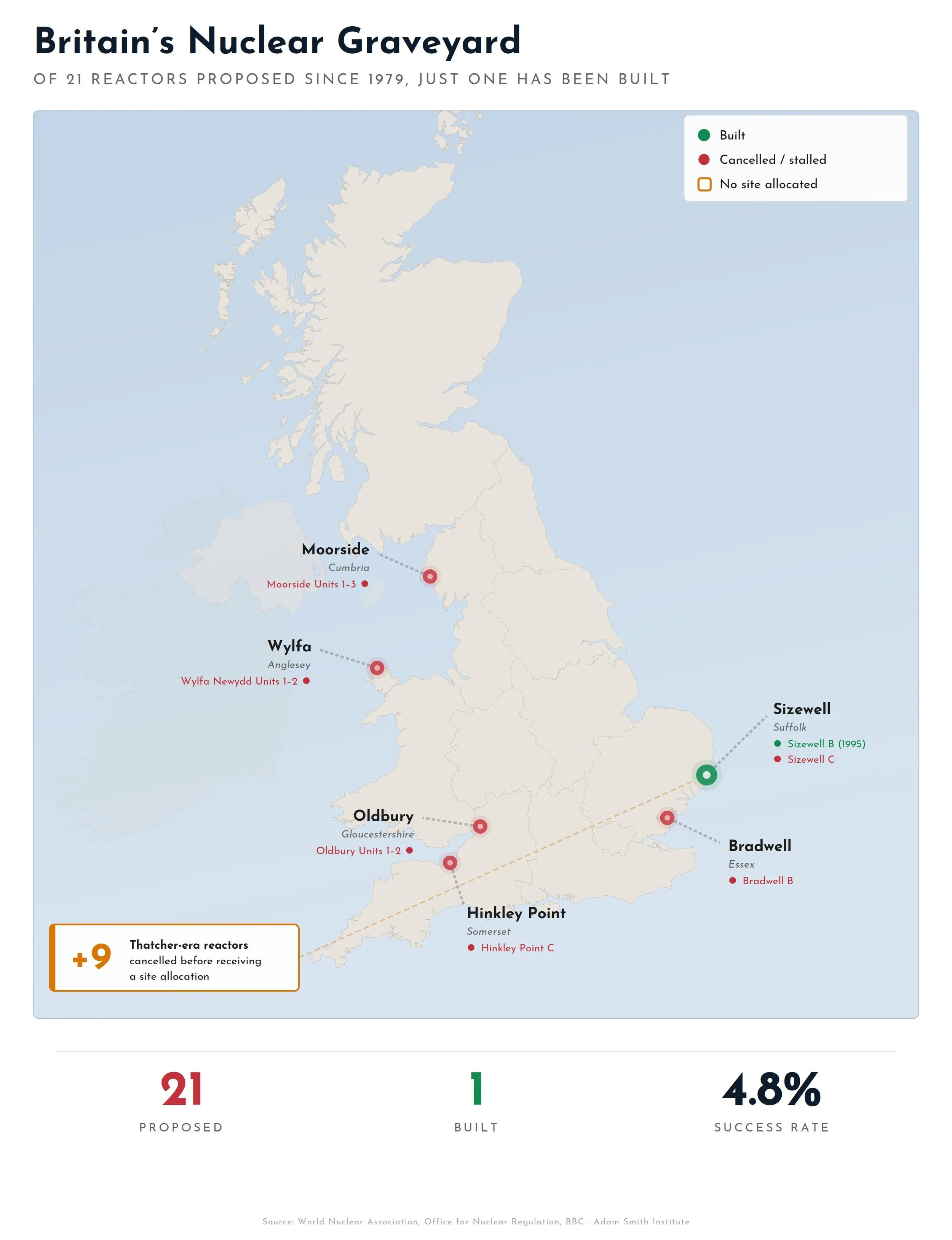
Since 1980, there have been serious proposals for 21 reactors, but only one is successfully operating. The failed projects from the 2010 round alone could have delivered 18 GW – enough to almost quadruple Britain’s nuclear capacity, which is currently around 6 GW.
Britain’s failure to deliver new nuclear is a direct consequence of a broken planning and regulatory framework. While countries like France and South Korea drive down costs through standardised designs, the UK treats every project as a bespoke, unique bureaucratic battle.
An important barrier is the ALARP (As Low as Reasonably Practicable) standard. Because this safety principle lacks a fixed target, regulators can mandate endless, minute design changes mid-construction. At Hinkley Point C, this resulted in 7,000 design changes, inflating costs to the point of deterring private investment. By contrast, France and Finland have delivered the same EPR design for 27% and 53% less, respectively, by avoiding such excessive gold-plating.
Image attribution: "Centrale nogent.jpeg" by Clicgauche is licensed under CC BY-SA 3.0.