We can reject the Joseph Rowntree poverty report immediately
We’re told that this is the big important report on poverty. It ain’t - it’s about inequality.
The Joseph Rowntree Foundation’s latest report on poverty in the UK, published this week, should be read first and foremost as an indictment of all Conservative governments between 2010 and 2024. During almost a decade and a half of Tory rule, the JRF estimates that no progress at all was made in reducing overall levels of relative hardship.
“Relative” is the important word there. The actual report gives us pages, pages and pages about “poverty”. It’s in Annex 1 that we get told this:
Relative poverty after housing costs (AHC) – this is our main measure of poverty and is where someone’s household income after they have paid their housing costs is below 60% of the median, adjusted for family size and composition
That’s not a measure of poverty that’s one of inequality. It doesn’t measure how much someone has it measures how much less or more someone has. It’s inequality, not poverty. Given that they’re not even measuring poverty we can reject the report as telling us anything useful about poverty as their measure is not about poverty. QED.
And, yes, this is important. For that same report tells us that:
However, economic growth on its own will not reduce poverty
This is untrue. Something that is easily shown:
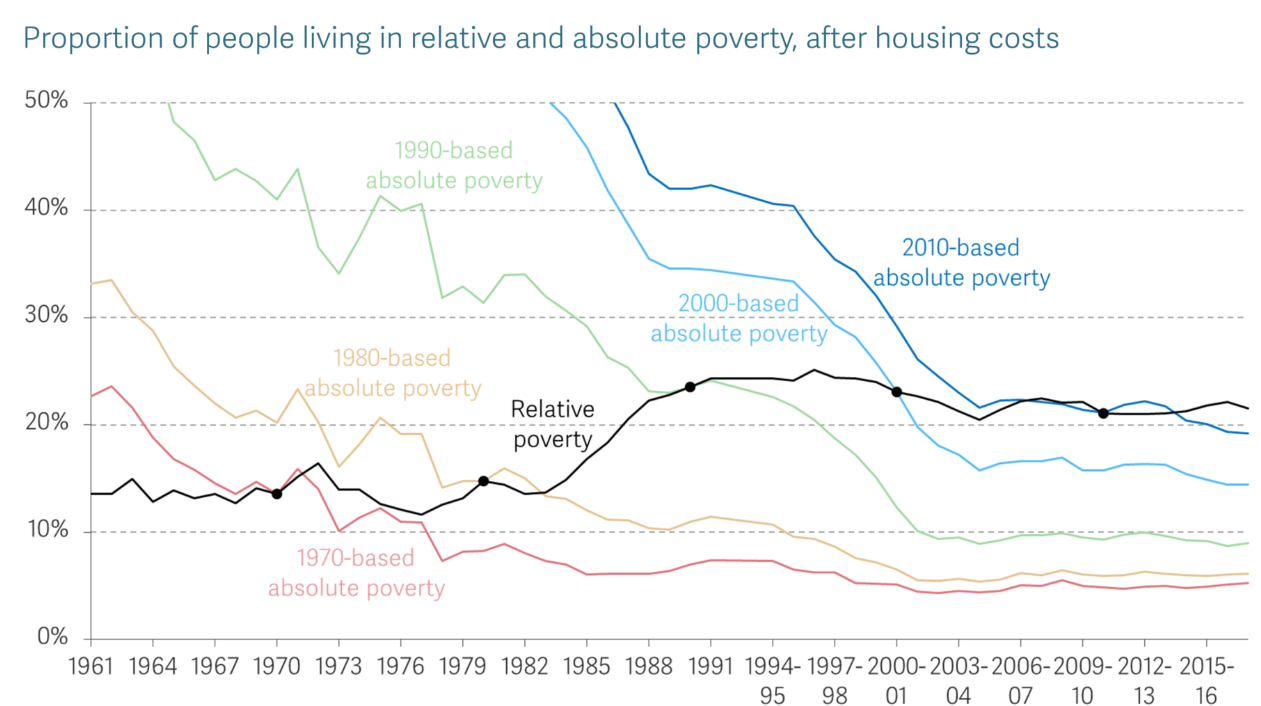
In this strange world where poverty and inequality are deliberately confused “absolute poverty” is being below the relative poverty standard of a previous year. So, say, 1970-based absolute poverty is to be below the 60% of median income of 1970 here in 2024 (the year the report refers to). 2010-based absolute poverty is to be below that 60% of median of 2010 here in 2024 and so on. This entire report whines on about how there has been no change in poverty - we have the same number in relative poverty in 2024 as we did in 2010 (of course that year is used - Tories, see?). But we have in fact more than halved the number who are, in 2024, living in poverty by the standards of 2010. And even more than that for previous periods, obviously.
Economic growth does reduce poverty. It’s the very thing that does reduce poverty - economic growth is the production of more stuff, more people having more stuff is less of that poverty which is having little to no stuff.
Economic growth can have varying effects upon inequality. It can rise, fall, remain static as growth happens. But poverty definitively falls with economic growth.
Which is why this inequality definition is used of course. There are some who insist that inequality is the very terror of civilisation. Those who so insist also know that the general public doesn’t share that view. On the other hand the general public does agree that leaving shoeless and weeping orphans to die, crustless, of poverty in the street is a bad idea. Which is good, as that is a bad idea. Thus the inequality that the report writers desire us all to cough up to reduce via tax and redistribution is disguised - sorry, defined as - the poverty that we will open our wallets to rectify. We’ll not pay vastly more to make sure that everyone is more equal while we will indeed pay to kill off poverty. As, you know, economic growth does so well.
That being the whole point of the definitions so misused here. To be able to plunder our wallets to solve what they think is a problem but we don’t. It’s all intentionally misleading on political grounds.
Tsk, eh?
Tim Worstall