
Development of Wages in the UK
Introduction
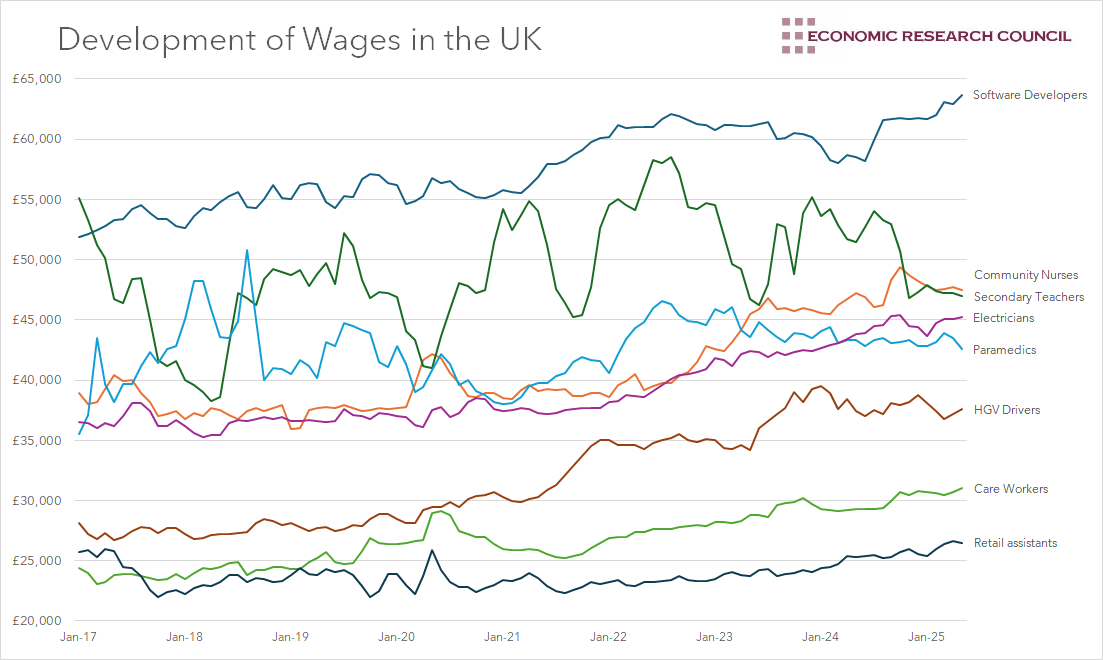
Our chart of the week tracks advertised salaries for eight familiar occupations from January 2017 to May 2025. The picture that emerges is not of one labour market but of three. Electricians, software developers and heavy‑goods vehicle drivers inhabit a world in which wages rise or fall with the immediate balance of supply and demand. Retail assistants and care‑home staff live under the statutory discipline of the National Living Wage. Nurses, teachers and paramedics, by contrast, sit in a realm where politicians hold the purse‑strings and pay review bodies can recommend but rarely compel. The interplay of Brexit, the pandemic and a burst of inflation has sent these three worlds spinning at very different speeds, reshuffling the UK’s pay hierarchy in the process.
What does the chart show?
Looking first at the broad contours of the chart, at the top sit programmers and electricians, each line climbing steadily from the low‑fifties and mid‑thirties respectively to roughly sixty‑three thousand and forty‑five thousand pounds by spring 2025. Mid‑table you find nurses, teachers and paramedics. The nurses’ series edges upwards but never convincingly beat inflation; teachers decline through the late 2010s, hover, and only recover late in the period; paramedics enjoy a step change after their 2017 re‑banding but then track nurses. HGV drivers draw the eye most dramatically. Their pay is flat for years, shoots up when Britain’s petrol pumps run dry in 2021, then plateaus once the emergency eases. At the foot of the chart retail assistants and care workers march upwards in lock‑step, propelled almost entirely by statutory increases in the Living Wage, yet they remain firmly anchored to the bottom of the distribution. All of these figures are nominal. Adjusted for the roughly twenty‑five to thirty per cent rise in prices since 2017, only a handful of occupations finish the period with meaningful real‑terms gains.
Why is the chart interesting?
The electricians’ experience illustrates how a competitive market responds to a chronic shortage. Demand has been bolstered by a long housing boom, a surge of green‑energy projects and the rapid spread of electric‑vehicle charging infrastructure. Supply, meanwhile, has been squeezed by an ageing workforce and a sharp fall in EU tradespeople after Brexit. The result is plain in the numbers: advertised salaries rise by almost a quarter, and a two‑year Joint Industry Board deal delivers another fourteen per cent just as inflation drops back towards target. For electricians, collective bargaining has proved an efficient conduit through which market pressure is converted into higher pay without lengthy industrial strife.
Software developers occupy a similar wage‑setting world but with milder swings. Digital transformation and cybersecurity concerns mean demand for coders has been strong throughout, yet global remote hiring and a steady pipeline of graduates prevent an explosive spike. Salaries grow at two or three per cent a year, enough to stay comfortably above the national median but seldom spectacular. Programmers may build the tools of automation, yet so far those tools have complemented rather than replaced their own jobs.
No occupation better captures the power of a sudden supply shock than HGV driving. Brexit removed tens of thousands of EU drivers, COVID throttled the test‑centre pipeline and an ageing workforce offered little slack. By the autumn of 2021 shelves were empty, forecourts were dry and wages jumped by double digits almost overnight. Pay now sits a third higher than in 2017 and, for the first time in decades, well above the overall median. Once emergency visas, fast‑track tests and overtime incentives nudged supply back up, further pay growth stalled. The episode shows how quickly wages will move when migration channels close and essential goods stop moving.
Where the market is nudged from below rather than allowed to find its own level, the story is different. Retail assistants and care workers both track the National Living Wage. Between 2017 and 2025 that statutory floor rose by more than half, lifting hourly pay from £7.50 to £11.44. In cash terms the gain is impressive and, unusually, it has left the lowest paid a shade better off in real terms. Yet the chart also reveals the policy’s limits. The care line never pulls away from retail even though looking after frail older people is vastly harder than scanning groceries. Vacancy rates in social care remain above ten per cent. A higher floor is not enough when unpleasant working conditions and erratic hours make labour supply notoriously inelastic. Unless government funds a sector‑specific premium, providers will struggle to recruit, no matter how high the general wage floor creeps.
Public‑service occupations form the third wage‑setting world. Nurses, teachers and paramedics went into the pandemic after a decade of one‑per‑cent pay caps. Their cash rises between 2017 and 2021 vaguely matched headline inflation, but when consumer prices spiked in 2022 real pay fell to its lowest in a generation. Vacancies soared: forty thousand unfilled nursing posts, half of secondary schools reporting at least one teacher vacancy, ambulance response times at record highs. Only when nurses and teachers staged the largest strikes in their professions’ histories did ministers loosen the purse‑strings. Five to seven percent settlements and one‑off bonuses in 2023 halted the decline but did not restore earlier living standards. In a monopsony, the Treasury may suppress wages for years, but eventually recruitment costs, agency premiums and political pain erase the fiscal saving.
Across the chart several cross‑cutting insights appear. Migration policy is the most obvious. Where government restricted inflows, as with lorry drivers, wages leapt. Where it expanded inflows, as with nurses and care workers, pay stagnated. Occupations with either collective agreements that tracked prices or strong individual bargaining power stayed afloat, while those without took a hit. Automation risk proved a red herring in the short run. Retail assistants sit high on every automation ranking yet enjoyed solid cash raises because labour scarcity bit before the robots arrived, whereas programmers, saw only modest wage growth as global supply kept a lid on rates. Fundamentally, the chart underlines that demand shocks raise pay only when employers have the budget freedom to respond. Ageing reinforces the need for more nurses and carers, but their monopsonistic employer is the taxpayer, not a private customer who will simply pay more for the service.
The economic lessons are clear. First, public‑sector pay would benefit from a multi‑year formula indexed to forecast inflation and adjusted for productivity, rather than politically driven feast or famine. Second, social care needs a fair‑pay settlement funded through higher local‑authority fees or a sector levy, otherwise the workforce crisis will deepen as migration routes close. Third, skilled shortages in construction, logistics and tech cannot be solved by wages alone. Boot‑camps, apprenticeships and faster recognition of overseas qualifications are cheaper than another emergency pay spike. Finally, macroeconomic management should remember that repressing wages in essential sectors does not curb inflation so much as shift the cost into service delays, agency bills and eventually industrial action.
This wages chart is a set of flashing dashboard lights warning of looming bottlenecks, underfunded services and the unintended costs of policy choices. Over eight turbulent years the UK learned, sometimes painfully, that pay cannot be held below market‑clearing or socially sustainable levels indefinitely. The adjustment will come, through shortage‑driven bidding wars, statutory uprating or picket lines outside hospitals and schools. The only question is whether policymakers prefer smooth, predictable alignment, or the shock therapy of empty petrol pumps and cancelled lessons. Our chart suggests that the smoother path is cheaper and kinder in the long run.