
Doctors Pay
Introduction
The ongoing dispute over resident doctors’ pay in England has intensified, driven by a firm stance from the British Medical Association, which insists on a 29% pay rise to restore earnings eroded by inflation since 2008. Amid threats of prolonged strikes, we delve into the arguments surrounding the demand, examining the complexities of inflation measures, affordability within NHS budgets, and broader societal implications.
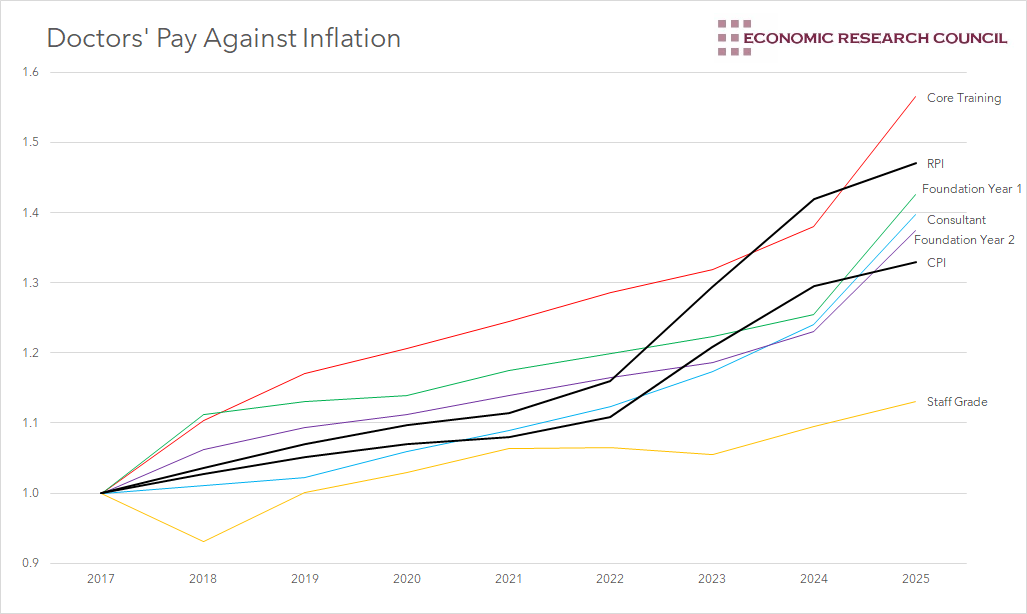
What does the chart show?
The chart clearly illustrates the changes in pay for NHS resident doctors from 2017 to 2025, indexed to 2017 levels. It highlights substantial pay growth for junior roles, particularly Foundation Year 1 and Core Training doctors, significantly surpassing inflation as measured by CPI. However, senior grades such as Consultants and Specialty Doctors show more modest growth, closer to the CPI.
Why is the chart interesting?
The British Medical Association is adamant that a 29% pay increase for resident doctors is essential to restore real-term pay levels eroded since 2008. Dr Tom Dolphin, BMA’s council chair, maintains this claim is non-negotiable because it represents the actual loss in pay value based on the Retail Prices Index. He emphasises that any reduction would compromise the principle of complete pay restoration. The government's recent 5.4% pay offer for 2025-26, despite being the highest among public sector groups, has been rejected by the BMA due to its absence of a "restoration" element.
An intriguing dimension highlighted by the data is the widening pay gap among different doctor grades. Junior doctors, especially those in Foundation Year 1 and Core Training, have seen substantial pay increments, potentially reflecting efforts to improve recruitment and retention at entry-level positions. In contrast, the more modest increments for senior doctors such as Consultants might indicate differing policy priorities or assumptions about labour market dynamics. These disparities could influence career trajectories within the NHS, affecting doctors' decisions regarding specialisation, further training, or even continuing employment within the UK healthcare system.
Central to the debate is the choice of inflation measure. The BMA bases its calculations on the RPI, historically higher than the Consumer Prices Index. RPI typically yields a greater erosion figure because it includes mortgage interest payments and tends to overstate inflation, losing its official statistical status in 2013. Conversely, CPI, the government's preferred measure, excludes housing costs and often presents lower inflation figures.
The Nuffield Trust critiques the BMA's method, illustrating that pay erosion calculations significantly depend on chosen baseline years. For instance, comparing resident doctors' pay to 2008 yields a real-term decline using CPI, whereas starting from 2015 suggests an increase. The selection of baseline years thus drastically alters perceptions of fairness and adequacy in remuneration, underscoring the complexity of resolving such disputes.
The BMA argue that the NHS can comfortably afford the proposed pay increase, noting the net cost after tax revenues would be £920 million, representing less than 0.5% of the NHS's £190.8 billion annual budget. While superficially appealing, this perspective overlooks broader fiscal pressures, including other public sector wage demands and potential inflationary effects. Granting significant pay rises to doctors may trigger similar claims from other public sector workers, placing further strain on public finances and potentially necessitating budget reallocations or higher taxes.
Public support for resident doctors' strike action has waned, reflecting broader societal dissatisfaction due to widespread pay stagnation and economic hardship. Polling now indicates more opposition than support, influenced by perceptions of fairness. The public increasingly questions the justification of substantial pay increases for NHS staff amid wider economic challenges and stagnant wages in other sectors. This shift in public sentiment is critical, as prolonged industrial action risks damaging trust in the NHS and weakening political support for future funding increases.
The current stalemate poses significant risks for both NHS service delivery and broader public sector wage negotiations. Extended industrial action, as threatened by the BMA, could severely disrupt patient care, compromise healthcare targets, and encourage further pay disputes across other public services. A prudent compromise is urgently needed, balancing equitable remuneration for healthcare professionals, fiscal responsibility, and the sustainability of public services.