Intellectual Property Fights: Optis v Apple, and IP in the age of AI
Sophie Hannigan
Introduction
“Good policy does not just consist of ‘more rights', it consists of maintaining a balance between the realm of property and the realm of the public domain” – James Boyle
In 2004, the Royal Society for the encouragement of Arts, Manufactures & Commerce, published the Adelphi Charter on Creativity, Innovation and Intellectual Property. The Charter, written by a large group of experts in law, economics, technology, education, and the arts, articulated a set of principles which intellectual property policy should abide by.
They argued for a “public-interest test”, which would evaluate if new intellectual property policies served the public interest before they were passed into law. There were four rules for governments making decisions: firstly, there must be an automatic presumption against extending rights and protections; secondly, the burden of proof must be on those who wish to expand rights; thirdly, rigorous analysis must prove that it is in the public interest; finally, there must be wide public consultation.
The Charter was a response to the feeling that the intellectual property system facilitated private enrichment rather than acting in the public interest. The number of patent applications was climbing, and wealthy companies were raking in royalties for licensing their IP. It no longer seemed like the eccentric inventor was being rewarded for their creativity.
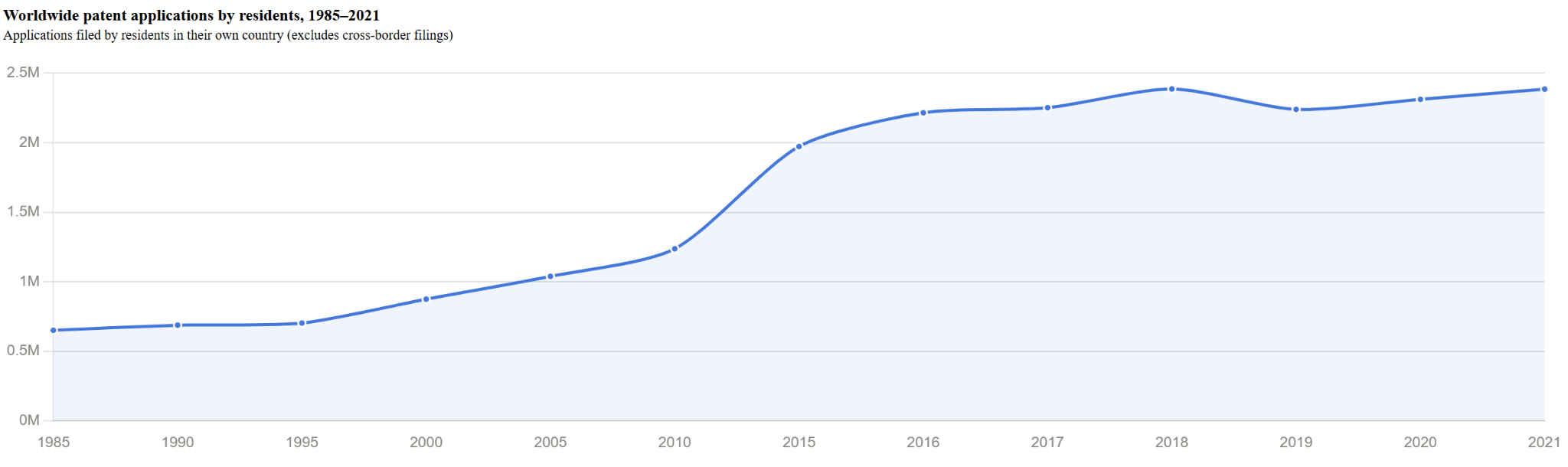
Figure 1: Worldwide patent applications by residents, 1985-2021. The 2010 inflexion point is explained almost entirely by China's National Intellectual Property Administration, which went from a minor player to filing more patents than the rest of the world's next dozen offices combined.
Nevertheless, intellectual property protections are essential. Not only do they guarantee legitimate ownership rights, they also foster innovation: quantitative studies find that the average effect of IPR protections on innovation is positive. The guarantee of reaping the rewards of invention drives investment in R&D, and ensures that actors benefit more from creation than repetition.
The existence of IP protections is relatively uncontroversial. Their extent, however, is highly contested. Intellectual property policy must outline precisely who can claim ownership, how long patents last for, what constitutes invention, infringement, and much more. Different legal systems vary greatly in how much they protect intellectual property, in part because the consequences of IP policy differ depending on their situation; for example, the effect of IPR on innovation tends to be stronger in developed countries than developing.
Additionally, enforcing IPR is far from easy. Take chemistry and pharmaceuticals: this has the highest rates of patents by industry, partially because patenting a clearly defined, unique chemical compound is (relatively) straightforward. However, a high rate of patents does not necessarily mean strong protections because these patents can be circumvented by minor changes to chemical structures.
The technology sector also poses new challenges for IP. In fact, many companies producing technology – both hardware and software – do not patent their creations. Or they abandon them, like Tesla, which announced in 2014 that it would no longer seek enforcement of its patents. This is because patents are not always useful and valuable for the companies that hold them. Litigation costs often outweigh the benefits because they are so complex to enforce. It tends to take years to get patent, copyright, or trademark approval, which can be too long for a company to wait to roll out a new product.
During the early 2000s, there was an explosion of new IP policy and litigation. Tech companies riding the wave of the internet’s growth wanted to protect their creations from hungry competitors. Microsoft sought to patent much of their software, including something as basic as storing files in their format. Companies were also pursued for new violations of intellectual property; Google was sued by a group of authors for placing book excerpts in its new search engine. Today’s ongoing discussion of how LLMs are being trained using “stolen” data echoes this period.
The lengthy and expensive litigation by tech giants proves why patenting technology is not always true protection for a company. Samsung, for example, developed a pattern of agreeing to honor patents, then not paying royalties for years. Companies sued Samsung, Samsung would countersue, and eventually settle when defeat became inevitable. Apple eventually called their bluff, filing a federal lawsuit against Samsung for infringing on the patents of both the iPhone and the iPad. The ensuing legal battle spanned Korea, Japan, Germany, Britain, France, the Netherlands, and the U.S. International Trade Commission in Washington, D.C.. Neither company could realistically call themselves a winner.
Overall, IP policy (especially in technology) is highly complex and increasingly messy. I will narrow this down, explaining and examining two developing examples which have significant implications for the wider landscape of intellectual property policy.
Firstly, the UK Supreme Court finished hearing on 1 July a case between Apple and Optis. Summarised simply, it is a case about calculating royalty rates for licensed patents which are essential to Apple’s products. For the industry as a whole, it will be a crucial decision that shapes how private ownership is balanced with public interest; it examines what is “fair” and “reasonable” in licensing technology. The case shows why IP policy must always be pragmatic, examining and responding to the commercial context of agreements.
Secondly, I will discuss how IP policy is adapting to incorporate generative AI. Human creatives are angry about their work being “stolen” and used as training data for large language models (LLMs). AI companies refuse to have their development stymied by copyright. Meanwhile, governments and bodies are trying to answer who owns the new work that AI produces. Like the Apple case, IP regarding AI emphasises the need to be pragmatic: AI companies are more than capable of paying the fines for infringing on copyright, so threats of litigation fall on deaf ears. Simply enforcing existing intellectual property law is therefore insufficient to protect creative works.
I suggest that intellectual property policy must seek to be both balanced and practical. As it did with the rise of the Internet, it must again adapt to be fit for purpose in new environments. Where it is failing, policymakers should work out how to change policy to fit the real world, rather than how to enforce more harshly. Intellectual property rights should not be viewed as a tool to protect ownership; instead, as the Adelphi Charter argued, it should be viewed as ensuring fairness and serving public interest.
Tech Royalty: Optis v Apple
The UK Supreme Court heard argument over three days, beginning on 29 June 2026, in Optis Cellular Technology LLC v Apple Retail UK Ltd. The case originated from negotiations breaking down between Apple and Optis over royalty payments; Optis has acquired a portfolio of patents from major industry players like Ericsson, LG, Panasonic, and Samsung, and Apple uses these standards in its products including the iPhone. The initial judgement required Apple to pay a total of $56.43 million. This was appealed by Optis on the basis that the rate was too low because the judge’s methodology was flawed. The Court of Appeal allowed Optis’ appeal, re-conducted the valuation, and left Apple with a much larger bill of $502 million. Apple appealed this decision, which brought it before the Supreme Court.
Background
This is a case about striking a delicate balance between respect for intellectual property and ensuring that the industry can function without paying exorbitant royalties. There is a special category of patents, called “standard essential patents” (SEPs) which protect technology that is essential to implementing a technical standard. In other words, SEPs apply in instances where a technology cannot be standard-compliant without using a patented component. “FRAND” refers to the fair, reasonable, and non-discriminatory licensing of these SEPs. In practice, FRAND rates ensure that patent-holders do not exploit their powerful position in the market by charging unreasonable royalty rates because they know that companies require their IP to function.
In Optis v Apple, the disagreement is over the terms of the FRAND licence. In most cases, royalty rates are decided in negotiations between the two parties. However, in 2019, negotiations over licensing terms collapsed. Apple agreed to accept whatever licence the UK courts determined to be FRAND.
In 2023, Mr. Justice Smith ruled that Apple would pay $56.43 million. The court rejected both Optis’ and Apple’s methods of valuation, and instead developed a new methodology based on the averaging of royalty rates from a wide range of licences. Additionally, the court enforced a six-year limit on how far back Apple’s royalty payments would go.
Optis appealed on the ground that valuation should be conducted on the basis of a separate licence agreement with Google as this was the closest comparison to Apple, rather than averaged blindly between licences with large variations in context and terms. The Court of Appeal upheld this, using the Optis/Google deal as the baseline. It removed the six-year limit, dating royalties back to 2013. Finally, it included any US damages as the floor for the global royalty. Cumulatively, these increased Apple’s royalty payments by nearly a factor of 10.
Apple appealed to the UK Supreme Court on five legal grounds: the first three on the rate and its methodology, the fourth on the limitation periods, and the fifth on the use of the US floor. I will focus here though on Apple’s policy argument: that Optis’ demand for unreasonable royalty rates was an abuse of a dominant position, designed to “hold up” implementers.
Apple claimed that Optis was able to wield the threat of an injunction to derail negotiations. The risk of halting sales of Apple products meant Apple had no choice but to agree to royalty rates much higher than the actual market value of the technology protected by Optis’ SEPs. The Court of Appeal rejected these arguments by Apple, concluding that because both parties agreed to FRAND terms, Apple was shielded from any sort of “hold-up” by Optis. Additionally, Apple was accused of patent “hold-out”, because it had not paid royalties despite using the patented technology of Optis.
Clearly, Apple was not beholden to Optis, because of the mutual agreement to FRAND terms. If Optis had indeed held this dominant position over Apple, it seems unlikely that Apple could have shirked royalty payments for so many years. What Apple’s argument does highlight, though, is that FRAND licensing is a vital protection against the complete dominance of patent-holders. It makes the methodology for calculating rates all the more important, because companies must rely on court-calculated FRAND rates being reasonable. As Apple’s lawyers submitted to the court: “If the UK courts’ approach to determining rates is subjective, unprincipled or erratic, this damages the proper functioning of industries worldwide.”
Implications
This is a case with massive players, and widespread consequences. Unwired Planet International Ltd v Huawei Technologies Co Ltd [2020] confirmed the jurisdiction of the English courts to determine global FRAND licence terms. Therefore, decisions by the UK Supreme Court on how FRAND royalty rates are calculated will shape the way that future agreements between multinational technology corporations are made. The royalty rates that companies expect to pay affect the commercial viability of new developments, which is why many heavyweights have entered the debate: chipmaker Intel and leading Hollywood film studios have backed Apple. Optis is supported by the various companies which license patents – including Samsung and Panasonic – as well as Qualcomm.
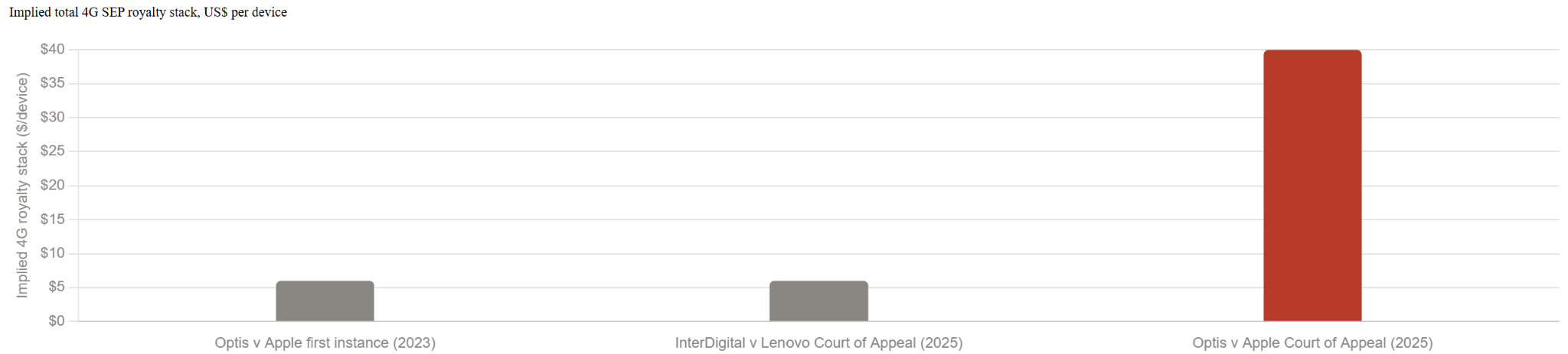
Figure 2: Implied total 4G SEP royalty stack, US$ per device. The Court of Appeal’s valuation in Optis v Apple sets a much higher rate than comparable cases and the High Court on the same case.
If the Supreme Court sides with Optis, this likely implies that FRAND rates will be higher. According to Apple, the Court of Appeal’s implied aggregate 4G royalty stack is nearly $40 per device, compared to approximately $6 implied by both the first determination of this case and the Court of Appeal’s ruling in InterDigital.
Royalty rates cannot, though, be evaluated on a simple “too high/too low” basis. In fact, a key reason that Optis’ appeal was upheld was that the Court of Appeal believed that the High Court had intervened too much, and used their discretion in what was a complex, commercial situation. The Court of Appeal was much more willing to lean on experts; deciding which licences are good comparisons remains a legal question, but extracting reliable data is an expert question. Regardless of the Supreme Court’s decision, this is a positive sign: companies can expect “grounded, commercially-oriented reasoning,” by the courts.
The exact rate decided by the Supreme Court will not be the most interesting part of the judgement. What will be important is how they got there, and what outcome they decide is most important. The court could side with Optis and rely on expert evaluations of the market value of their patents and comparable licences. Alternatively, they could side with Apple to ensure that FRAND rates remain similar to previous determinations. Whichever side the court ultimately comes down on, their methodology will set the standard for patent licensing across the sector.
AI to IP
“Every invention has brought predictions of copyright’s demise: the daguerreotype, the phonograph, radio, cassettes, home video and the internet. All those predictions were premature, and Britain’s soft power flourished as a result.” – Financial Times
Intellectual property is based on a Lockean assumption that individuals own their bodies, use their bodies to labour, and thus (in a vacuum) own the products of that labour. Given that ideas are the product of the labour of one’s mind, we also ought to own our unique ideas. IP law enshrines this ownership. The development of a synthetic mind – artificial intelligence – thus challenges the very basis of intellectual property.
I will comment on how AI’s “Input” and “Output” pose new challenges to IP policy. The “Input” challenges, i.e. if AI violates intellectual property law with the data it is trained on, are reminiscent of past debates like those around Google including unlicensed books in their search engine. The “Output” questions, however, are new territory. For the first time, entirely new concepts are being generated without a human mind. Who (or indeed what) owns these outputs is an open question that current IP policy does not have an answer to.
Input
LLMs require vast amounts of data to be trained on. LLMs trained on restricted data sets will have large gaps in their knowledge, hallucinate more often, and produce less sophisticated answers. Thus the AI race, so fiercely competitive that companies cannot afford to fall even a week behind, is a race to accumulate data.
Unfortunately for AI companies, much of the data they wish to access is copyrighted and protected creative work. There have been a litany of suits against AI companies for their infringement of copyrights, and “theft” of creative works. In 2023, the New York Times launched a suit against OpenAI and Microsoft for training models on its journalism. They have already spent upwards of $28 million on suing AI companies. In 2024, Meta was training its Llama 3 model. Unwilling to endure the wait (approximately four long weeks) to get approval to train models on a set of books, Meta authorised the team to use “LibGen” – a pirated library of millions of works. Both Meta and OpenAI have argued that it is “fair use” to train generative AI on this data. In 2025, Anthropic settled for $1.5 billion in a class-action lawsuit by authors for training models on their work without permission, and around 17 other class-actions have been filed in the US on behalf of authors against AI developers. A German court ruled that it was even illegal to use copyrighted lyrics to train generative AI models without a licence. Across the world, authors, actors, singers, journalists, artists, and many more have vocally protested against what they perceive as the theft of their property.
In some jurisdictions, adaptation is beginning. Some US courts have held that copyrights are not being infringed upon because generative AI produces new outputs and does not store copies of training data. More tangibly, the EU’s 2019 Digital Single Market Copyright Directive (DSMD) introduced a new Text and Data Mining (TDM) exception. Article 4 allows any entity, including commercial businesses, to perform text and data mining on lawfully accessible works, although the owners are able to opt-out. Australia has proposed similar legislation. This exception has been discussed in the UK, with proponents arguing that this would help UK AI companies have a chance at competing with the US and China, and boost AI investment in Britain. However, the House of Lords have opposed a TDM exception.
Clearly, IP law is ill-suited to deal with the new challenges of AI. Copyrights are being consistently flouted. Litigation will take years to produce any kind of judgement, in which time LLMs will have been operating and developing with the contentious data. Even in the extreme scenario where AI giants are fined billions of dollars, this is a drop in the ocean; both Anthropic and OpenAI are likely to aim for $1 trillion valuations at IPO. Simply enforcing existing policy is no longer going to cut it.
A TDM exception for all purposes, including commercial AI training, is a good place to start. Allowing for opt-out, as the EU has done, means enforcement becomes more feasible. Those creatives who are vehemently against their works being used to train AI can opt-out, and AI companies are more likely to comply with this when only some works are removed rather than everything being off-limits. This is, of course, imperfect. It is perfectly understandable that artists are angry at suddenly losing control of their work. However, as with AI development writ large, trying to force it back into the box is a fool’s errand.
Output
What about the work that AI produces – who owns that? More complicated still, much work made with AI is not entirely AI-generated but rather a collaboration between a human operator and AI model. Does the human operator get to claim ownership of the entirety of the product, despite only contributing to some? Currently, the answers to these questions differ depending on the nature of the case, and the jurisdiction.
Regarding patents, most legal systems take a case-by-case approach. The US uses a two-part test to decide if computer software and AI-implemented inventions are eligible for patents. Under English law, the European Patent Office’s (EPO) has been adopted: if the patent claims incorporate any hardware, i.e. elements which are not produced by AI, it is not automatically ineligible for patent protection.
In inventorships, the position is much clearer. The US is clear that only “natural persons” can be named as inventors. AI systems can merely be tools. The UK Supreme Court held in the DABUS case that current IP law does not make provisions for non-human inventors. Furthermore, it is not enough for a human to simply “own, oversee or direct” the use of an AI system for the human to be credited as inventor.
Similarly on copyright, both the US copyright office and Europe have maintained that copyright exists only with a natural person as the author. The UK Copyright & AI Report has proposed abolishing a protection where the “author” is deemed to be the person who made the “arrangements necessary” for the work to be produced, because it diverges from copyright’s intention to reward human creativity.
The current laws and court decisions err on the side of safeguarding human creativity. However, the jurisdictional divergence and constantly evolving decisions mean that commercial actors must curate context-specific IP strategies for AI use. Although courts are reluctant to extend IP protections to AI creations, AI output cannot be left in a legal gray area indefinitely. Rather than try to squeeze AI into ill-fitting legislation, the UK should explicitly address these questions. It is likely that a human actor, be that the AI company or LLM user, has to take legal responsibility but not full intellectual ownership. This is not a philosophical argument that AI models are creative entities which deserve ownership, but that it is practically useful to clarify ownership of AI output such that it is controlled and properly used.
Conclusion
Like the 2000s and early 2010s, the 2020s are shaping up to be a transformative period for intellectual property policy. Both of these stories reflect the underlying tension: how to protect those who create value while still preserving space for the rest of society to build on it. Optis v Apple is a dispute about what is a fair and reasonable amount to charge in royalties. Generative AI raises the question of how much can be taken from artists before innovation becomes expropriation.
While issues of ownership are highly philosophical discussions, I suggest that the priority ought to be pragmatism – we should evaluate IP policy based on how well it serves the public interest, rather than individual rights to ownership. In Optis v Apple, the UK Supreme Court’s task is to build a justifiable valuation method sufficiently robust that companies can commit to long product cycles without having to gamble on judicial discretion.
The instinct is to call for stronger enforcement: make Apple cough up, so they do not delay paying royalties for a decade again. Force OpenAI and Anthropic to care about copyright infringement by fining them eye-watering sums. This is not a sustainable model because it does not resolve the procedural problems: royalty rates differ on a case-by-case basis, so we need a method for calculating them during contract negotiations. We need to decide what data is fair and usable for AI to use, and what constitutes theft.
The Adelphi Charter should be remembered at this moment. Transparent, commercial reasoning should be used in conjunction with case law to develop intellectual property policy. IP policy does not need to decide between the inventor and the public, because when it works well, it balances between the two. Whoever wins in court, the real verdict is still pending: whether IP policy can learn to move as fast as the technology industry it governs.