
How 21 Failed Nuclear Projects Left UK Households Paying 40% More For Electricity Than France
After the release of Ofgem’s energy price cap in February, the Adam Smith Institute’s (ASI) Electricity Tracker reveals that UK households are paying 40% more for electricity, adding an average of £193 to quarterly domestic bills, compared to France.
While the cut to the cap is being spun as a win for consumers, our stats show UK households are still paying far more per kilowatt-hour than their counterparts across the Channel.
The UK's high electricity prices, relative to France, are primarily caused by our low nuclear capacity - the product of a broken planning system.
Since 1980, there have been serious proposals for 21 reactors. However, thanks to strict planning laws, only one has started construction and been completed in that period.
The failed projects from the 2010 round alone could have delivered 18 GW - enough to almost quadruple Britain’s nuclear capacity.
By reforming its energy system to match the competitive electricity prices of nuclear-heavy nations like France, the UK could unlock a long-term GDP boost of 4.25% while simultaneously driving down household energy bills
Following the recent energy price cap announcement on the 25th of February, the Adam Smith Institute’s (ASI) updated Electricity Tracker reveals a staggering divergence in electricity costs between the UK and its nearest neighbour. British households are now paying 40% more for electricity than those in France, adding an average of £193 to quarterly domestic bills.
Despite the Government moving many green levies from billpayers to taxpayers, British bill payers are still struggling more than their counterparts across the Channel. This burden will fall hardest on the poor. According to the most recent ONS data, the bottom 20% of households by income spend twice as much of their income on energy as the top fifth.
Since 1980, the UK has proposed 21 nuclear reactors, but managed to start and complete only one - Sizewell B. This lost fleet represents a massive missed opportunity for cheap, reliable energy. It includes nine unbuilt reactors from the 1979 Thatcher program, three scrapped clones of Sizewell B from the 1990s and eight failed projects from the 2010 Nuclear Renaissance (such as Moorside and Wylfa).
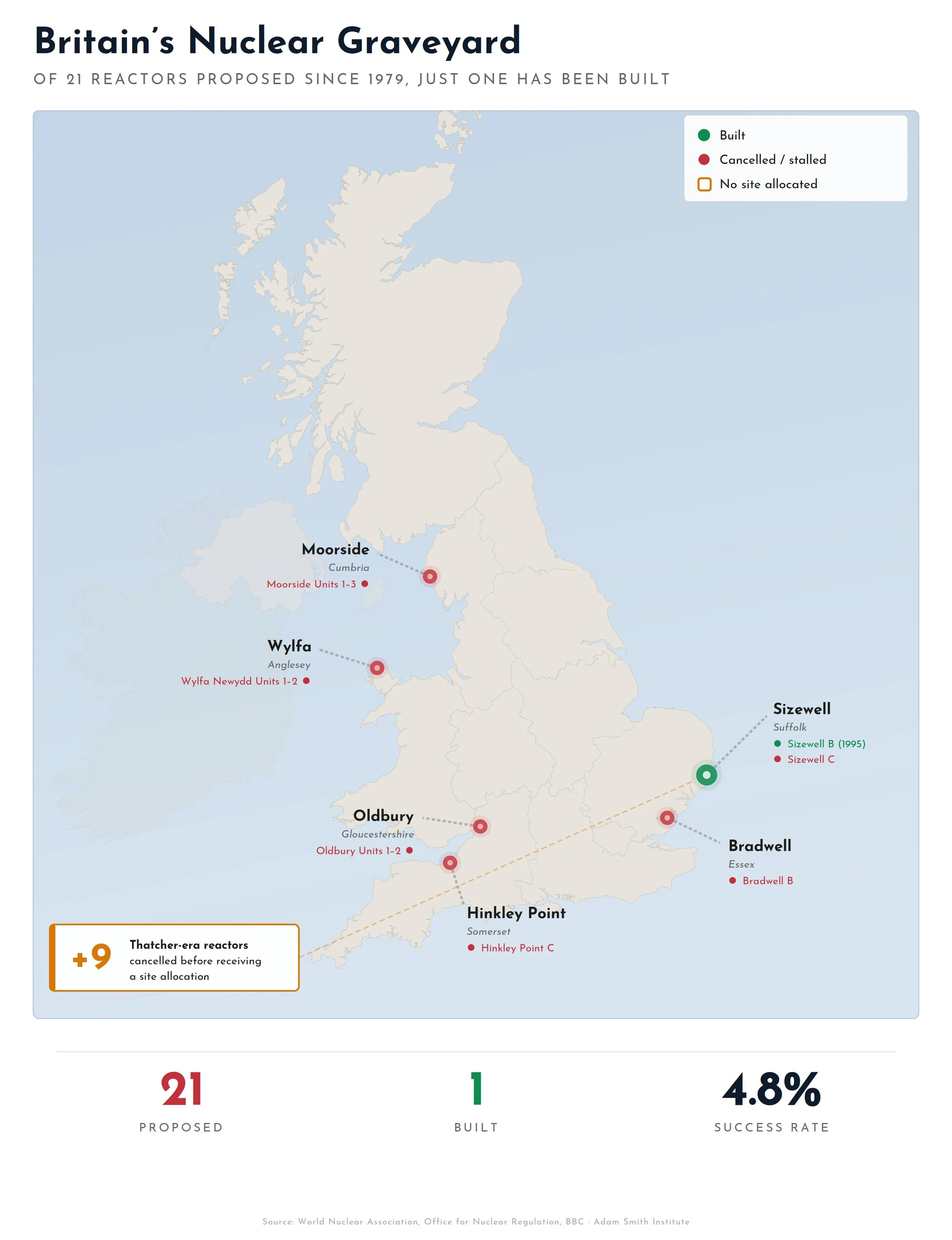
The failed projects from the 2010 round alone could have delivered 18 GW – enough to almost quadruple Britain’s nuclear capacity, which is currently around 6 GW.
Britain’s failure to deliver new nuclear is a direct consequence of a broken planning and regulatory framework. While countries like France and South Korea drive down costs through standardised designs, the UK treats every project as a bespoke, unique bureaucratic battle.
An important barrier is the ALARP (As Low as Reasonably Practicable) standard. Because this safety principle lacks a fixed target, regulators can mandate endless, minute design changes mid-construction. At Hinkley Point C, this resulted in 7,000 design changes, inflating costs to the point of deterring private investment. By contrast, France and Finland have delivered the same EPR design for 27% and 53% less, respectively, by avoiding such excessive gold-plating.
Combined with a planning process where single inquiries can last years, this planning tax has effectively regulated the UK out of cheap energy. The result is a massive drag on the national economy as high prices act as a barrier to the very industrial growth that abundant nuclear power should be fueling.
In fact, the ASI’s Electricity Tracker recently revealed that, for British industry, electricity prices are now 81% higher than in France. The price disparity creates a massive competitive disadvantage for UK manufacturing. For a major site like the Nissan factory in Sunderland, the electricity bill is estimated at £43 million per year. If that same factory were located across the Channel, it would pay just £23 million - a saving of £20 million annually that could otherwise be used for investment, wages, or R&D.
The ASI's Growth Agenda estimates that by deregulating the energy industry and building more nuclear power, the UK could unlock 4.25% in GDP growth. Cheap and abundant energy is the lifeblood of a thriving economy. Unless we make it easier to build nuclear and extract gas, British households and businesses will continue to be out-competed and impoverished by our neighbours.
Commenting on the findings, Mitchell Palmer, Economist at the Adam Smith Institute, said:
“British households are being sacrificed on the altar of a broken energy policy. Paying 40% more than the French is a Nuclear Tax resulting from decades of regulatory gold-plating. While Whitehall mandated 7,000 design changes for a single plant, our neighbours built a standardised fleet and reaped the rewards of energy sanity.”
“We have effectively regulated ourselves into de-industrialisation. Ministers need to scrap the 'ALARP' principle and make it easier to build nuclear. Otherwise, we are guaranteeing that heating a home remains a luxury that ordinary working Brits can no longer afford.”
ENDS
Notes to editors:
Mitchell Palmer is an Economist at the Adam Smith Institute, based in London. He concurrently serves as a Senior Policy Advisor at the New Zealand Parliament.
He previously worked as a Ministerial Advisor (special advisor) to the Deputy Prime Minister of New Zealand, whom he advised on fiscal policy and microeconomics. He has also worked in economic consulting in New Zealand and at a think tank in Singapore.
Mitchell holds a first-class degree in History and Economics from the University of Oxford (New College). While at Oxford, he was made a Hayek Fellow of the Mont Pelerin Society. He also studied at Yale-NUS College in Singapore.
For any further details on the methodology, or to arrange an interview, please contact press@adamsmith.org / +44 7584778207
The Adam Smith Institute (ASI) has recently released its Growth Agenda, which, along with other policy areas, outlines how deregulating energy could boost UK GDP.
—---------------------------------------------------------------------------------------------------------------------
The Adam Smith Institute is one of the world’s leading think tanks. It is ranked first in the world among independent think tanks and as the best domestic and international economic policy think tank in the UK by the University of Pennsylvania. Independent, non-profit and non-partisan, the Institute is at the forefront of making the case for free markets and a free society, through education, research, publishing, and media outreach.