
Polling Suggests 3 in 4 Young Brits Fear Risk of UK Getting Dragged Into War Rising
Poll finds young Brits feel less safe, see fewer opportunities and fear the NHS is slipping.
New polling of British 18-30 year olds, conducted by Adam Smith Insights as part of its Anxious Generation series, reveals a generation gripped by insecurity on almost every front.
The nationally representative poll of British 18–30-year-olds finds that three-quarters believe the risk of the UK being drawn into war has grown, six-in-ten are worried about violent crime where they live, and a similar share expect good jobs to become harder to find. Women, in particular, are markedly more pessimistic about the quality of NHS services than men.
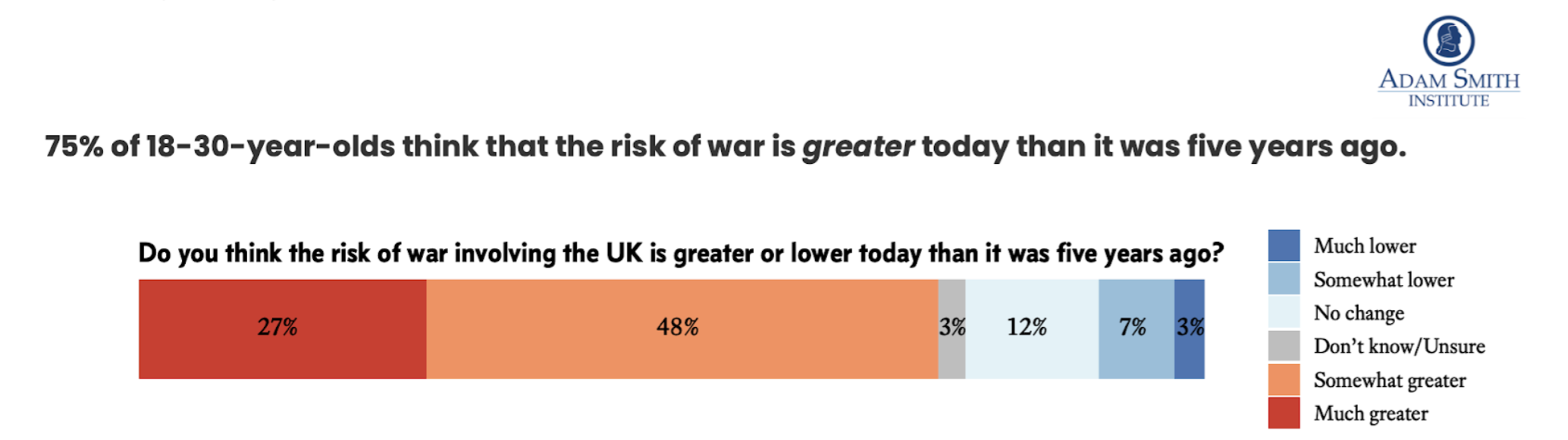
From the war in Ukraine to tensions in the Middle East, global instability looms large. That fear is fuelled not only by ongoing conflicts abroad, but also by the knowledge that Britain’s own safety depends on the reliability of sanctions and border controls. As the Adam Smith Institute points out, sanctions work only when tightly enforced and paired with a broader economic-statecraft strategy, something the UK still lacks. An unreliable sanctions regime, combined with record flows of people across UK borders feeds the sense that hostile states can reach Britain.
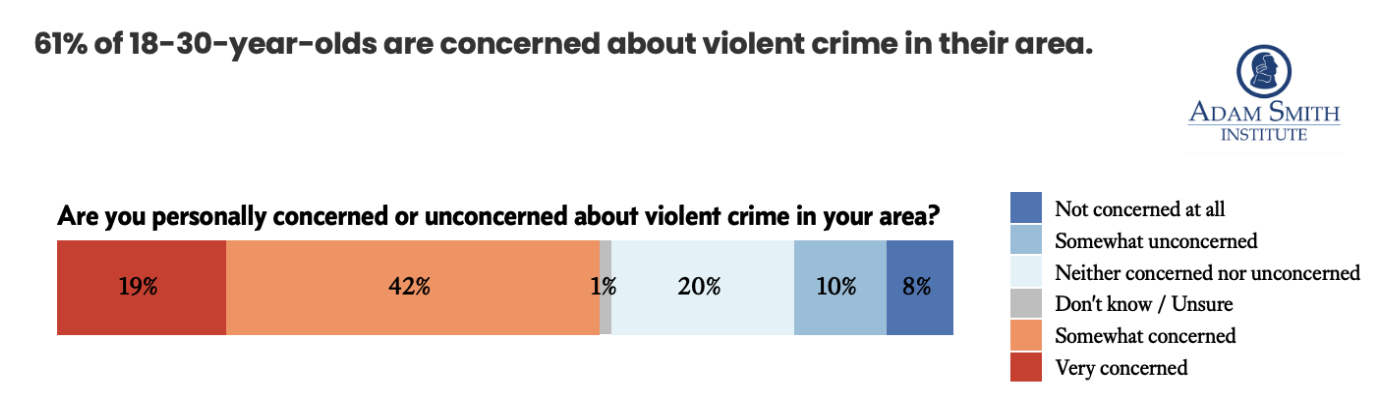
Concern about violent crime at home has become mainstream. With small-boat crossings hitting record highs, city populations are rising faster than police numbers can adjust. Concern about violent crime is no longer confined to particular neighbourhoods or demographics; it is now the majority position in every ethnic group surveyed.
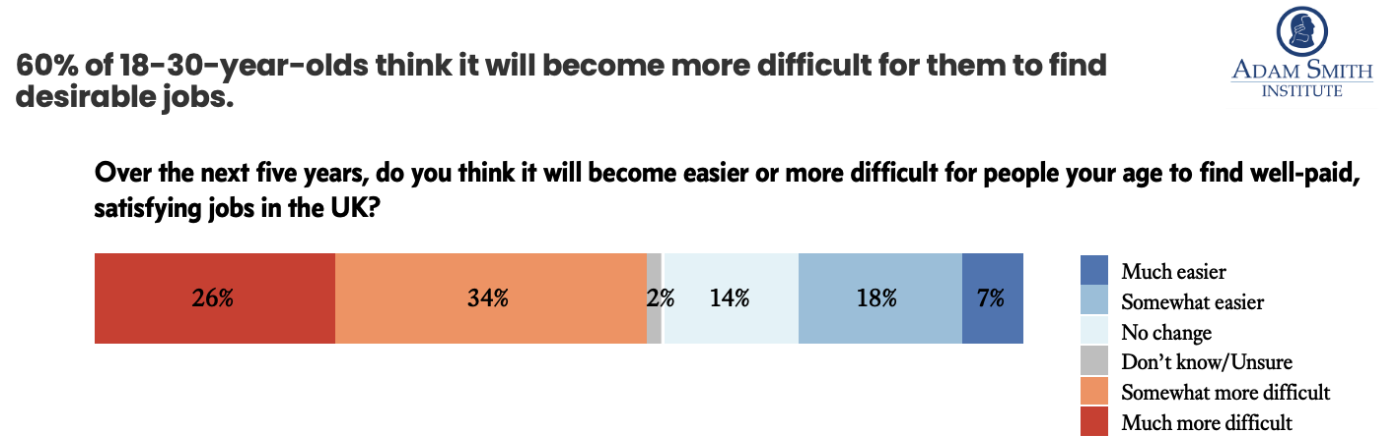
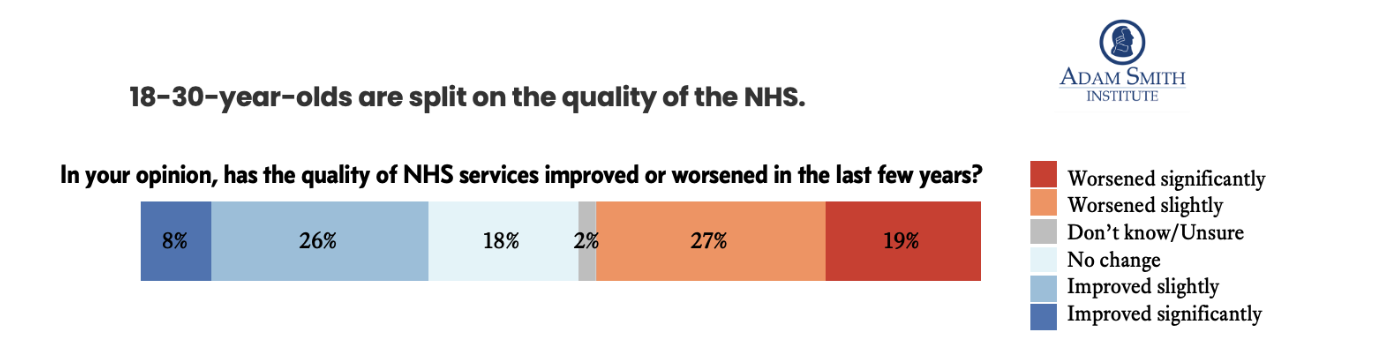
Years of sluggish growth have eroded confidence that hard work will be rewarded with meaningful, well-paid employment. Meanwhile, young women - frequent users of reproductive and mental-health services - are especially sceptical that the NHS is keeping pace with demand.
KEY FINDINGS:
Risk of war
75% say the risk of war involving the UK is greater today than five years ago.
27% “much greater”, 48% “somewhat greater”. Fears span party lines: 71% of young Conservatives, 70% of young Labour voters and 79% of young Reform voters agree.
Violent crime
61% are concerned about violent crime in their area.
19% “very”, 42% “somewhat”. Concern is high across ethnic groups (64% of Black 18-30-year-olds, 60% of White).
Job prospects
60% think it will become more difficult to find well-paid, satisfying jobs over the next five years.
26% “much more difficult”, 34% “somewhat more difficult”. Just 25% expect things to get easier.
NHS quality
Women are dramatically more negative than men.
55% of young women say NHS quality has worsened (vs 36% of young men). Only 26% of women think services have improved, compared with 43% of men.
Commenting on young people's attitudes to conflict, James Cartlidge MP, Shadow Secretary of State for Defence, said:
“With conflict on so many fronts in recent months, it’s understandable that young people are concerned about Defence. Of course, the best way to address the threats we face and secure our nation is to boost our armed forces, and strengthen our overall deterrence - ultimately making war less likely.
That means Labour needs to replace its endless policy documents and unfunded defence spending plans with rapid procurement of new equipment for our military, particularly drones and counter drone tech. But people remain our most important capability.
As such, to boost morale - and thereby recruitment and retention - the Government needs to scrap its plans to reopen legacy investigations against our veterans, so that we can encourage a new generation to sign up as reservists or regulars’”
Commenting on young people's attitudes to conflict, Sir Ben Wallace, former Secretary of State for Defence, said:
“Social media has turbo boosted peoples anxiousness. Sadly this impacts young people more than most. Government has a role to make sure we provide reassurance, not through warm words but through action and that means investing properly in our defence and defence industry.”
Commenting on young people's attitudes to conflict, Emma Schubart, Data & Insights Manager at the Adam Smith Institute, said:
“These figures show a cohort who feel physically unsafe, financially boxed-in and poorly served by the public services they fund. When young people simultaneously fear war abroad, crime at home, dwindling career prospects and deteriorating healthcare, politicians should treat it as a code-red warning.
We already know that Britain’s current sanctions regime is too porous and slow-moving to deter hostile states; without tougher, better-coordinated economic statecraft and a better-resourced military, young people will go on feeling exposed to threats we could blunt.”
Commenting on young people’s attitudes to crime, Nigel Farage MP, Leader of ReformUK, said:
“These figures should come as no surprise. Successive Labour and Conservative governments have run down our criminal justice system and left Britons to pay the price. We now live in a country where violent criminals and sex offenders receive shockingly short sentences, while ordinary citizens are prosecuted for social media posts.
“Only Reform UK will invest in our police force, enforce zero-tolerance policing, and restore proper justice, where the punishment truly fits the crime.”
Commenting on young people’s attitudes to crime, Chris Philp MP, Shadow Home Secretary, said:
“This is brilliant work by the ASI. Young people often bear the brunt of some crime types, such as knife crime and phone snatches. Crime has gone up under Labour and Labour has cut Police numbers, with more cuts coming this year. Labour won’t properly back tactics like stop and search which are proven to make streets safer.
And in London, Labour Mayor Sadiq Khan has completely lost control of crime, is presiding over crashing declines in police numbers and is shutting police stations. Labour is letting young people - and everyone - down on crime.”
Commenting on young people’s attitudes to crime, Emma Schubart, Data & Insights Manager at the Adam Smith Institute, said:
“Our findings should be a wake-up call for anyone still in denial about the state of public safety in the UK. When 61% of young Britons, across all backgrounds and political affiliations, are genuinely afraid of violent crime in their communities, we have a serious problem.
And the numbers don’t lie: knife crime is soaring, robberies are up, and violent crime is no longer just an urban issue, it’s everywhere. The fact that this crisis is being ignored or dismissed by politicians, particularly those who prefer to label concerned citizens as 'far-right', only adds fuel to the fire. People are fed up. This is a generation living in fear, and it’s time for the government to stop playing political games and take action. Enough is enough.”
Commenting on young people’s attitude to jobs, Sir Mel Stride MP, Shadow Chancellor of the Exchequer, said:
“We should be sending a message to young people that if you work hard, save and do the right thing, the system is on your side – that means more opportunities, lower taxes, home ownership. At the moment they can see no prospect of any of that.”
Young people need hope for the future. But at the moment, they can see a stagnant jobs market and a government intent on piling up debts for the next generation. Measures like the Jobs Tax and new employment regulations will hit younger workers the hardest.”
Commenting on young people’s attitude to jobs, Richard Tice MP, Deputy Leader of ReformUK, said:
“This should come as no surprise. Labour has tanked the economy and set this country up for failure.
Britain’s youth are in a dire situation. Jobs are scarce, wages are stagnant, yet the cost of living and taxes continue to rise.
The United Kingdom needs full-scale economic reform. We need leaders with real business experience – those who will prioritise cheap energy and incentivise growth.”
Commenting on young people’s attitude to jobs, Emma Schubart, Data & Insights Manager at the Adam Smith Institute, said:
“With 60% of young Britons fearing a shrinking job market, it's clear that years of economic stagnation have robbed them of the belief that hard work will lead to meaningful employment.
The stark ethnic divide in these concerns underscores how deeply inequality has embedded itself within our youth, leaving many to wonder if their ambitions will ever be rewarded in an economy that has been hijacked by horrendous policies which punish this country’s youth."
Commenting on young people’s attitude to health, Stuart Andrew MP, Shadow Health Secretary, said:
“This should be a wake-up call that women are losing trust in the NHS.
Yet Labour have scrapped targets to improve access to women's health services, failed to get a grip on union overreach, and hit mental health charities with higher taxes, leaving women to pay the price of this Government.
The last Conservative government published the first ever Women’s Health Strategy to tackle decades of systemic neglect. Labour must do more than talk, they must act. Without urgent intervention, women will continue to lose faith in a system that should be supporting them.”
Commenting on young people’s attitude to health, Emma Schubart, Data & Insights Manager at the Adam Smith Institute, said:
“The growing dissatisfaction with the NHS among young Britons is a clear reflection of the mounting pressures the system faces. Years of underfunding, staffing shortages, and the lingering effects of the pandemic have taken their toll, leaving many feeling that the quality of care has deteriorated.
With nearly half of young people believing the NHS has worsened in recent years, the question now is whether the government can act quickly and decisively to restore confidence and ensure the system is fit to meet the needs of the next generation.”
ENDS
Notes to editors:
For any further details on the methodology, or to arrange an interview, please contact press@adamsmith.org / +44 7584778207
Methodology:
Adam Smith Insights ran a poll on behalf of its sister think tank, the Adam Smith Institute, of a nationally representative sample of GB adults:
Nationally representative poll of UK 18 - 30 year olds in the UK.
Poll conducted via online panels
Field dates 8 July – 10 July 2025
N = 1338
Poll weighted to population targets to match GB 18-30 year old population profile across age, gender, region, ethnicity, and 2024 general election vote using ONS 2021 Census data, age-by-vote distributions derived from Ipsos’s post-election analysis: “How Britain voted in the 2024 election”, national vote share data from the Electoral Reform Society’s 2024 general election results, and YouGov/BES polling.
The poll results, with a median completion time of approximately 5 minutes, has a margin of error of ±2.7%.
Respondents were filtered for completion quality (e.g., straight-lining, speeding), and responses with incomplete or invalid data were excluded from analysis. No imputation was applied.
—---------------------------------------------------------------------------------------------------------------------
The Adam Smith Institute is one of the world’s leading think tanks. It is ranked first in the world among independent think tanks and as the best domestic and international economic policy think tank in the UK by the University of Pennsylvania. Independent, non-profit and non-partisan, the Institute is at the forefront of making the case for free markets and a free society, through education, research, publishing, and media outreach.
Adam Smith Insights is a new type of data and polling organisation, with a special focus on economics and policy change. Through analysis of public sentiment, we reshape what is politically possible. We help construct reforms which will be more popular and successful, while exposing the failings of our current system. Through a range of quantitative and qualitative methods, we equip policy makers with the right insights to shift the agenda and change reality. We operate globally, with data and analysis covering all regions.