The UK’s Latest Tax Freedom Day Ever
Tax Freedom Day 6th June: The Highest On Record
Tax Freedom Day falls on the 6th June;
This year, Brits are working 156 days solely to pay taxes;
This is the latest Tax Freedom Day ever;
This would mean that the tax burden is higher than it was during WW2 and The Napoleonic Wars;
This is based on current Government taxation and spending plans, and OBR projections;
Cost of Government Day, which factors in borrowing as well as taxes, is July 13th - the latest since the pandemic.
Tax Freedom Day is a measure of when Britons stop paying tax, and start putting their earnings into their own pocket. In 2026, the Adam Smith Institute has estimated that every penny the average person earned up to and including June 5th went to the taxman - from June 6th they are finally earning for themselves. This is the latest date ever, under our improved methodology.
British taxpayers have worked for a gruelling 156 days for the taxpayer this year, the latest since current records began. That’s 4 days later than last year, and 14 days later than before the pandemic. In 2009, Tax Freedom Day fell on May 17th - almost a whole month earlier.
But, things are only getting worse. Based on current Government taxation and spending plans and OBR projections, the ASI predicts that by 2030 Tax Freedom Day will fall on 12th June.
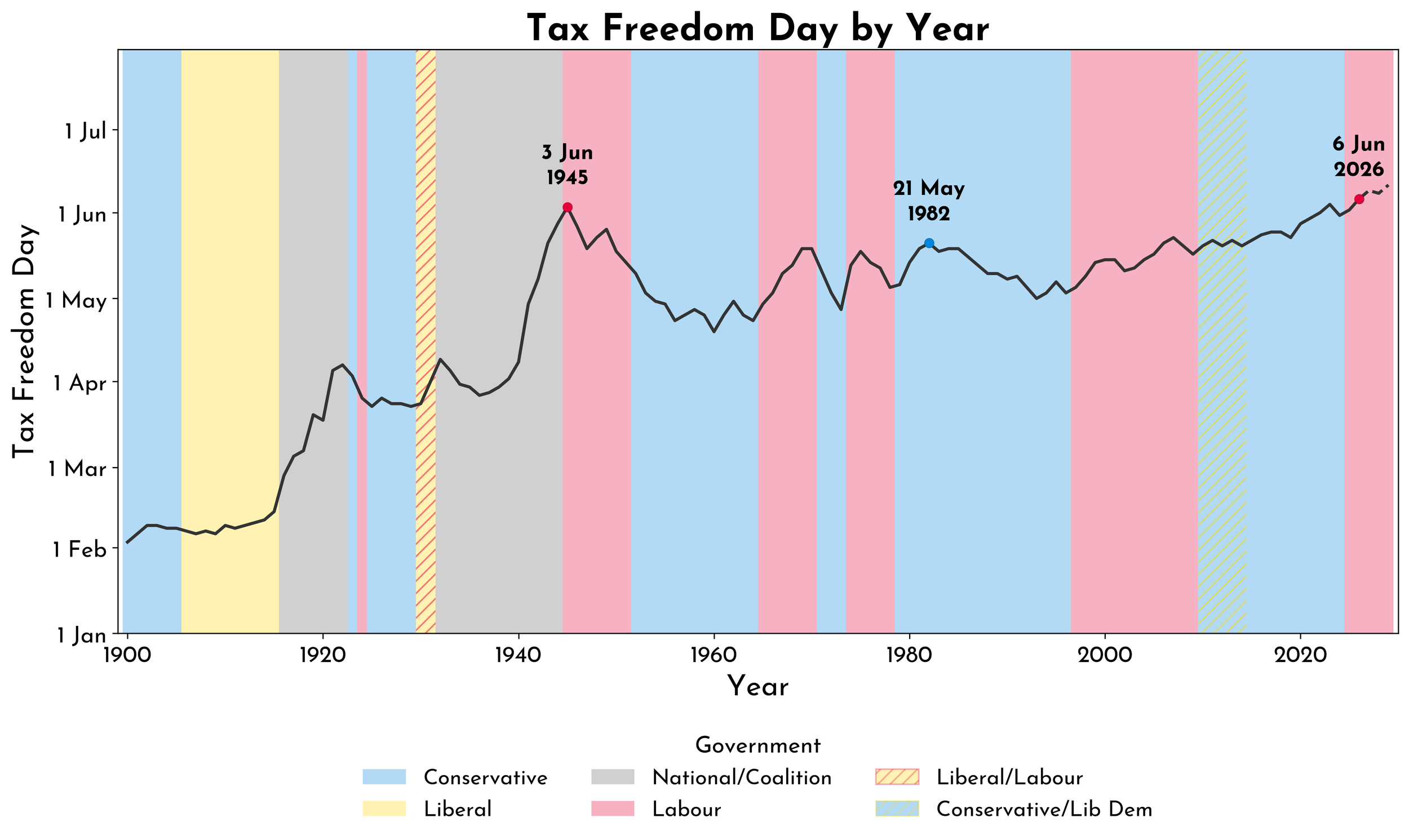
Even through war time, the economic crises of the 1970s and reforms of the 1980s, in-year taxation, as a share of national income, has never reached such heights. Moreover, unfunded government spending remains incredibly high. Cost of Government Day, which factors in borrowing as well as taxes, is July 13th - the latest since the pandemic.
Britain’s tax burden has been moving in the wrong direction for years. With the tax burden reaching its highest level in history, The Adam Smith Institute is calling on politicians to be honest with the public about the size and nature of the tax burden on British taxpayers.
Mel Stride MP, Shadow Chancellor of the Exchequer, said:
“The tax burden is rising to historic highs with British taxpayers working longer and longer each year just to pay the taxman.
The tax rises we have seen from this Labour government have damaged employment, business confidence and investment, while wasteful spending like the ballooning welfare bill is left unchecked. Increasingly for too many people in our country, it simply does not pay to work.
“We need to get taxes down, especially anti-growth taxes like Stamp Duty, to get our economy moving again and stop punishing hard work and aspiration.”
Robert Jenrick MP, Reform UK’s Chancellor & Member of Parliament for Newark, said:
“Everyone is having to pay more and more because this Labour Government is wasting our money on benefits, net zero and silly schemes like foreign aid to rich countries. We should scrap the waste and use the money to lighten the load on working people by cutting their taxes.”
John O’Connell, Chief Executive of the TaxPayers Alliance, said:
"That Tax Freedom Day falls on the latest date on record is shocking, but not surprising. After all, this dangerous government has squeezed the life out of businesses with national insurance hikes and launched an all-out assault on family firms, private schools and pensions.
“It's not just about funding more welfare spending; it's an ideological attack on Brits who have the temerity to succeed and look after their families.
“We have to cut spending drastically, but we must also cure a sickness in the political class that sees taxpayers and businesses as miscreants to be brought under state control through tax and regulation."
James Lawson, Chairman of the Adam Smith Institute, said:
“Britons are now working longer for the taxman than at any point on record.
“Tax Freedom Day falling on 6th June should be a wake-up call to politicians that the tax burden has reached unsustainable levels.The root cause is years of rising government spending, which then leads to rising taxation and debt.
“The UK is now taking a larger share of national income in tax than at any point in modern history, with taxpayers facing a heavier burden than during the Second World War or the economic crises of the 1970s. Even worse, once borrowing is included, Britons are effectively funding government spending until mid-July.
“Ministers need to be honest about the scale of the tax burden and start reversing it. If Britain wants stronger growth, higher wages and rising living standards, the priority must be controlling spending, cutting taxes and allowing people to keep more of the money they earn.”
ENDS
Notes to editors:
For any further details on the methodology, or to arrange an interview, please contact joanna@adamsmith.org / +44 7985 540467
The full research is available here.
Methodology:
Tax Freedom Day (and its sister, Cost of Government day, which measures total spending over national income) is not meant as anything but an illustration—an indication of the size of the state. As the complexities detailed below suggest, it does not correspond exactly to any individual’s experience. And yet many people do find it shocking to see how large the state really is, expressed in an intuitive way.
While Tax Freedom Day is a simple idea in principle, in reality it’s a little bit more complicated. First, there’s no average person. Because we don’t have a proportional tax system, every individual will have a different tax freedom day. In theory, Tax Freedom Day will come later for high-earners and earlier for low-earners and the unemployed. In practice, this isn’t necessarily true because HMRC does not simply tax income, but also taxes consumption, investment and ‘sin’ activities at different rates.
Second, we measure the total tax take. This includes indirect taxes (such as VAT and Corporation Tax) as well as direct taxes (Income Tax and National Insurance). Economists distinguish between legal and economic incidences (a fancy economist word for ‘burden.’) The legal incidence of Corporation Tax may fall on individual firms, but corporations are just legal constructs. In reality, Corporation Tax is paid by people, the debate between economists is to what extent it falls between consumers, shareholders and workers. (Our paper Corporation Tax: Who Pays had a crack at the answer.)
Thirdly, we take into account depreciation and foreign investment earnings, as is standard around the world, measuring total taxes over net national income, not gross domestic product. This better approximates the ‘taxable income’ concept that people are familiar with in their personal or corporate tax returns.
Fourth, tax receipts and net national income statistics are regularly revised by the Office of National Statistics and we revise past Tax Freedom Days along with them.
Data Sources
Before 2026, the ONS's NSRX is used for Net National Income and AHHY is used for Total Tax Take. This enables a TFD comparison going back until 1998, with a single consistent data source and methodology. The OBR's Economic and Fiscal Outlook is used to enable forecasting. Before 1998, we use the tax receipts data from the Bank of England’s Millennium of Macroeconomic Data, spliced to be continuous with AAHY, for total tax receipts. Before 1987, we use the gross national income series, less the capital consumption series, from the same database, spliced to be continuous with NSRX, for net national income. Between 1900 and 1920, adjustments are made to account for the inclusion of Southern Ireland.
Historic reporting of Tax Freedom Days has been based on different data sources, or affected by ONS data revisions, so it can appear earlier or later than in ASI's latest analysis. This is the first year in which we have updated our figures using internally consistent data, going back to 1900. The Tax Freedom Day for a given year in the past therefore may well have changed. For the purposes of monitoring the trend of Tax Freedom Day and making inter-year comparisons, our latest analysis is most appropriate.
As Net National Income and Total Tax Take figures are not available up-to-date for the latest or future calendar years, they are proxied from government and OBR forecasts and financial year numbers. They are then revised when exact numbers become available in subsequent years.
—---------------------------------------------------------------------------------------------------------------------
The Adam Smith Institute is one of the world’s leading think tanks. It is ranked first in the world among independent think tanks and as the best domestic and international economic policy think tank in the UK by the University of Pennsylvania. Independent, non-profit and non-partisan, the Institute is at the forefront of making the case for free markets and a free society, through education, research, publishing, and media outreach.